


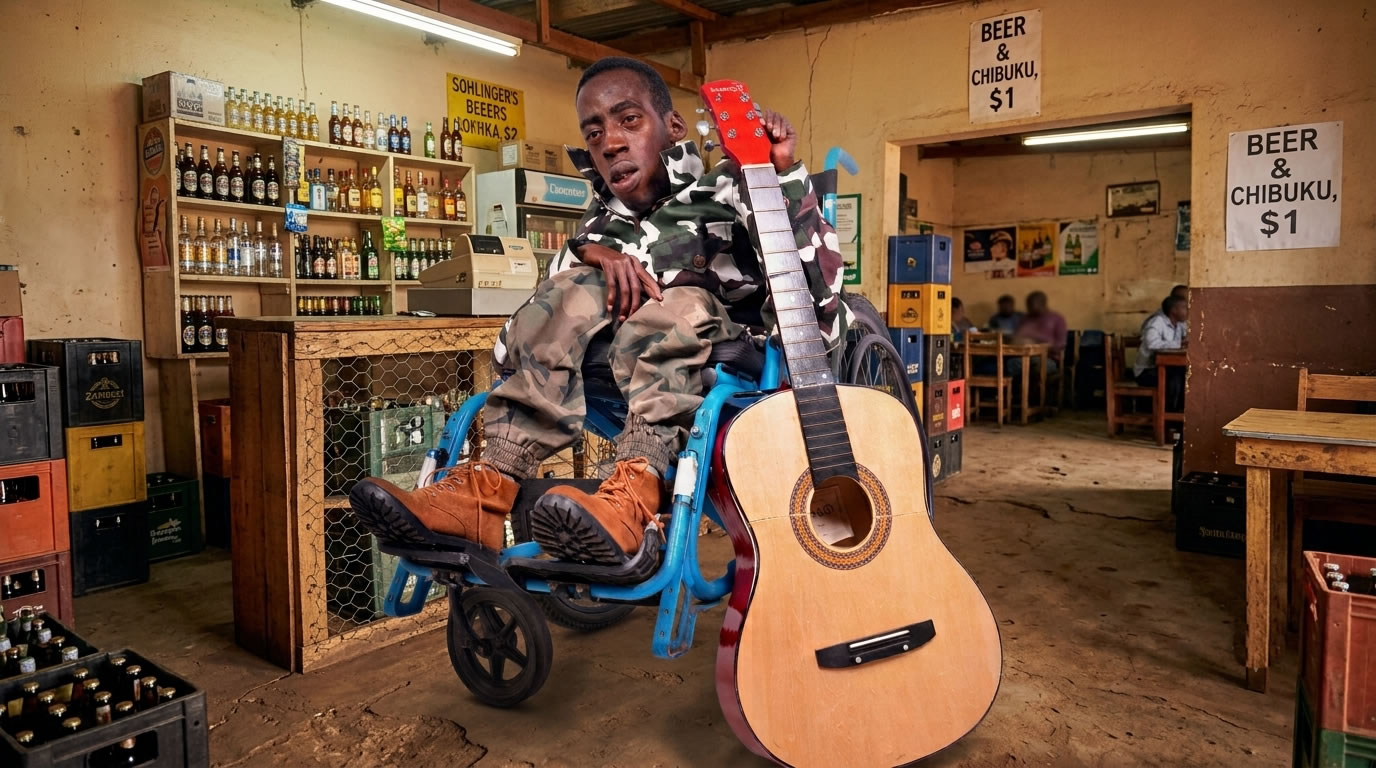
In the quiet, dusty corners of Harare’s suburbs, where the scent of woodsmoke often mingles with the hope of a better tomorrow, a local hero is facing his darkest hour. Tongai Gwaze, the Afro-fusion musician known to thousands of Zimbabweans simply as Greatman, sits in his home today with a heavy heart and an empty stomach. The man who once filled dance floors and collaborated with the nation’s musical elite has made a confession that has stopped many in their tracks: he is now dead broke, unable to afford even a single dollar to buy bread for his family.
The fall from grace for the 33-year-old artist is not merely a tale of personal misfortune, but a stark window into the broader, often brutal reality of survival in Zimbabwe’s capital. It is a story that intersects with a massive police crackdown, a surging cost of living, and the desperate measures individuals take when the music stops playing and the lights go out. Greatman’s nightmare began with the closure of his nightclub, an establishment he admits was running without the necessary legal permits.
A Star in the Shadows
Greatman’s journey has never been easy. Born with muscular dystrophy, a condition that has confined him to a wheelchair and tested his muscle strength since birth, he became a symbol of defiance against the odds. From his early days in the copper mining town of Mhangura to his rise in the Harare music scene, Gwaze used his voice to bridge the gap between the able-bodied and the disabled. His Greatman Foundation was not just a name on a letterhead; it was a mission to source wheelchairs for those who, like him, had been left behind by a society that often overlooks the differently abled.
However, the foundation that was meant to lift others up became the very vehicle for his recent downfall. In an attempt to generate income to support his family and his charitable work, Gwaze opened a nightclub under the Greatman Foundation banner. But in the eyes of the law, this was no ordinary business venture. It was an unlicensed liquor outlet, operating in the shadows of the regulatory framework.
“Greatman Foundation operated a small bar without a licence. That was very wrong, and I take full responsibility,” Gwaze admitted recently. The admission was candid, raw, and devoid of the usual excuses often heard from public figures caught in the net of the law. He has apologised for breaking the law, acknowledging that his arrest was a direct consequence of operating without a licence.
The consequences were immediate and devastating. The Zimbabwe Republic Police (ZRP) descended on the premises, arresting the musician and seizing his entire stock. “I was arrested, and the crates of beer were taken (by) the State,” he said. The loss of the beer was more than just a loss of inventory; it was the evaporation of his only remaining lifeline, leaving him in a state of absolute financial ruin.
The Breadline Crisis
Today, the man who once sang of hope is struggling to find food. The economic climate in Zimbabwe has been unforgiving. By June 2026, the price of a standard loaf of bread has surged to between US$1 and US$1.17, driven by rising fuel and transport costs. For many, a dollar is a manageable sum; for Greatman, it has become an insurmountable wall.
“Right now I am home with my wife and child. I have not had even US$1 to buy bread,” he confessed. “I am really hungry and struggling to find food.”
This desperation is not an isolated incident. Across Harare, families are feeling the pinch of an economy where the cost of basic commodities is rising faster than the opportunities to earn a living. The irony is not lost on observers: a man who dedicated himself to helping others through his foundation is now the one in need of a helping hand, reduced to a state where he cannot even afford the most basic of staples.
Operation Hurricane: Cleaning the Streets
Greatman’s arrest was not a random event. He was caught in the widening net of “Operation Hurricane,” a major police initiative launched by the Harare Province Police. The operation, led by Commissioner Maxwell Chikunguru, was designed to restore order in suburbs like Southlea Park, which have been plagued by a spike in violent crime. The operation specifically targeted criminals linked to killings and break-ins in the area.
Southlea Park has become a flashpoint for criminal activity in recent months. In early 2026, the area saw bloody shootouts between police and armed robbery suspects. The community has been on edge following reports of murders, assaults, and brazen robberies. Commissioner Chikunguru’s mandate was clear: to neutralise the criminal elements and shut down the illegal hubs that often serve as their hideouts.
“On Tuesday and Wednesday, police embarked on an operation code-named Operation Hurricane covering Southlea Park and surrounding areas,” the Commissioner stated. The operation was comprehensive. Police carried out saturation patrols, arrested people found loitering without satisfactory explanation, conducted stop-and-searches for items that could be used for criminal activities, and raided shebeens.
The results were telling. Twenty people were arrested, and 20 shebeens were closed in a single sweep. Perhaps most significantly, four drug bases were destroyed, and sachets of dagga were recovered. Of those arrested, ten were found to be on the police wanted list for serious offences, including unlawful entry and robbery. Commissioner Chikunguru warned that the operation would be extended to other areas.
“Police is going to leave no stone unturned in bringing all criminals to book,” Commissioner Chikunguru warned. He also issued a stern warning to residents who provide accommodation to strangers without proper checks. “We would like to warn people harbouring criminals by providing accommodation as tenants that the law will take its course. Do not rent your houses to criminals. Have detailed information before renting strange people into your homes.”
A Professional Hand in a Hard Time
Despite the loss of his livelihood and his current “dead broke” status, Greatman has maintained a surprising level of respect for the authorities who shut him down. In an era where tension between the public and the police can often boil over, his praise for the ZRP was notable. He praised the officers for carrying out their duties professionally.
“To ZRP Zimbabwe: You did your job, and you did it very well. No one is above the law,” he said. He described the officers as carrying out their duties professionally and stated he had no complaints about how his case was handled. It was a mature stance that earned him significant respect on social media platforms.
Facebook users were quick to comment on his accountability. “He owned up to his mistake. That’s something many people fail to do these days,” one user noted. Another added, “This should be a lesson to every business owner. Licences are there for a reason.”
However, the support was not universal. Some argued that while they sympathised with his physical and financial challenges, the law is the law. Operating without the required licences, they argued, cannot be justified, especially when such outlets can sometimes become magnets for the very criminal elements Operation Hurricane is trying to eradicate.
A Warning to Others
Gwaze is now using his experience as a cautionary tale for other aspiring entrepreneurs. He knows that the lure of quick income from an unlicensed nightclub can be tempting when the cupboard is empty, but the risks, he says, are simply too high.
“My plea to you is if you have a small or big bar out there, please do not operate without the proper licences. Let my situation be an example,” he warned. His message is clear: the short-term gain of bypassing regulations is not worth the long-term pain of arrest, seizure, and the subsequent spiral into deeper poverty.
The musician’s public admission has sparked a broader discussion about business compliance in Zimbabwe. It highlights the struggle of the “little guy” trying to navigate a complex and often expensive regulatory environment. For many small-scale entrepreneurs, the cost of a liquor licence is a barrier that feels impossible to overcome, leading them into the risky world of unlicensed nightclubs and shebeens.
The Road to Recovery
As the dust settles on Operation Hurricane, the question remains: what happens next for Greatman? He is not asking for a handout, but for a way back into the workforce. Rebuilding his life from zero, he has offered his promotional services to any business willing to hire him.
“If anyone needs me to advertise your business, please contact me. That little income will help me feed myself as I rebuild,” he pleaded. It is a humble request from a man who once shared the stage with superstars like Sulumani Chimbetu.
The plight of Tongai Gwaze is a reminder that even the most celebrated among us are not immune to the harsh realities of economic hardship and the consequences of breaking the law. His story is one of a man who tried to survive by cutting corners and paid the ultimate price. But it is also a story of a man who, in the face of total ruin, chose to stand tall, admit his faults, and ask for a second chance.
In the suburbs of Harare, where Operation Hurricane continues to sweep through the streets, the message from the authorities is firm: no one is above the law. But for the people watching Greatman’s struggle, there is a hope that justice can be tempered with opportunity. As one social media user put it, “I hope companies give him a chance. Everyone deserves an opportunity to recover after making a mistake.”
For now, Greatman remains at home, waiting for the phone to ring, hoping that his next dollar will come from honest work, and that the next time his name is in the headlines, it will be for the music that once made him great, rather than the hunger that now defines his days. The cost of a loaf of bread may only be a dollar, but for Tongai Gwaze, it represents the first step on a long and difficult road to redemption.
The investigation into the impact of Operation Hurricane continues, as more shebeens are closed and the police extend their reach to other areas of the province. Commissioner Chikunguru has urged the public to continue providing information that could lead to the arrest of criminals, promising that the crackdown will not relent until order is fully restored. For the residents of Southlea Park, the hope is that the storm of the hurricane will eventually give way to a lasting peace, and for Greatman, that the music will one day play again.
Fact Box: Operation Hurricane and the Cost of Living
|
Category
|
Details
|
|
Operation Name
|
Operation Hurricane
|
|
Primary Target Areas
|
Southlea Park and surrounding Harare suburbs
|
|
Key Objectives
|
Targeting murder, robbery, assaults, and unlicensed liquor outlets
|
|
Arrests to Date
|
20 individuals (10 on wanted lists for robbery and unlawful entry)
|
|
Seizures
|
20 shebeens closed, 4 drug bases destroyed, dagga recovered
|
|
Bread Price (June 2026)
|
US$1.00 – US$1.17 per loaf
|
|
Greatman’s Condition
|
Muscular Dystrophy (Myopathy)
|
|
Police Command
|
Harare Province Commissioner Maxwell Chikunguru
|