


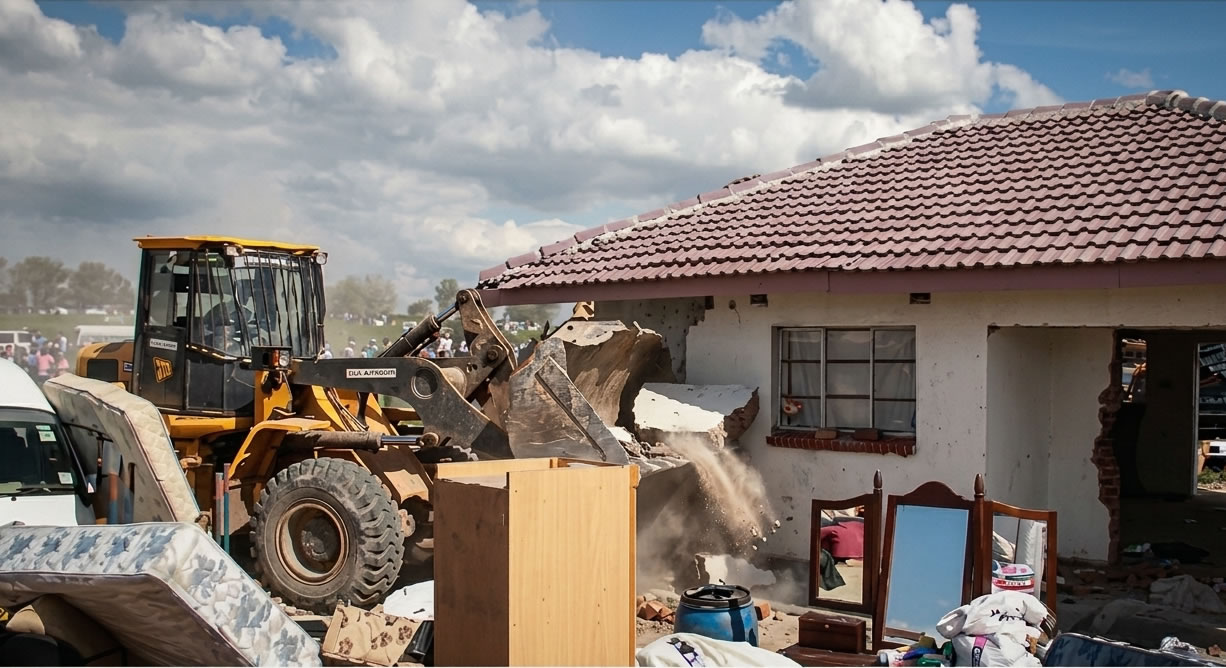
Harare – A new government directive banning what it terms “parallel development” has cast a long, dark shadow over thousands of Zimbabwean families, threatening to render them homeless. This policy targets housing projects initiated without full council approval, often in areas where local authorities have been criticised for their sluggishness or alleged corruption in issuing necessary permits. The critical question that arises is: why are homeowners, many of whom have invested their life savings, being penalised instead of the corrupt land developers and council officials who facilitated these irregular settlements?
For many, the dream of homeownership in Zimbabwe has become a nightmare. Across Harare, the sound of bulldozers has become an ominous harbinger of despair, echoing the devastating Operation Murambatsvina of 2005. While the current campaign may not match the scale of that infamous event, which displaced an estimated 700,000 people, the human cost for those affected remains equally profound.
The Crackdown on ‘Parallel Development’
The recent pronouncement by the Zimbabwean government marks a significant shift in its approach to urban planning and housing development. Local Government and Public Works Minister Daniel Garwe unequivocally declared an end to “parallel development,” a practice where residential structures are erected before essential infrastructure, such as roads, water supply, sewer systems, and stormwater drainage, is fully installed and certified by local authorities.
Minister Garwe stated, “There is no such thing as parallel development, where people are being asked to build houses while servicing of roads, water and sewer is still taking place. We don’t have such a thing.” He emphasised that proper planning dictates that all infrastructure must be in place and a Certificate of Compliance issued by the local authority before any construction begins or stands are sold. This new stance effectively revokes elements of the 2012 National Housing Policy, which had, in some interpretations, allowed for incremental development to address the nation’s burgeoning housing backlog.
The government argues that this crackdown is a necessary measure to restore order to urban planning and curb the proliferation of poorly serviced settlements. For decades, a growing housing deficit has fuelled the rise of private land developers and housing cooperatives, many of whom sold residential stands without the prerequisite infrastructure. This often left residents in limbo, living for years without basic services, a situation the government now seeks to rectify.
The Human Cost: Dreams Turned to Dust
The impact of this policy is most acutely felt by ordinary citizens who, in their desperate quest for shelter, fell prey to unscrupulous land deals. Consider the plight of a man in Budiriro, who, according to a report by Propertybook, spent fifteen years meticulously saving to acquire a stand. He paid a cooperative, received an offer letter that appeared legitimate, and painstakingly built his home, brick by brick, roof sheet by roof sheet. Then, one morning, a council bulldozer arrived, and a 48-hour demolition notice was taped to a tree outside his gate. His life’s investment, his sweat, and his children’s inheritance – all gone, with the council asserting the land was never legally his to buy.
This narrative is not an isolated incident. In areas like Harare South and Budiriro, over a hundred families have been left stranded following demolitions. Residents of Stoneridge, for instance, are counting their losses after authorities razed homes built on a disputed 20-hectare piece of land. These families, including vulnerable children, are now facing the harsh realities of homelessness, exposed to the elements with no alternative accommodation in sight.
Critics argue that while the government’s stated intention to regularise urban development is commendable, the execution disproportionately punishes the victims rather than the perpetrators of these illegal schemes. Many homeowners genuinely believed they were acquiring legitimate property, having been presented with what appeared to be official documentation from cooperatives or individuals claiming authority over the land.
The Shadowy World of Land Barons
At the heart of Zimbabwe’s chaotic urban land market are the so-called “land barons.” These powerful figures, often with alleged links to the ruling ZANU-PF party, have for years exploited the housing crisis, illegally parcelling out and selling land without proper title or planning approval. They operate through a network of housing cooperatives and individuals, peddling offer letters and agreements that lack legal standing, yet are convincing enough to entice desperate home seekers.
Investigations have revealed that numerous illegal cooperatives have been active in areas like Budiriro, with names such as Takaitora Nyika, Parkridge, Ruvimbo, Bantu, United We Stand, and Excellence Stars being cited in official reports. Some of these groups sold land they did not own, and their “offer letters” were not council-issued cessions, leaving buyers with weak or non-existent legal title. The City of Harare’s Regularisation Task Force report, published in May 2025, detailed how more than thirty such illegal cooperatives operated in Budiriro alone, with some having a long history of court cases against them.
The government has also acknowledged the problem of “sabhuku deals” – illegal land sales by unauthorised village heads in rural and peri-urban areas. Minister Garwe stated, “The Government policy on urban development is very clear. We strongly discourage the construction of houses on illegal land or land that has been processed illegally by institutions or individuals… This idea of being sold a piece of land by an individual who does not own or have title to that land is not only criminal but is going to attract severe penalties.” He added that a Statutory Instrument is being finalised to strengthen enforcement and prosecute those involved in illegal land transactions.
However, the perceived impunity of many land barons, some of whom are reportedly well-connected politically, raises questions about the sincerity and effectiveness of these measures. There are allegations that these land grabs are not merely about cleaning up cities but are a calculated move to clear valuable land for new, elite-owned projects, including luxury housing developments for wealthy investors.
The Political Dimension and Hypocrisy
The involvement of political figures and party-affiliated groups further complicates the narrative. The Patriotic Vendors4ED, a group associated with the ruling ZANU-PF, recently toured Chiredzi, endorsing the government’s crackdown on illegal structures. Hazvinetsi Chinogwenya, Masvingo Provincial Chairperson of Patriotic Vendors4ED, asserted that vending sites were initiated through ZANU-PF empowerment programmes and that the “First Family is untouchable”. Such statements, while ostensibly supporting order, also highlight the deep political entanglement in land and urban development issues.
For ordinary Zimbabweans, the legal framework surrounding urban planning is a complex labyrinth designed to benefit the powerful. The process of acquiring land and building legally requires navigating multiple layers of bureaucracy, obtaining approved layout plans, building plans, council-issued cessions or deeds of transfer, and ensuring rates are paid and up to date.
The advice to prospective homeowners is clear but often difficult to follow in practice: verify the status of any stand at district offices in person, request written confirmation of its existence in council records, check the seller’s registration, and confirm no demolition order is pending. Crucially, buyers are advised to engage their own conveyancer, not the seller’s, to search the deeds registry and trace the chain of title. The warning is stark: “trust no one. Not the cooperative chairman… Not the agent who says paperwork is ‘in process.’ Not the relative who knows a man at the council. The Zimbabwean property market is not yet a place where trust alone is enough”.
A Future of Uncertainty
The “parallel development” ban, while framed as an effort to bring order and legality to urban settlements, has ignited fear and uncertainty among thousands. It underscores a systemic failure where corruption, political patronage, and a desperate housing crisis converge, leaving the most vulnerable to bear the brunt of punitive measures. As bulldozers continue their work, the question remains: will this crackdown genuinely lead to equitable and orderly urban development, or is it merely another chapter in a long history of land disputes that disproportionately affect the poor, while the powerful remain largely untouched?