


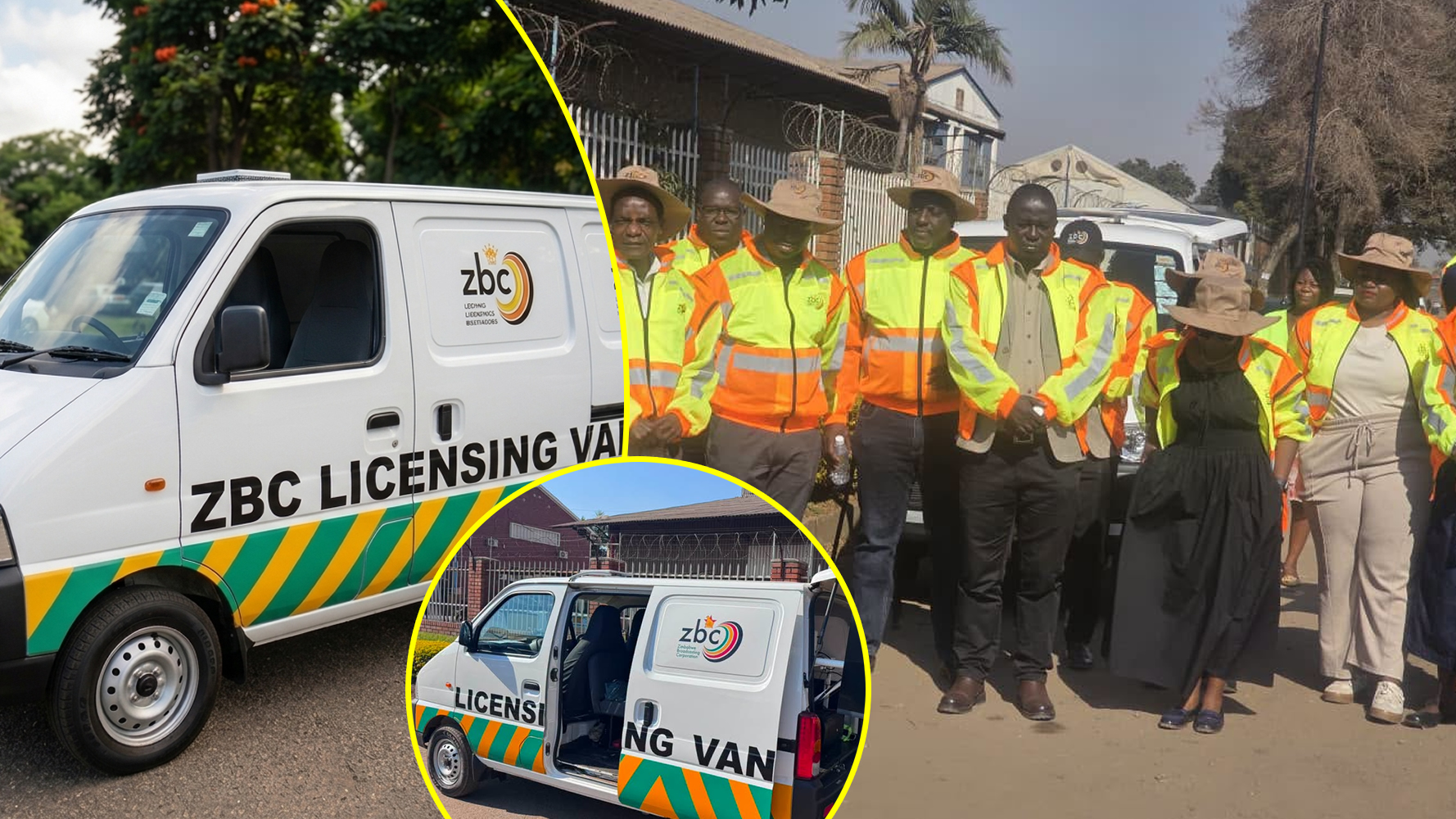
ZBC launches door-to-door TV and radio licence inspections across Harare estates
The Zimbabwe Broadcasting Corporation will begin a two-week door-to-door inspection campaign in Harare on Monday, sending licensing teams into some of the capital’s largest gated communities and residential estates as it intensifies efforts to collect television and radio licence fees.
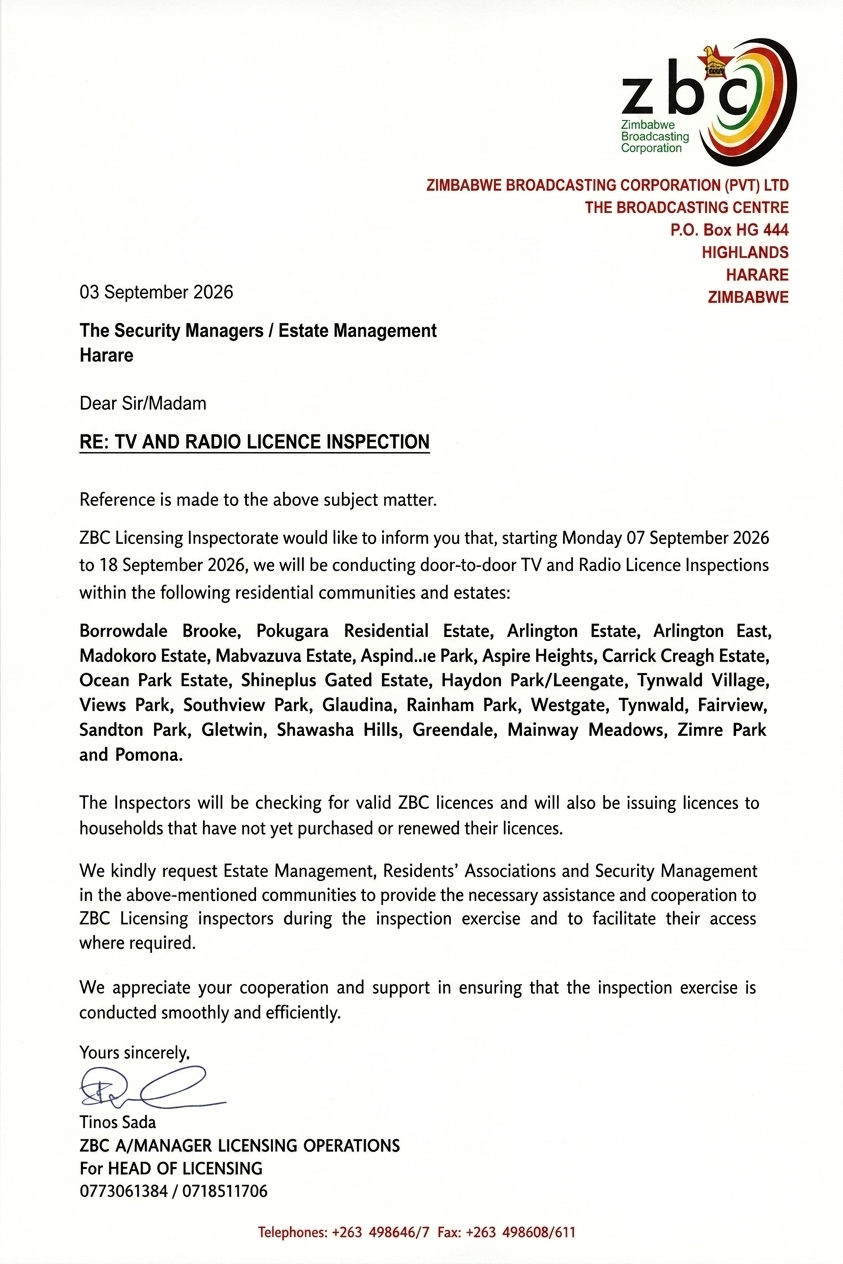
The exercise will run from 7 to 18 September 2026 and will cover a wide spread of up to 28 suburbs and private developments, including Borrowdale Brooke, Pokugara Residential Estate, Arlington Estate, Arlington East, Madokero Estate, Mabvazuva Estate, Aspindale Park, Aspire Heights, Carrick Creagh Estate, Ocean Park Estate and Shineplus Gated Estate.
Other areas listed for visits are Haydon Park and Leengate, Tynwald Village, Views Park, Southview Park, Glaudina, Rainham Park, Westgate, Tynwald, Fairview, Sandton Park, Gletwin, Shawasha Hills, Greendale, Mainway Meadows, Zimre Park and Pomona.
The campaign is being led by ZBC’s Licensing Inspectorate. Its teams will check whether households hold valid licences and will issue new licences or process renewals for residents who are not up to date. The corporation has asked estate managers, residents’ associations and private security companies to help its officers enter the targeted communities and move between properties during the operation.
In a letter dated 3 September 2026 and addressed to security managers and estate management companies in Harare, Tinos Sada, ZBC’s acting manager for licensing operations, set out the purpose of the exercise.
“Inspectors will be checking for valid ZBC licences and will also be issuing licences to households that have not yet purchased or renewed their licences.”
The letter requested “the necessary assistance and cooperation” of estate management, residents’ associations and security management, including help to facilitate access where required. The inspection drive follows the expansion of ZBC’s monitoring fleet to 15 vans and a wider compliance campaign being carried out across the country. A standard home broadcasting licence (which covers both television and radio sets) is currently priced at US$24 per year.
The operation comes as the state broadcaster pushes to strengthen the revenue stream that has become central to its financial recovery. ZBC returned to profitability in 2025 after recording heavy losses in the previous year, with the corporation reporting an operating profit of ZWG334 million and total comprehensive income of ZWG241 million.
That result compared with an operating loss of ZWG2.1 billion in 2024 and a comprehensive loss of ZWG1.1 billion. Licence-fee revenue rose to more than ZWG1.2 billion in 2025, almost three times the amount collected during the previous year.
“This turnaround was anchored by the enactment of the Broadcasting Services Amendment Act No. 2 of 2025, gazetted on 23 May 2025 and brought into operation on 15 July 2025, which integrated vehicle radio licensing collection into the motor vehicle licensing and insurance renewal process,” Rushwaya said.
Under the system, motorists must produce a valid radio licence before obtaining vehicle insurance or a motor vehicle licence. The requirement also applies where a vehicle owner says there is no radio in the vehicle. In such cases, the owner must obtain an exemption from ZBC before completing the licensing or insurance process.
The 2025 changes created a direct collection point for the broadcaster at a time when ZBC was under pressure to improve its finances. The policy has also placed the corporation’s licensing system at the centre of routine vehicle transactions, while the latest Harare campaign takes the collection effort directly to households.
The National Competitiveness Commission has recorded the scale of the vehicle-linked charges introduced under the amendment. Private vehicle radio licences were set at US$23 per quarter, or US$92 a year, while licences for corporate-owned vehicles were set at US$50 per quarter, equivalent to US$200 a year. The additional costs have been particularly significant for companies operating several vehicles or large fleets.
For households, the Harare inspections will focus on television and radio licences rather than vehicle documentation. Inspectors are expected to visit properties within the listed estates, check existing licences and provide residents with an opportunity to purchase or renew them during the campaign.
The corporation’s renewed enforcement drive is taking place alongside an internal programme to modernise its broadcasting operations. Acting director of finance Maxwell Judah said the improved financial position had given ZBC room to support its technical and operational plans, although the organisation continued to face pressure to develop income beyond licence fees.
“Total comprehensive income was ZWG241 million, against a comprehensive loss of ZWG1.1 billion in 2024,” Judah said.
The pressure to diversify is linked to a revision of broadcasting licence tariffs that took effect on 15 January 2026. Rushwaya said the lower per-unit rates would affect the corporation’s income even as licence fees continued to provide the greater majority of its revenue.
“Looking to the year ahead, the board is mindful that the Government’s revision of broadcasting licence tariffs, effective 15 January 2026, will reduce per-unit licence fee rates, even as the corporation continues to depend on this revenue stream for the greater majority of its income. The board and management are therefore prioritising revenue diversification,” Rushwaya said.
ZBC chief executive officer Sugar Chagonda said the organisation had used the recovery period to invest in transmission infrastructure, production facilities and digital services. The corporation commissioned two modernised television studios and a master control room, as well as eight digitised radio studios at Montrose Studios.
“On the technical and digital front, the Engineering and Broadcast Technology Department commissioned two modernised television studios and a master control room, as well as eight digitised radio studios at Montrose Studios,” Chagonda said.
ZBC has also continued developing its Z+ streaming platform, deploying enterprise resource planning automation modules and installing a media asset management system. On programming, the Television Productions Department introduced nine programme genres, exceeding its target of six.
The investments reflect the corporation’s effort to maintain its traditional television and radio services while adapting to changes in how audiences receive news and entertainment. The expansion of digital services has been accompanied by a renewed focus on local content and the technical infrastructure needed to distribute it across the country.
Information, Publicity and Broadcasting Services Minister Soda Zhemu welcomed the financial turnaround but said the broadcaster now had to convert the improvement into measurable performance under its 2026-2030 strategic plan.
“The ZBC strategic plan running from 2026 to 2030 must now be translated into tangible and measurable results,” Zhemu said.
The government expects ZBC to increase its audiences, produce competitive Zimbabwean content, expand geographical and digital access, diversify revenue and modernise its broadcasting infrastructure. It has also set expectations around corporate governance, accountability, the creative economy and the development of a skilled and performance-driven workforce.
The corporation’s audited financial statements for 2025 were adopted at its annual general meeting. Its priorities for 2026 include consolidating the gains made through legislative and digital transformation, improving revenue generation and continuing investment in broadcasting services.
The Harare inspection campaign will be the most visible part of that revenue effort for residents in the targeted communities. From Monday, ZBC inspectors are expected to work with estate managers, residents’ associations and security teams as they check licences, record renewals and issue new documents to households that have not yet paid for the corporation’s television or radio services.