


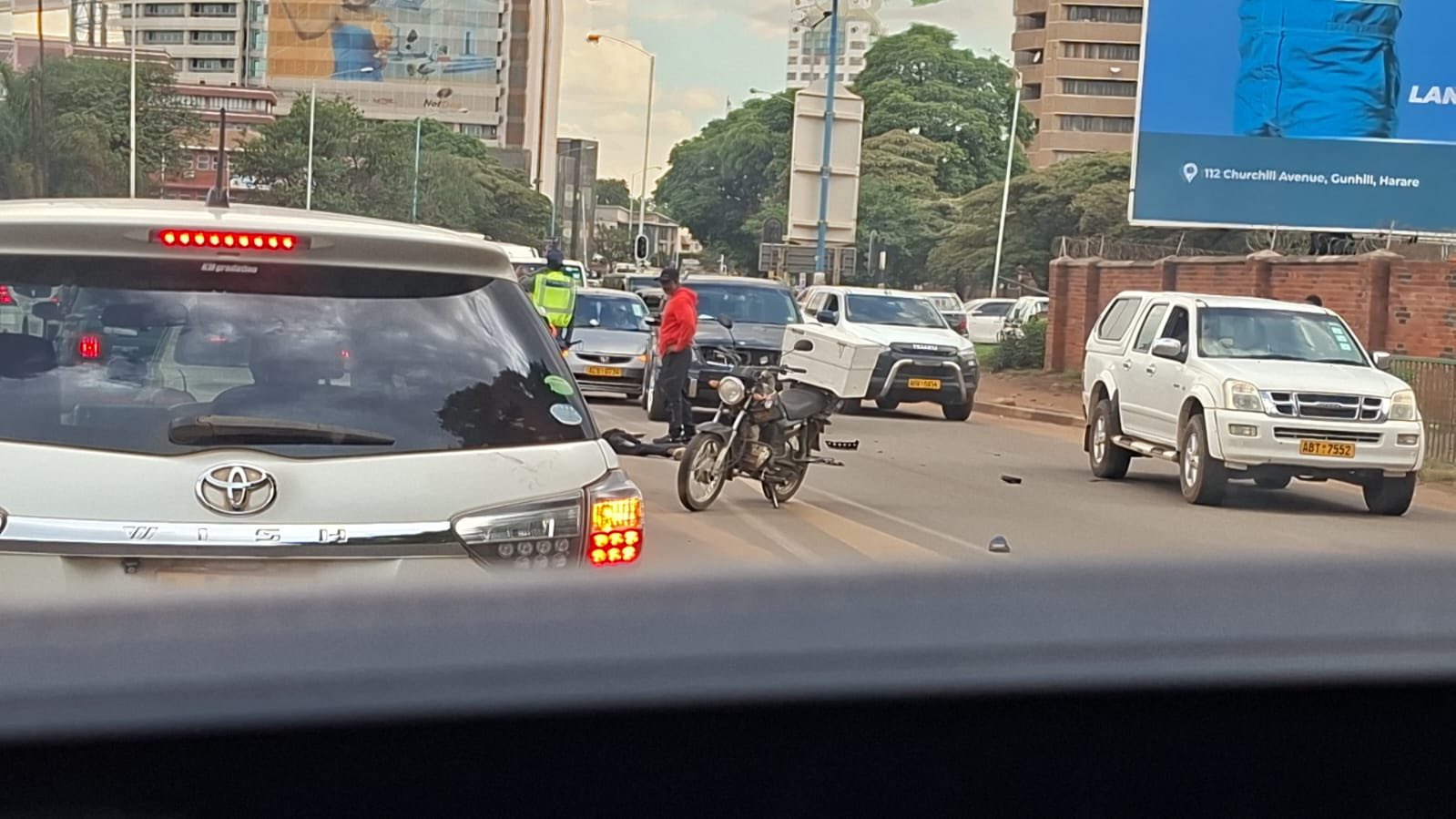
HARARE – In the bustling heart of Harare, where the frantic pace of the central business district often collides with the stark realities of urban decay, a Mercedes-Benz driven by one of the country’s most outspoken political figures has become the latest symbol of a troubling national discourse. Temba Mliswa, the 55-year-old former legislator for Norton, found himself at the centre of a dramatic scene on Tuesday afternoon when his luxury vehicle struck a pedestrian near the Harare Polytechnic.
The incident, which occurred along Prince Edward Road, left an unidentified man bleeding on the tarmac and a high-profile politician scrambling to control the narrative. Witnesses described a scene of immediate chaos, with the impact of the collision shattering the Mercedes’ windscreen and leaving the victim sprawled across the road. Yet, before the dust had even settled, a familiar pattern began to emerge—one where the powerful seek to shift the burden of blame onto the vulnerable.
The Collision and the Claim
The collision took place during the Tuesday afternoon rush. Mliswa, a former Zanu PF Mashonaland West provincial chairperson who has long cultivated an image as a fearless independent voice, was reportedly driving his Mercedes-Benz when he hit the pedestrian. Mliswa is also President Emmerson Mnangagwa’s cousin, and it is reported that during his school days, President Mnangagwa was residing with Temba Mliswa’s parents. The force of the impact was significant enough to cause severe damage to the vehicle’s front windscreen, suggesting a collision of considerable speed or directness.
Witnesses at the scene recounted seeing Mliswa making several “frantic phone calls” while the victim lay injured on the road. Police arrived shortly thereafter, followed by an ambulance that transported the man to a nearby hospital for assessment. Mliswa was interviewed at the scene and later provided a statement at Harare Central Police Station before being released pending further enquiries.
However, it was Mliswa’s reaction in the hours following the accident that has sparked the most intense scrutiny. Taking to the social media platform X (formerly Twitter) on Tuesday evening, the former MP offered his version of events.
“An inebriated pedestrian unexpectedly entered the roadway and collided with my vehicle, resulting in minor injuries,” Mliswa claimed. He went on to state that the victim was “able to walk by himself from the scene and appeared to be in stable condition.”
More controversially, Mliswa used the incident to pivot to a broader political talking point, claiming the accident highlighted “a pressing and troubling issue regarding drug and substance abuse among the youth in Zimbabwe, particularly within the central business district.”
A History of Blame and the “Inside Job” of Reputation
The swiftness with which Mliswa labelled the victim as “inebriated” has raised eyebrows among legal experts and the public alike. To date, no medical evidence has been produced by the police or hospital staff to support the claim that the pedestrian was under the influence of drugs or alcohol.
This tactic—diagnosing the victim at the scene of the crime—is not new in the annals of Zimbabwean traffic incidents involving the elite. It serves a dual purpose: it mitigates the driver’s potential liability for “culpable homicide” or “negligent driving” and reframes the incident as a social failure rather than a personal one.
The case of Mliswa is the latest entry in a long and often frustrating history of how the law interacts with Zimbabwe’s prominent figures on the road. In recent years, the Zimbabwean public has watched with growing cynicism as high-profile individuals involved in fatal or serious accidents navigate a legal system that often appears more lenient toward the well-connected.
The Chillmaster Precedent: Justice or Leniency?
Perhaps the most resonant recent comparison is the case of the popular musician Gift Hombarume, known professionally as “Chillmaster.” In early 2025, Hombarume was involved in a fatal road accident in the Hopley area of Harare that claimed the life of a pedestrian.
The subsequent legal proceedings became a flashpoint for public anger. Hombarume was found guilty of driving without a licence and culpable homicide. However, the initial sentencing by a Mbare magistrate—which spared him immediate imprisonment in favour of community service—sparked widespread outrage. Critics argued that the sentence was a slap on the wrist for a crime that resulted in the loss of human life.
The public outcry was so significant that the High Court eventually ordered a reopening of the case for a fresh inquiry into the sentencing. Judge President Mary Zimba-Dube noted that the initial sentence may have been too lenient given the gravity of the offence. The “Chillmaster” case serves as a stark reminder that while the law eventually catches up, the initial impulse of the system is often to protect the “prominent” from the full weight of their actions.
The Shadow of Dudu Manhenga
The conversation around high-profile traffic accidents in Zimbabwe inevitably leads back to the 2013 case of Afro-jazz sensation Dudu Manhenga. Manhenga was convicted of culpable homicide and driving without a licence after she fatally struck a pedestrian, Graham Garlon, along the same Prince Edward Road where Mliswa’s accident occurred.
Manhenga was initially sentenced to 18 months in prison, but her sentence was later suspended on the condition that she paid a fine and performed community service. The case remains a touchstone for discussions on “class justice” in Zimbabwe, as many felt that a less famous citizen would have faced the full term of imprisonment.
A Pattern of Immunity?
The list of prominent Zimbabweans involved in traffic incidents is long, and the outcomes are often obscured by the passage of time or the lack of transparent follow-up.
– In 2024, the legal system faced criticism after an unlicensed driver in Chinhoyi was sentenced to just 360 hours of community service after fatally striking a pedestrian and injuring four others.
– High-ranking officials and their relatives are frequently involved in “fender benders” or more serious collisions that are resolved quietly through “out-of-court settlements,” a euphemism that often leaves the victims’ families without true justice or closure.
For the ordinary Zimbabwean, the road is a dangerous place. According to the World Health Organisation (WHO), an estimated 2,000 pedestrians were killed on Zimbabwe’s roads between 2013 and 2016 alone. In 2025, Bulawayo reported 77 pedestrian deaths in a single year. These are not just statistics; they are lives cut short, often by vehicles driven by those who feel they are above the rules of the road.
The “Drug Abuse” Narrative: A Convenient Shield
By framing the Tuesday accident as a symptom of the “drug and substance abuse” epidemic, Temba Mliswa has attempted to turn a personal liability into a public service announcement. While Zimbabwe is undoubtedly facing a crisis regarding the use of “mutoriro” (crystal meth) and other substances among the youth, using a victim’s alleged intoxication as a shield before a formal investigation is completed is seen by many as a cynical manipulation of a genuine national crisis.
The Zimbabwe Republic Police (ZRP) have remained notably silent on the details of the investigation. No formal charges have been laid against Mliswa, and the identity and condition of the pedestrian remain unknown to the public.
Conclusion: The Road Ahead
As the investigation into the Prince Edward Road collision continues, the question remains: will Temba Mliswa face the same scrutiny as any other motorist, or will his status as a “former MP” and “provincial chairperson” grant him the same soft landing enjoyed by others of his rank?
The shattered windscreen of Mliswa’s Mercedes-Benz is a literal and metaphorical break in the facade of security. It represents the moment when the lives of the elite and the ordinary collide. For the pedestrian currently recovering in a hospital bed, the “minor injuries” claimed by Mliswa are a painful reality. For the Zimbabwean public, the incident is a test of whether the law truly is the “great equaliser” or if, on the roads of Harare, some are simply more equal than others.
The investigation is ongoing, and as the detectives at Harare Central Police Station compile their report, the nation waits to see if the “inebriated pedestrian” narrative will hold up under the cold light of forensic truth, or if it will join the long list of excuses used by the powerful to drive away from the consequences of their actions.