


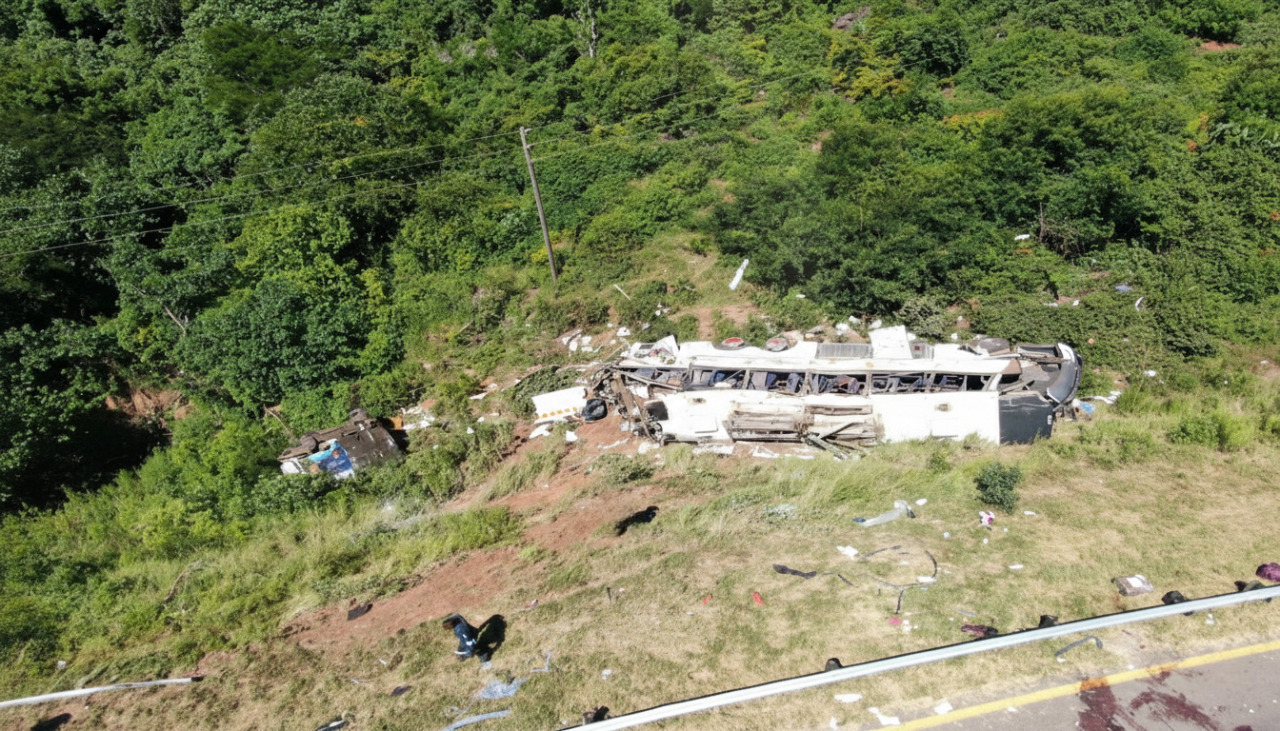
BEITBRIDGE – Just days after a devastating bus crash on South Africa’s N1 highway claimed five lives, another horrific incident has unfolded on the Beitbridge to Harare Highway, leaving two people burnt beyond recognition. This latest tragedy, occurring on the evening of Thursday, 19 February 2026, near the Joko resettlement area, underscores a deepening crisis of road safety along the critical transport corridors connecting South Africa and Zimbabwe. The relentless toll of lives lost and futures shattered paints a grim picture of a region grappling with systemic failures in road infrastructure, vehicle maintenance, and driver conduct.
The Beitbridge accident, a head-on collision between two commercial trucks, occurred at approximately 8 pm. The impact was so severe that both vehicles immediately erupted in flames, trapping and incinerating two individuals. Chief Superintendent Mesuli Ncube, the police officer commanding Beitbridge District, confirmed the details on Friday morning. This incident follows closely on the heels of the N1 highway disaster, where a Bulawayo-bound Marcopolo bus, travelling from Gauteng, lost control near the notorious Ingwe Lodge at approximately 02:50 am on Thursday, 19 February 2026.
That crash resulted in the instant deaths of five people, including the driver and four passengers, and left 34 others injured. Limpopo’s Member of the Executive Committee (MEC) for Transport and Community Safety, Ms Violet Mathye, who visited the scene, reported that “Four passengers sustained serious injuries, 10 were critically injured, and 18 others suffered minor injuries. All injured parties have been taken to nearby medical facilities for treatment.” The injured from the Beitbridge crash were also rushed to Beitbridge Hospital, where their condition is reported as serious.
The location of this latest disaster is hauntingly familiar. It is the exact same spot where, exactly four months ago on 12 October 2025, 44 people — including 36 Zimbabweans and eight Malawians — lost their lives when their bus plunged into the same cliff. Amongst those victims were 18 women, 17 men, and seven children, including a 10-month-old baby. That bus, en-route from Gqeberha (formerly Port Elizabeth) to Harare, was found to be severely overloaded, carrying 91 passengers in a vehicle designed for 62.
As the sun rose over the wreckage on Thursday, the road remained closed while emergency services and investigators combed through the debris. The preliminary cause of the crash has been recorded as “driver loss of control,” but for the families of the deceased, such technicalities offer little comfort. The area around Ingwe Lodge has become a “death trap,” a sentiment echoed by frequent travellers and local residents who have witnessed the mounting toll of metal and lives.
The frequency of these incidents has reached a boiling point, prompting direct intervention from the highest levels of the South African government. Minister of Transport Ms Barbara Creecy and her Deputy, Mr Mkhuleko Hlengwa, have directed the South African National Roads Agency SOC Limited (SANRAL) to find an urgent road engineering solution to the “persistent rise in the number of road crashes on the same curve.”
Furthermore, the Road Traffic Management Corporation (RTMC) has been ordered to provide an update on a directive issued last October to intensify roadworthy inspections of buses crossing the Beitbridge border. “Both the RTMC and SANRAL are expected to provide reports as a matter of priority,” the National Department of Transport said in a statement. “Minister Creecy and her deputy Mr Hlengwa have extended their heartfelt condolences to the bereaved families who lost their loved ones and wish a speedy recovery for those who were admitted in hospitals.”
While the N1 continues to claim lives in South Africa, the road safety crisis extends across the border into Zimbabwe. Just hours after the Makhado bus crash, another horrific incident unfolded on the Beitbridge to Harare Highway. On the evening of Thursday, 19 February 2026, at around 8 pm, two commercial trucks collided head-on near the Joko resettlement area, approximately 15 kilometres from the border town.
The collision was so violent that both vehicles immediately caught fire. Two people were burnt beyond recognition, while another two sustained life-threatening burns. Chief Superintendent Mesuli Ncube, the police officer commanding Beitbridge District, confirmed the details on Friday morning. “Indications are that one of the trucks, which was empty, was travelling from Harare towards Beitbridge with only the driver,” he said. “The second truck was carrying a load of maize and had three people, including two passengers.”
According to Chief Supt Ncube, the driver of the empty truck attempted to avoid hitting a cow on the road, encroaching into the lane of oncoming traffic. “As a result, the two vehicles caught fire and the driver and one passenger were burnt beyond recognition. Another passenger and the driver of the second truck sustained serious burns,” he explained. The injured were rushed to Beitbridge Hospital, where they remain in serious condition.
These twin tragedies are part of a broader, more systemic failure of road safety in the region. In Zimbabwe, the Zimbabwe Republic Police (ZRP) and the Zimbabwe National Statistics Agency (ZimStat) have recorded a sharp rise in road traffic accidents throughout 2025. Between January and November 2025, Zimbabwe recorded 54,102 road traffic accidents, a significant increase from the 49,292 recorded during the same period in 2024. The 2025 festive season alone saw 177 people killed between 16 and 26 December, up from 77 during the same period the previous year.
In South Africa, the N1 highway serves as the primary route for the estimated 15,000 people who cross the Beitbridge Border Post daily. Approximately two-thirds of these travellers rely on buses and “omalaicha” (cross-border transporters) to navigate the long distances between South African cities and Zimbabwean towns. Authorities suspect that driver fatigue is a major contributing factor, with many drivers operating for long hours without adequate rest to meet tight schedules.
Just weeks before the latest Makhado crash, another disaster was narrowly averted. An Exo bus travelling from Zimbabwe to Gauteng was involved in a pile-up with a truck and a light vehicle just 11 kilometres from Makhado. While the bus driver was injured, the passengers escaped unhurt, forced to find alternative transport to finish their journey. Such “near misses” are now a common feature of life on the N1.
The recurring nature of these accidents has led to calls for more than just “engineering solutions.” Investigative journalists and safety advocates point to a culture of negligence that includes overloading, poorly maintained vehicles, and a lack of enforcement at border crossings. The October 2025 crash involving the 91-passenger bus is a prime example of how regulatory oversight can fail with catastrophic consequences.
As the RTMC begins its investigation into the latest bus crash, with a preliminary report expected within 48 hours, the pressure on SANRAL to redesign the Ingwe Lodge curve is immense. “The Department extends its gratitude to the emergency responders and urges all road users to exercise caution, especially during night-time travel,” MEC Mathye added.
For the people of Zimbabwe and South Africa, the N1 and the Beitbridge-Harare highway represent more than just tarmac; they are the lifelines of the regional economy. Yet, until the systemic issues of vehicle roadworthiness, driver fatigue, and road engineering are addressed, these lifelines will continue to be stained with the blood of those simply trying to reach home.
The bodies of the two victims from the Beitbridge truck collision now lie in a mortuary pending post-mortems, their identities yet to be officially confirmed due to the severity of the fire. In Makhado, 34 people are beginning the long process of recovery in hospitals across Limpopo. Their stories are a testament to a crisis that shows no signs of abating — a silent toll that continues to mount, one kilometre at a time.
Key Incidents and Statistics: A Timeline of Tragedy
|
Date
|
Location
|
Incident Description
|
Casualties
|
|
12 Oct 2025
|
N1, Ingwe Lodge, SA
|
Overloaded bus (91 people) plunged into a cliff.
|
44 Dead, 49 Injured
|
|
Jan – Nov 2025
|
Zimbabwe (National)
|
Total road traffic accidents recorded.
|
54,102 Accidents
|
|
16 – 26 Dec 2025
|
Zimbabwe (National)
|
Festive season road fatalities.
|
177 Dead
|
|
Jan 2026
|
N1, near Makhado, SA
|
Exo bus involved in a pile-up with a tanker and car.
|
1 Injured (Driver)
|
|
19 Feb 2026
|
N1, Ingwe Lodge, SA
|
Bulawayo-bound bus veered into a ditch at 02:50 am.
|
5 Dead, 34 Injured
|
|
19 Feb 2026
|
Beitbridge-Harare Hwy
|
Head-on collision between two trucks due to a cow.
|
2 Dead, 2 Injured
|
“The road remains closed while emergency services, traffic officers and investigators work at the scene. Motorists are advised to use alternative routes and expect delays. Our thoughts are with the loved ones of the deceased, and we pray for the swift healing of those hurt.” — Ms Violet Mathye, Limpopo MEC for Transport.
“Indications are that… the driver who was heading towards Beitbridge tried to avoid hitting a cow that was on the road and encroached into the lane of oncoming traffic, resulting in a head-on collision. As a result, the two vehicles caught fire and the driver and one passenger were burnt beyond recognition.” — Chief Superintendent Mesuli Ncube, ZRP.