


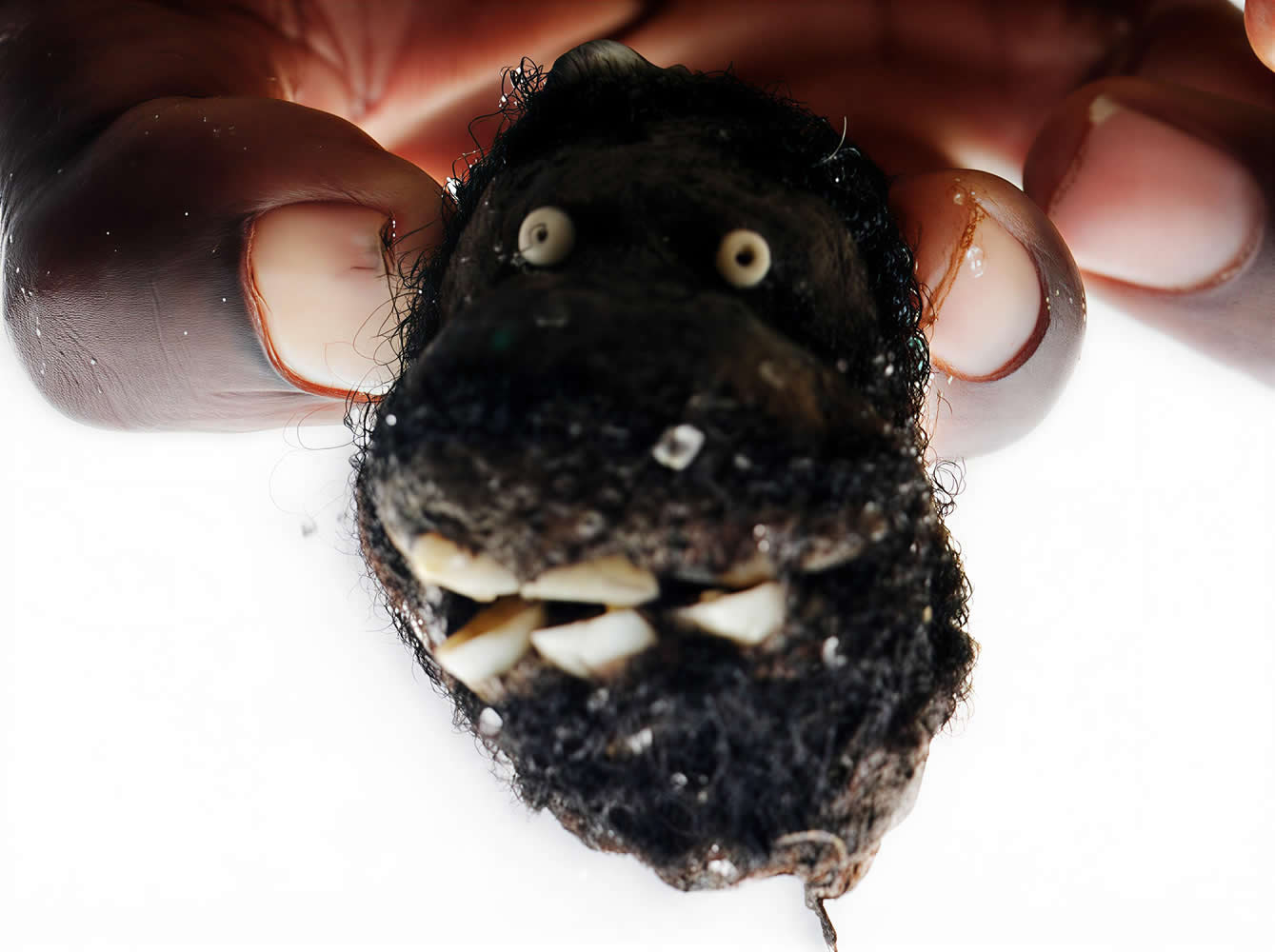
BEITBRIDGE — In the dusty, heat-soaked border town of Beitbridge, where the Limpopo River marks the boundary between hope and hardship, Mazvita Marvelous Msavi walks the streets as a ghost of the woman she might have been. At 35 years old, her appearance is a testament to a life spent in the shadows of a terror most would find impossible to comprehend. Unkempt, desperate, and weary, she carries a burden that she claims began when she was only three years old—a 32-year sentence of torment by supernatural beings she says were invited into her family by those she should have been able to trust.
Msavi’s story is not merely one of personal tragedy; it is a window into a dark corner of Zimbabwean belief systems where the quest for wealth through “ondofa” — goblins — can lead to the sacrificial suffering of the innocent. Sitting in the sweltering heat of the town, her voice often dropping to a haunting monotone, she recounted an ordeal that has robbed her of her dignity, her family, and her future.
“These things have been sexually abusing me since I was a child,” she said, her voice finally breaking after a long period of flat, inflectionless narration. “Actually, the story of my suffering began when my relatives went to seek help from a witch doctor, when I was still very young. I was only three years old at the time.”
According to Msavi, the genesis of her nightmare lies in a visit two of her relatives made to a traditional healer, or n’anga, more than three decades ago. In the pursuit of supernatural assistance—often linked in local lore to the acquisition of wealth or protection—the relatives were allegedly given ten goblins. The instructions from the witch doctor were specific: the creatures were to be accommodated within the family. However, instead of the relatives hosting the spirits themselves, the burden was split.
“They were told that these goblins were supposed to be accommodated in either my father’s or my mother’s relatives,” Msavi explained, stifling a sob. “Instead, five of the goblins were lodged within me and the other five were placed in my younger sister.”
This practice, known in some circles as “kutakura mapere” or carrying the hyenas, involves using a vulnerable family member as a “vessel” or host for the spirits, allowing the primary owners to reap the benefits—usually financial prosperity—without enduring the direct physical or spiritual toll. For Msavi, the toll has been absolute.
The torment follows a grimly predictable schedule. As the sun dips below the horizon and the evening air begins to cool, the entities make their presence known. “These things torment me every day. From as early as six o’clock in the evening they begin to appear, sometimes disguising themselves with my relative’s face,” she said. The psychological warfare is as brutal as the physical. “I live in fear because I never know when they will come. They disturb my sleep and my peace.”
Perhaps most disturbing is Msavi’s claim regarding her biological cycles. She alleges that the entities’ predilection for blood becomes more aggressive during her menstrual cycle. “When I menstruate, these things come to drink the blood. Even when I throw away my sanitary pads, they come back to take the blood from the pads,” she said, her eyes betraying a deep-seated fear that her flat voice tried to mask. “The situation is now beyond control and I honestly do not know what to do anymore.”
Msavi’s plight is far from an isolated incident in Zimbabwe, a country where the intersection of traditional beliefs and modern life often creates complex social dramas. Only last year, in June 2024, the Gwambe police base in Bulilima, Matabeleland South, was reportedly deserted by officers who claimed they were being terrorised by goblins at night. Similarly, in the Epworth area of Harare, families have come forward claiming that “ondofa” have caused mysterious deaths and sexual assaults within their households. These incidents highlight a persistent cultural phenomenon where the supernatural is blamed for tangible suffering, often leaving the victims with little recourse in the formal legal system.
For Msavi, the refusal of her relatives to acknowledge the damage or seek a “cleansing” has left her isolated. She has repeatedly begged them to accompany her to a healer who can remove the spirits, but her pleas have fallen on deaf ears. “I have tried many times to persuade both my relatives to go with me so that we can look for help, but they have refused. They do not want to be involved. They are getting rich through the goblins. That has left me suffering alone,” she said, finally allowing a single tear to roll down her cheek.
The cost of this “wealth” has been Msavi’s entire adult life. She explained that her relatives have actively sabotaged any attempt she made to build a normal existence. This sabotage, she claims, included the destruction of her most vital documents. “They burnt my academic certificates, both my O-level and A-level certificates. They also destroyed my identification documents, including my birth certificate and my national identity card. They just want me as a vessel for their goblins,” she said.
Without identification or proof of her education, Msavi is a non-person in the eyes of the state, unable to secure formal employment or even rent a proper home. The woman who once held A-level certificates now survives as a homeless vendor, selling small wares to travellers at the Beitbridge bus ranks. When night falls, she does not return to a bed; instead, she seeks refuge in the open air of the bus ranks, where the goblins, she says, continue to find her.
“I am now a homeless vendor. Most of the time I seek refuge anywhere at the rank just to pass the night,” she said. “I do not have proper clothes or property to my name. I am living in deep poverty because of the decisions and choices my relatives made many years ago.”
The interference extended even to her personal relationships. Msavi claims that potential suitors have been driven away by the same relatives who host the spirits. “This problem has contributed to my failure to get married. There have been men who came to ask for my hand in marriage but my relatives always stood in the way,” she said. In the cultural context of rural Zimbabwe, marriage is often seen as a form of protection and social standing; by preventing it, her relatives have ensured she remains under their spiritual and physical control.
The psychological impact of such a prolonged ordeal is evident in the way Msavi speaks. She oscillates between a detached, almost clinical description of the abuse and sudden flashes of intense emotion. Journalists who spoke with her noted the chilling contrast between her flat, monotone delivery and the sheer terror visible in her eyes. It is the voice of someone who has told her story many times to people who did not believe her, or who were too afraid to help.
The issue of “wealth-making” spirits is a sensitive one in Zimbabwe. While the Witchcraft Suppression Act—a colonial-era law that was updated in 2006—aims to penalise those who use supernatural means to harm others, the burden of proof is notoriously difficult. Often, cases like Msavi’s are viewed by authorities as matters for traditional leadership or family intervention rather than criminal prosecution. This leaves victims in a “no-man’s-land” where neither the law nor the spirits offer any mercy.
As Msavi stands amidst the chaos of the Beitbridge border post, surrounded by the noise of engines and the shouts of touts, she represents a silent crisis. She is a woman who has been “used” in the most literal and horrific sense of the word, her body and soul allegedly bartered for the prosperity of others.
“They are inside me. I can’t shake them off. I need someone, anyone who can help me to get rid of them. There is no sign of them during the day,” she said, looking out toward the horizon as the evening shadows began to lengthen—the time of day she dreads the most. “All I want now is help so that I can live a normal life like other people.”
For now, Mazvita Marvelous Msavi remains a prisoner of a 32-year-old curse, waiting for a deliverer in a town that is too busy moving forward to notice those who have been left behind in the dark. Her story is a harrowing reminder that for some, the greatest terrors are not those that lurk in the wilderness, but those that are brought home by the people who are supposed to love them.
Contextual Background: The Phenomenon of Goblins in Zimbabwe
The belief in goblins, or zvidhoma (Shona) and ondofa (Ndebele), is deeply rooted in certain Zimbabwean traditional beliefs. These entities are often described as small, humanoid creatures created or captured by traditional healers to perform tasks for their owners. While some are said to be for protection, the most notorious are those acquired for wealth creation.
- Wealth and Sacrifice: It is commonly believed that for a goblin to generate wealth, it requires a “sacrifice” or a “vessel.” This often involves the suffering, illness, or even the life of a family member.
- Sexual Abuse: Reports of “spiritual husbands” or goblins sexually abusing women are frequent in local media, often linked to families where someone is suspected of practicing witchcraft.
- Social Isolation: Victims of alleged goblin attacks often face social stigma. If the family refuses to acknowledge the problem, the victim is often left homeless or destitute, as seen in the case of Msavi.
- Legal Standing: Zimbabwean law struggles to address these claims. While the Criminal Law (Codification and Reform) Act recognizes the “practice of witchcraft” as a crime, proving the existence or influence of supernatural entities in a court of law remains an insurmountable challenge for many victims.