


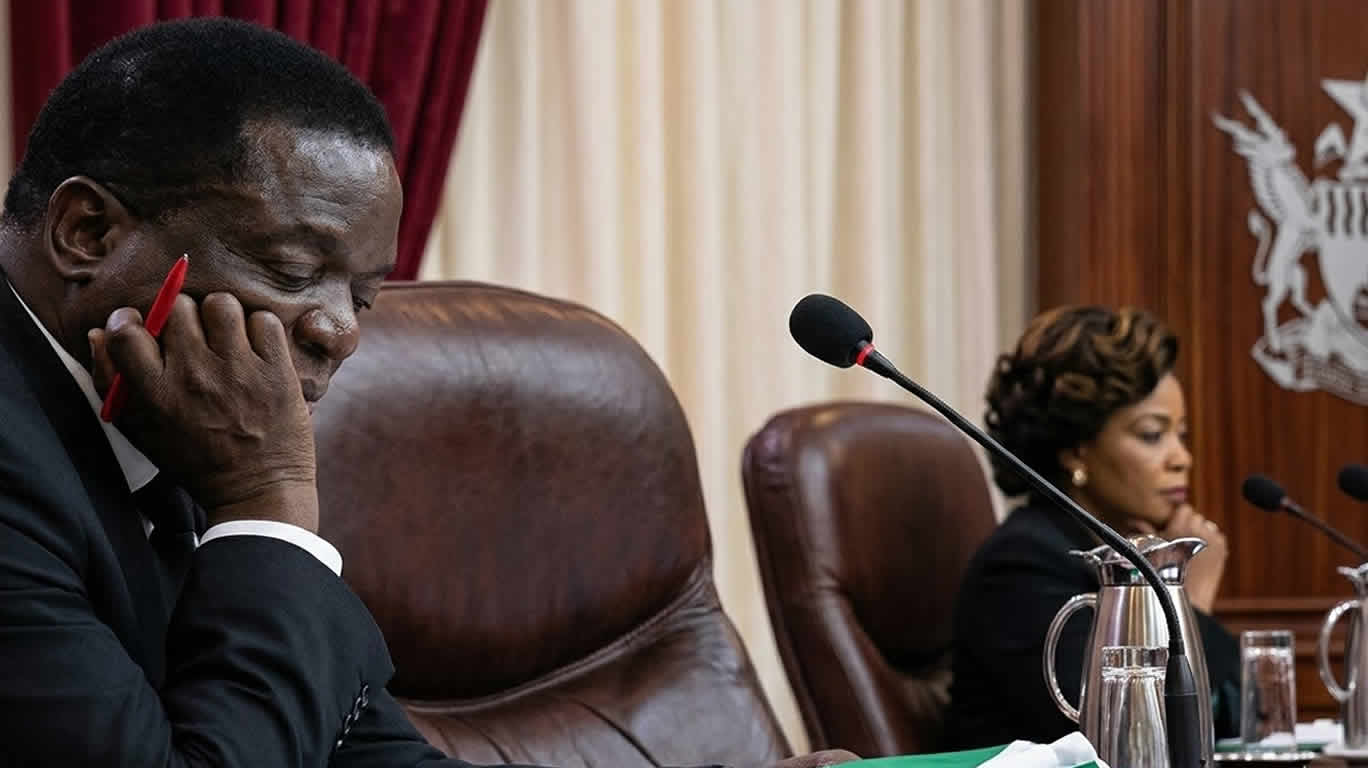
President Emmerson Mnangagwa recently declared that Zimbabwe is taking “bold steps” to address its formidable international debt, a staggering sum reported to be around $23 billion. But for the average Zimbabwean citizen, the true implications of these pronouncements remain shrouded in mystery. An in-depth investigation into the secretive negotiations with the African Development Bank (AfDB) and other international creditors reveals a complex web of agreements, often laden with “hidden strings” that could bind the nation for generations. This report aims to demystify the intricate world of international finance, explaining how debt restructuring, while seemingly beneficial, can lead to the selling off of national assets, the granting of long-term mining concessions, and the imposition of harsh austerity measures that disproportionately affect the most vulnerable.
At the heart of this unfolding narrative is what many are calling the “conspiracy of the spreadsheets” – a significant disparity between the government’s optimistic financial projections and the stark economic realities faced by a country still largely excluded from mainstream international lending. The critical question remains: Is Zimbabwe genuinely clearing its name on the global financial stage, or is it inadvertently mortgaging its future to a new cadre of economic masters? This exposé delves into the private meetings held in exclusive venues such as Harare and Davos, where the very economic sovereignty of Zimbabwe appears to be under negotiation, and elucidates why the much-touted “debt clearance” success story might, in fact, be a blueprint for prolonged economic servitude.
The Staggering Sum: A Nation in Arrears
Zimbabwe’s international debt burden is a colossal figure, oscillating between $21 billion and $23 billion in recent reports. A substantial portion of this debt comprises arrears, which have effectively barred the country from accessing crucial low-cost loans from institutions like the World Bank and the African Development Bank since 1999. These are the very financial lifelines that other developing nations utilise for vital infrastructure projects, such as roads and railways. To address this immediate hurdle, Zimbabwe is actively seeking $2.6 billion in bridge financing – a temporary loan designed to settle overdue debts to international lenders. The hope is that by clearing these arrears, Zimbabwe will pave the way for more affordable borrowing from global financial institutions.
President Mnangagwa has publicly affirmed the government’s commitment to this process. “My government’s ongoing engagement with international financial institutions, under the Arrears Clearance and Debt Resolution Process, is progressing well. We are taking concrete steps towards fulfilling our financial obligations,” he stated, though specifics of these steps remain largely undisclosed. Finance Minister Mthuli Ncube has been at the forefront of these negotiations, attending high-level meetings in Washington and Davos, pushing for a new Staff Monitored Programme (SMP) with the International Monetary Fund (IMF).
The Architects of the Deal: Key Players and Their Roles
Beyond President Mnangagwa and Finance Minister Ncube, several other key figures and institutions are central to Zimbabwe’s debt resolution efforts. The African Development Bank, under the leadership of its President, Dr. Akinwumi Adesina, plays a pivotal role in facilitating the debt resolution process. Former Mozambican President Joaquim Chissano has also been enlisted as a facilitator, lending his diplomatic weight to the complex negotiations. These individuals and bodies are tasked with navigating the intricate landscape of international finance, balancing the demands of creditors with Zimbabwe’s aspirations for economic recovery.
However, the path to debt clearance is not without its controversies. The Mutapa Investment Fund, a sovereign wealth fund reportedly holding approximately $16 billion in assets, has drawn criticism for its perceived lack of transparency and accountability. Accusations of “smoke and mirrors” surround its operations, particularly after it acquired a 35% stake in Kuvimba Mining House for $1.6 billion, a transaction funded through Treasury Bills. Critics argue that such deals, conducted with limited public oversight, could serve as vehicles for asset stripping rather than genuine national development.
Hidden Strings: The True Cost of Debt Clearance
While the government speaks of “bold steps” and “progress,” a closer examination reveals potential trade-offs that could have profound long-term consequences for Zimbabwe. The concept of “debt restructuring” often comes with conditions that can compromise a nation’s economic sovereignty. One such area of concern is mining concessions. In February 2026, Zimbabwe imposed an immediate ban on the export of raw minerals and lithium concentrate. While officially aimed at promoting local processing and curtailing illegal shipments, this move is also seen by some as a strategic lever in debt repayment negotiations, potentially leading to long-term concessions to foreign entities, particularly from China, which has a significant interest in Zimbabwe’s mineral wealth.
The IMF’s Staff Monitored Programme, secured in early 2026, while a crucial step towards rebuilding trust with international lenders, typically entails stringent fiscal reforms and austerity measures. These measures, often involving cuts to public spending and subsidies, tend to hit the poorest segments of society the hardest, exacerbating existing inequalities. The AfDB’s President, Dr. Akinwumi Adesina, while acknowledging Zimbabwe’s progress, has also voiced concerns over recent legislative developments. “The recent assent to the PVO Bill is a significant setback and poses a risk to the arrears clearance and debt resolution process,” Adesina warned. The Private Voluntary Organisations (PVO) Amendment Bill, enacted recently, is viewed by critics as a tool to expand state control over non-governmental organisations and stifle civil society, a move that could undermine democratic governance and deter international goodwill.
Joaquim Chissano echoed these sentiments, highlighting persistent challenges in democratic governance, including freedom of expression, judicial independence, and electoral processes. “These challenges show that dialogue is still needed for reforms to take root. They also show that political reforms are not a linear process,” Chissano observed, underscoring the interconnectedness of economic stability and good governance.
The Davos Dialogues and the Reality on the Ground
Zimbabwe’s engagement with the international community has been visible, with President Mnangagwa and his delegation actively seeking investment and holding bilateral meetings at events like the World Economic Forum in Davos in January 2026. These platforms are used to project an image of a nation open for business and committed to reform. However, the optimistic rhetoric from these high-profile gatherings often contrasts sharply with the realities on the ground.
For instance, the state-owned mining firm, Zimbabwe Mining Development Corporation (ZMDC), faced the risk of asset seizure in April 2025 over a $93 million debt, a stark reminder of the country’s ongoing financial vulnerabilities. This incident, along with the broader implications of the lithium export ban and the scrutiny surrounding the PVO Bill, paints a more nuanced picture than the government’s narrative of smooth progress. The “conspiracy of the spreadsheets” becomes apparent when the government’s projections of economic turnaround are weighed against the tangible struggles of its citizens and the persistent concerns of international observers.
A Future Mortgaged?
The drive to clear Zimbabwe’s $23 billion debt is undoubtedly a critical undertaking for the nation’s economic future. However, the methods employed and the conditions attached to these deals warrant careful scrutiny. The opaque nature of some negotiations, the potential for national assets to be bartered for debt relief, and the imposition of austerity measures raise serious questions about the true cost of this “clearance.” While President Mnangagwa asserts that Zimbabwe is taking “concrete steps towards fulfilling our financial obligations,” the journey is fraught with challenges and potential pitfalls.
As Dr. Akinwumi Adesina eloquently put it, “It’s time to look at Zimbabwe with new lenses. Even wars never last this long.” This sentiment encapsulates the urgency and complexity of Zimbabwe’s situation. The nation stands at a crossroads, where the pursuit of financial stability must be carefully balanced with the preservation of economic sovereignty and the welfare of its people. The secret deals being made today will undoubtedly shape Zimbabwe’s destiny for decades to come, determining whether it truly clears its name or merely trades one form of economic dependence for another.