


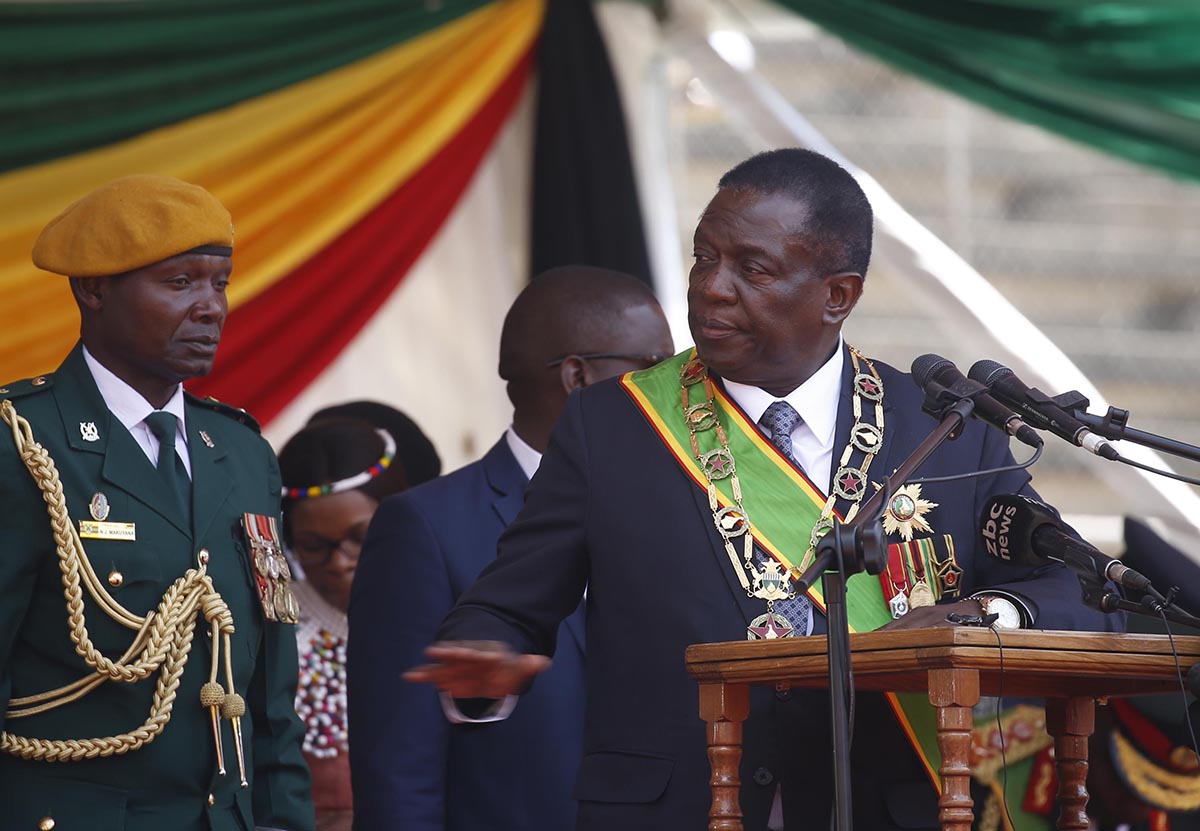
HARARE — The political landscape of Zimbabwe is currently experiencing a seismic shift that many are describing as the most significant challenge to President Emmerson Mnangagwa’s authority since he assumed power in 2017. The long-debated “ED 2030” agenda, a concerted effort by loyalists within the ruling ZANU-PF party to extend the President’s tenure, appears to have hit an immovable object: the very military establishment that once paved his way to the State House. In a stunning and unprecedented intervention, a powerful group of retired military generals and liberation war commanders has formally demanded that any changes to the presidential term limits must be subjected to a national referendum, effectively signalling the “end of the road” for the President’s controversial term extension plans.
The intervention came in the form of a detailed and emotionally charged submission to Parliament on March 12, 2026. The group, which includes some of the most decorated figures from Zimbabwe’s liberation struggle, has made it clear that they view themselves not merely as party members, but as the “stockholders” of the nation’s revolutionary legacy. Their message was unambiguous: while ZANU-PF has the right to manage its internal affairs, the Constitution of Zimbabwe belongs to the people, not to a single political party. This bold stance has fundamentally altered the trajectory of the proposed Constitution Amendment Bill (No. 3) of 2026, which sought to extend the presidential term from five to seven years and allow the incumbent to remain in office until 2030.
The retired generals’ statement, which has been circulating within the corridors of power in Harare, pulls no punches. “We wish to be clear on one matter: we are ZANU-PF. We have always been ZANU-PF. We will die ZANU-PF. We are not merely members, we are stockholders. This is our party, forged in our sacrifice,” the statement begins, establishing their credentials before delivering a stinging rebuke to the architects of the term extension. “ZANU-PF may govern its own internal affairs as it sees fit; that is the party’s sovereign right. But the national Constitution is not ZANU-PF’s property. It belongs to every Zimbabwean including the millions who have never held a party card in their lives.”
This distinction between party and state is at the heart of the current crisis. For months, Mnangagwa’s allies have been pushing the “2030” slogan at every public gathering, arguing that the President needs more time to see his “Vision 2030” economic projects to completion. However, the military commanders, who have historically been the ultimate arbiters of power in Zimbabwe, appear to have grown weary of what they perceive as the “monarchisation” of the presidency. Their intervention is seen by many analysts as a direct challenge to the President’s inner circle, who have been accused of driving these constitutional changes for personal enrichment and the consolidation of power.
The proposed Constitution Amendment Bill (No. 3) is a complex piece of legislation that goes far beyond a simple term extension. If passed in its current form, it would not only increase the presidential term to seven years but would also scrap the direct popular election of the President. Instead, the President would be elected by a joint sitting of Parliament—a move that critics say would strip the Zimbabwean people of their most fundamental democratic right. Furthermore, the bill contains a controversial clause intended to bypass Section 328(7) of the 2013 Constitution. This section explicitly states that any amendment extending a term limit cannot benefit the person who held the office at the time the amendment was made.
The government’s justification for these sweeping changes has been met with widespread scepticism. According to the memorandum attached to the bill, the extension is necessary to “eliminate election mode toxicity and allow sufficient time for project implementation.” Legal experts and civil society groups, however, have dismissed these arguments as a thin veil for a power grab. “The toxicity of elections has nothing to do with their frequency,” noted a recent analysis by Veritas, a prominent legal watchdog. “If a government fails to carry out its projects in five years, it should go back to the voters and justify its failure, so that the voters can either renew its mandate or give another party a chance to do better.”
The retired generals have echoed these sentiments, framing the issue as a matter of honour and a betrayal of the fallen heroes of the liberation struggle. “We commanded and led men and women into combat. We looked them in the eye and told them that their sacrifice would not be in vain, that their children would inherit a Zimbabwe governed by the people, for the people,” the generals’ statement continues. “Many of those comrades never came home. They are buried in the soil of this country and in foreign lands. They died with our promise in their ears. Do the architects of these amendments wish to make liars of us? Do they wish us to stand at the graves of our fallen and admit that what we told them was false? That will not happen. Not while we still draw breath.”
The timing of the military’s intervention is critical. Zimbabwe has been on edge for months, with tensions rising as the “2030” campaign gathered momentum. In April 2025, at least 95 people were arrested during anti-government protests in Harare, with police using heavy-handed tactics to disperse demonstrators who were calling for the President to respect the two-term limit. More recently, on March 10, 2026, Human Rights Watch released a report detailing a campaign of violence and intimidation against opponents of the term extension bill. The report cited numerous instances of activists being harassed, abducted, and assaulted by suspected state security agents.
The internal frictions within ZANU-PF have also become increasingly visible. While the President’s loyalists have been vocal in their support for the bill, a silent but powerful faction aligned with Vice President Constantino Chiwenga—the former army chief who led the 2017 transition—is believed to be deeply opposed to the extension. The retired generals’ statement is widely interpreted as a proxy for the views of the current military leadership, who are bound by constitutional protocols that prevent them from making public political statements. By speaking out, the retired commanders have provided a voice for the active-duty officers who are concerned about the country’s stability.
The legal battle over the bill is also intensifying. A former opposition legislator and prominent lawyer has filed an urgent application in the Constitutional Court, seeking to block Parliament from considering the term extension clauses on the grounds that they are illegal and unconstitutional. Meanwhile, ZANU-PF legal hawks, led by former COPAC co-chair Paul Mangwana, have been frantically trying to justify the bill, claiming that no referendum is required because the changes merely “elongate the electoral cycle” rather than extending a term limit.
However, the generals’ demand for a referendum has placed the government in a difficult position. “Democracy does not permit one party, however powerful, to reshape the nation’s foundational law without the express consent of the people,” the generals argued. “And democracy demands not only that the majority governs, but that it governs in a manner that protects the rights of the minority. Why should our party, the party in which we are stockholders, bully other citizens, most of whom are not members of any political party at all? We did not fight for ZANU-PF members alone; we fought for the people. We will not move an inch from this position.”
The prospect of a national referendum is a nightmare scenario for the President’s supporters. Given the current economic hardships—characterised by hyperinflation, high unemployment, and a collapsing healthcare system—it is highly unlikely that a majority of Zimbabweans would vote to give the President more time in office. A referendum would also provide a platform for the opposition and civil society to mobilise and challenge the government’s record on a national stage.
As the debate rages on, the influence of the military remains the most decisive factor. In Zimbabwe, the “road to 2030” has always run through the barracks. If the generals have indeed decided that the road ends here, the President’s options are severely limited. The “2030” agenda, once seen as an inevitable progression of Mnangagwa’s rule, now looks like a spent force.
The retired generals concluded their submission with a powerful call to action that has resonated across the political spectrum. “We are not rebelling. We are exercising the most fundamental right in any democracy—the right to speak. We remain loyal to the party, loyal to the nation, and loyal above all to the people of Zimbabwe, in whose name every sacrifice of the liberation struggle was made. We call on Parliament to do the right thing and submit these proposed amendments to a national referendum, as democratic principles demand. Anything less is not a constitutional amendment. It is a betrayal—not of us, but of every Zimbabwean who ever dared to hope for a better country.”
For now, the bill remains in Parliament, but the political cost of pushing it through has become prohibitively high. The intervention of the “stockholders” has reminded the nation that power in Zimbabwe is not a personal possession, but a trust that can be revoked when those who hold the guns feel that the original promise of the revolution is being betrayed. The road to 2030 may have reached its end, but the struggle for the soul of Zimbabwe’s democracy is only just beginning.
|
Key Stakeholder
|
Position on Amendment Bill No. 3
|
Primary Argument
|
|
ZANU-PF Loyalists
|
Strongly Support
|
Continuity and stability are needed for “Vision 2030” projects.
|
|
Retired Military Generals
|
Strongly Oppose
|
Demanding a referendum; Constitution belongs to all citizens, not just the party.
|
|
Legal Experts (Veritas)
|
Oppose
|
Bill violates Section 328(7) and requires a national referendum to be legal.
|
|
Civil Society / Church Leaders
|
Oppose
|
Warn against “hijacking the nation” and weakening democratic accountability.
|
|
Active Military Factions
|
Divided / Silent
|
Concerns over stability and the “monarchisation” of the presidency.
|
The coming weeks will be crucial as Parliament decides whether to heed the generals’ call or risk a direct confrontation with the military establishment. One thing is certain: the “2030” dream is no longer the undisputed path forward, and the “Powerful Army Generals” have ensured that the voice of the people—via a referendum—can no longer be ignored.