


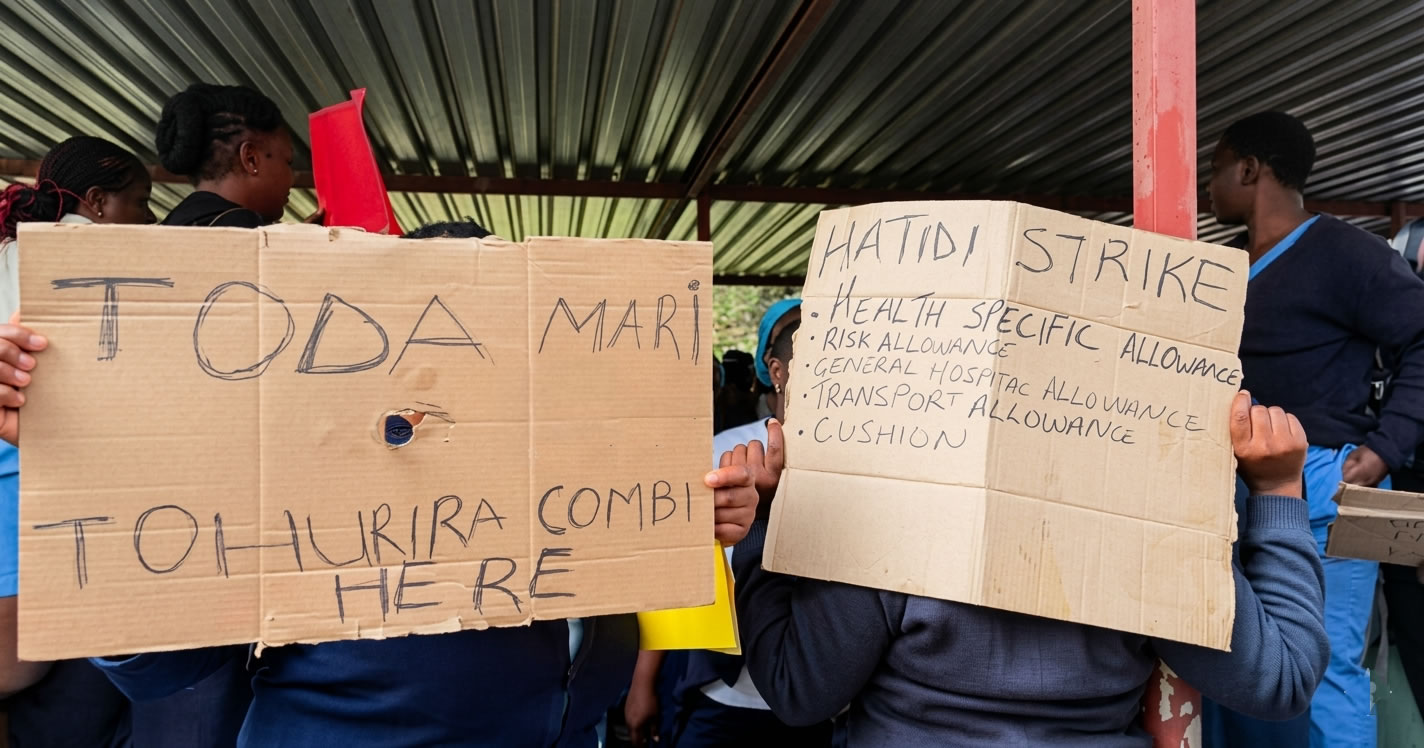
HARARE — The rhythmic thud of feet against the dusty pavement outside Sally Mugabe Central Hospital on March 20, 2026, was not the sound of a routine shift change. It was the sound of a “flash toyi-toyi,” a spontaneous outburst of collective desperation from the very people tasked with keeping Zimbabwe’s heart beating. As nurses sang and danced under the sweltering sun, their placards told a story that the official government press releases have spent months trying to bury.
The protest was triggered by a sudden surge in fuel prices, with petrol jumping from $1.52 to $2.17 per litre in a single month. For a nurse earning a mix of United States dollars and the local ZiG currency—averaging a mere $450 per month—this was the final straw. “Nurses want to work, but coming to work is now a challenge,” explained Belcred Farai Matsiwe, a representative of the Zimbabwe Nurses Association (ZINA) at the hospital. The government provides a transport allowance of ZiG500, roughly $15, yet many nurses now face a daily commute costing $6. The maths simply does not work.
However, our investigation reveals that the anger on the streets of Harare is about far more than the price of a bus fare. It is a response to a healthcare system that has been hollowed out from the inside, leaving behind a shell of a service where “care” is a luxury that few can afford. Behind the hospital’s high walls, a “conspiracy of silence” has taken hold. Multiple sources within the administration, speaking on condition of anonymity for fear of their lives and livelihoods, have confirmed that hospital managers are under strict orders. “If you speak to a journalist about the lack of paracetamol or the broken radiotherapy machines, you are gone,” one senior administrator told us. “The threat of dismissal is not just a rumour; it is the first item on the agenda in every management meeting.”
This forced silence hides a grim reality. Inside the wards, the staff-to-patient ratio has reached a point that is physically impossible to maintain. In some departments, a single nurse is expected to monitor upwards of forty patients, many of whom are in critical condition. “We are being told to work for the love of the country,” one nurse said, her voice cracking with emotion. “But the love of my country cannot buy a loaf of bread for my children. I am watching patients die because we don’t even have basic painkillers. How can I love a system that treats us like disposable tools?”
The government’s response to this crisis has been a masterclass in deflection. George Charamba, the presidency spokesman, took to social media to plead for calm. “Patience, patience macomrades: Good tidings are coming both on the fuel front and salaries for civil servants,” he wrote, blaming “disturbances in the Middle East” for the local economic turmoil. But for the nurses at Sally Mugabe Central, formerly known as Harare Hospital, “patience” is a commodity that ran out years ago. They have now resolved to boycott night duties entirely. “The night duty allowance doesn’t make sense,” said Kumbirai Maresva, ZINA’s provincial organising secretary for Harare. “We have agreed to work from 7AM to 4PM. For night duties, we have agreed to stop coming to work”.
|
Economic Metric
|
Previous Rate
|
Current Rate (March 2026)
|
|
Petrol Price (per litre)
|
$1.52
|
$2.17
|
|
Monthly Nurse Salary (Avg)
|
–
|
$450 (Mixed Currency)
|
|
Daily Commute Cost
|
$2.00
|
$6.00
|
|
Monthly Transport Allowance
|
–
|
ZiG500 (Approx. $15)
|
The true scandal, however, lies in what appears to be a deliberate strategy of neglect. While the public health sector crumbles, private clinics are flourishing. Our investigation has uncovered a disturbing trend where the “brain drain”—the exodus of thousands of Zimbabwean nurses to the United Kingdom and Australia—is not just an unfortunate side effect of a bad economy, but a calculated move. By refusing to pay a living wage and allowing public infrastructure to rot, the government is effectively forcing the healthcare sector towards privatisation.
This shift benefits a small, elite group of private clinic owners who maintain high-level political ties. While a mother at Harare Hospital might be told there is no bed for her child, a new “elite” hospital wing across town, recently upgraded despite legal challenges over its funding, offers world-class care to those who can pay in hard currency. The government’s recent decision to pull out of a $367 million health funding deal with the United States, citing “sovereignty” concerns, has only deepened the crisis. This funding was intended to replace critical programmes for malaria, tuberculosis, and HIV/AIDS, but it was rejected by the leadership in a move that many health experts call a death sentence for the poor.
The conditions inside the public wards are nothing short of harrowing. Machines that should be saving lives sit idle, covered in dust because there are no spare parts or technicians to fix them. Basic supplies like bandages, syringes, and even clean water are frequently unavailable. Nurses often have to ask patients’ families to go out and buy their own surgical gloves and needles before a procedure can begin. This is the “hidden mechanics” of the collapse: a slow, agonizing transition where the state abdicates its responsibility to its citizens, leaving them at the mercy of a predatory private market.
The government continues to use patriotic rhetoric to guilt-trip its workforce. First Lady Auxillia Mnangagwa recently hailed nurses as the “lifeblood of the nation,” urging them to maintain their “strength and courage”. Yet, these same “lifeblood” workers are frequently threatened with arrest if they participate in organised strikes. The passing of controversial laws that curb the right of healthcare workers to take industrial action has left many feeling like indentured servants rather than professional medics.
“They want us to be silent while the system burns,” said a midwife who has worked at Harare Hospital for over twenty years. “They tell the world that everything is fine, that the ZiG is stable, and that the hospitals are functioning. But we are the ones who have to tell a father that his daughter died because we didn’t have the oxygen to save her. We are the ones who see the truth every single day”.
The “flash toyi-toyi” on March 20 was a brief moment of visibility for a struggle that usually happens in the shadows. By walking out for even a few hours, the nurses forced the nation to look at the cracks in the foundation. The government’s plea for “patience” rings hollow when the cost of living continues to spiral and the elite continue to seek medical treatment in Singapore or Dubai, leaving the rest of the population to rely on a system that is, by all accounts, on the verge of total collapse.
The “conspiracy of silence” may keep the hospital administrators quiet, and the threats of dismissal may keep the wards staffed for now, but the spirit of the toyi-toyi suggests that the breaking point has been reached. As the nurses return to their 7AM to 4PM shifts, the empty corridors during the night will serve as a haunting reminder of a government that has chosen to prioritise political survival and private profit over the lives of its people.
The question that remains is how much longer a nation can survive when its “lifeblood” is being systematically drained. For the nurses of Harare, the answer is clear: they can no longer afford to work for the “love of the country” when that country no longer loves them back.
Summary of Recent Incidents and Context
|
Event
|
Date
|
Impact
|
|
Flash Toyi-Toyi Protest
|
20 March 2026
|
Nurses resolve to boycott night duties due to low pay and high fuel costs.
|
|
US Health Deal Withdrawal
|
February 2026
|
Government rejects $367m in funding, citing sovereignty, risking major health programmes.
|
|
Fuel Price Hike
|
March 2026
|
Petrol rises to $2.17/L, making commuting unaffordable for civil servants.
|
|
Brain Drain Crisis
|
2024-2026
|
Continued mass exodus of healthcare professionals to the UK and Australia.
|
This investigation shows that the crisis is not merely a result of “global supply disruptions” as claimed by the presidency. It is a man-made disaster, fueled by a refusal to invest in the public good and a desire to enrich a well-connected few at the expense of the many. The “flash toyi-toyi” was not just a protest; it was a warning. And it is a warning that the government ignores at its own peril.