


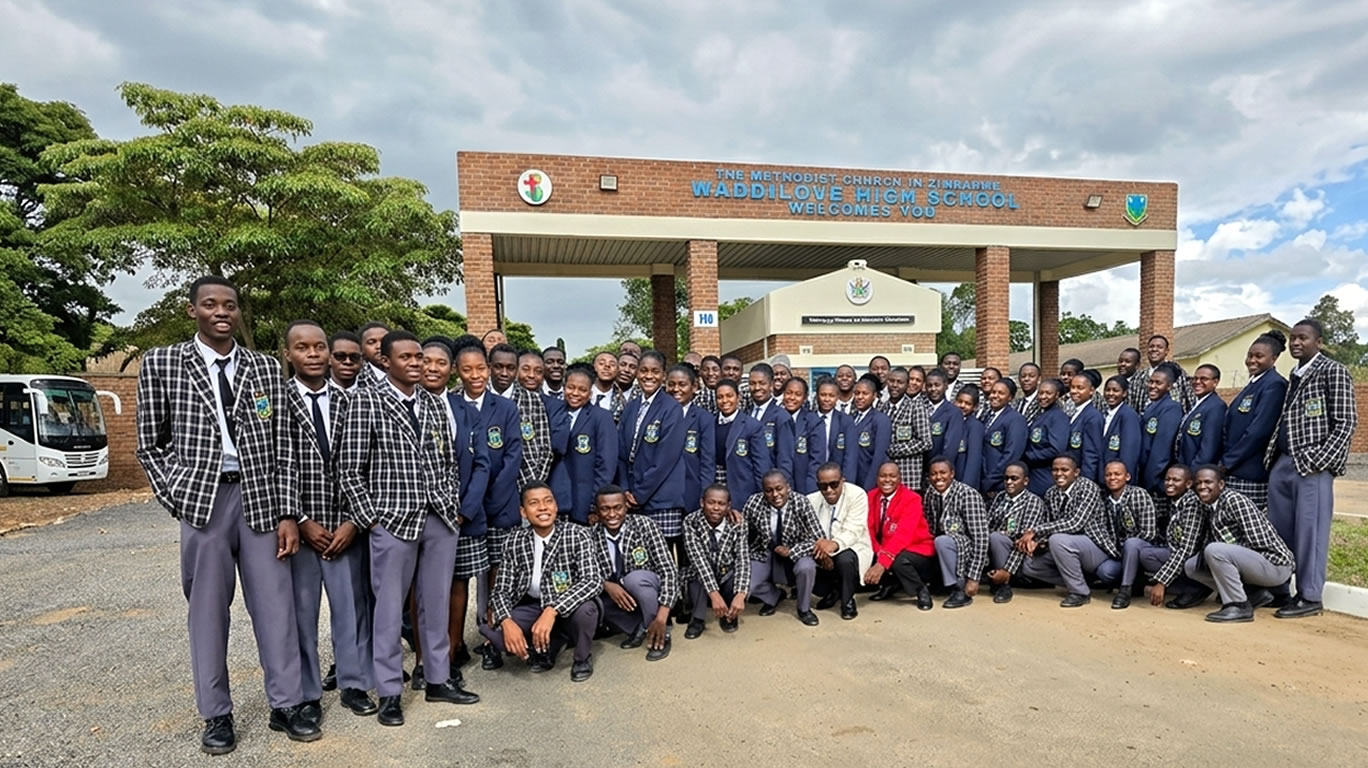
HARARE – The Harare International Conference Centre (HICC) was a sea of academic regalia and celebratory fanfare last week as the Ministry of Primary and Secondary Education hosted its annual awards ceremony. Amidst the glittering lights and the presence of Vice President Kembo Mohadi, one name echoed more frequently than any other: Waddilove High School. The Marondera-based institution, a long-standing bastion of Methodist education, secured a triple crown of accolades, including the coveted Best Ordinary Level School (National Award), Best Special Needs Education Ordinary Level School Award, and the Best Ordinary Level School (Provincial Level).
Yet, behind the “colourful ceremony” and the triumphant smiles of headmaster Charles Gwenda, lies a complex tapestry of a national education system in the throes of its most significant transformation in decades. As Waddilove celebrates a near 100 per cent pass rate, the broader sector is grappling with the controversial transition to the Heritage-Based Curriculum (HBC) and a brewing storm of industrial unrest amongst the nation’s educators.
A Legacy of Excellence
Waddilove High School is no stranger to the limelight. Established in 1891 by the Methodist missionary John White and named in honour of Sir Joshua Kelley Waddilove, the school has spent over a century evolving from a humble training centre into a premier boarding facility. Its performance in the 2025 Zimbabwe Schools Examination Council (ZIMSEC) results has been nothing short of extraordinary.
The school’s commitment to inclusivity was also on full display. As an inclusive institution, Waddilove saw all of its visually impaired learners who sat for the 2025 O-Level examinations pass with flying colours. Reverend Daniel Muzenda, the Methodist Church in Zimbabwe (MCZ) secretary for education and academics, described the recognition as a “great honour.”
“This is a great honour from government and we are happy as a church when government acknowledges such excellent performance,” Reverend Muzenda stated. “This honour is attributed to the hard work of the school management, teaching and non-teaching staff, and the support from the church as the responsible authority. Also, as MCZ schools, our motto is a beacon of excellence.”
The Methodist Dominance
The success of Waddilove is part of a broader trend of Methodist-run schools dominating the national rankings. In the early 2025 ZIMSEC results, the MCZ “trio” – Waddilove, Sandringham, and Moleli – saw a staggering 258 candidates achieve 15 points or better at A-Level. This performance places these mission schools at the vanguard of Zimbabwean education, often outperforming government-run institutions that are struggling with resource constraints.
Other notable performers highlighted during the ceremony included Corpus Christ High School, where 84 out of 105 candidates scored 10 points or more, alongside exceptional results from Rufaro High School and Gwanda High School. However, the consistent dominance of mission schools raises questions about the widening gap between these well-supported institutions and the underfunded public schools, particularly those in rural and marginalised areas.
The Heritage-Based Pivot
The awards ceremony served as a platform for the government to champion its latest educational reform: the Heritage-Based Curriculum (HBC) Framework 2024-2030. This new framework marks a definitive shift away from the previous Competency-Based Curriculum and its controversial Continuous Assessment Learning Activities (CALA).
The HBC places a heavy emphasis on skills development, problem-solving, innovation, entrepreneurship, patriotism, and the traditional concept of Ubuntu. Under this new framework, learners are expected to acquire practical competencies designed to prepare them for employment, self-reliance, and economic productivity.
Vice President Kembo Mohadi, the guest of honour at the HICC event, reiterated the government’s commitment to these reforms. The state has intensified teacher training programmes and strengthened continuous assessment systems. Furthermore, there has been a concerted effort to roll out ICT infrastructure and digital learning tools, with a specific focus on bridging the digital divide in rural communities. These interventions are being bolstered by expanded partnerships with development agencies to improve access to textbooks and school infrastructure.
The Investigative Reality: A Sector Under Strain
However, the “colourful” narrative presented at the HICC is only one side of the story. While the government honours top-performing schools, a “storm is brewing” in the staffrooms across the country. Teacher unions, most notably the Amalgamated Rural Teachers Union of Zimbabwe (ARTUZ), have expressed deep-seated concerns that the new Heritage-Based Curriculum uncomfortably mirrors the ruling party’s political manifesto.
Critics argue that the imposition of “heritage studies” as a compulsory subject was done without broad national consultation. There are fears that the subject is being used for political expediency rather than genuine educational reform. More pressingly, the success of any curriculum depends on the people delivering it – and Zimbabwe’s teachers are increasingly demotivated.
As recently as late March 2025, teacher unions issued an ultimatum to the government over “poverty wages” and deteriorating working conditions. While the headmaster of Waddilove receives certificates of excellence, thousands of his colleagues across the nation are threatening job action. The disconnect between the high-achieving “islands of excellence” like Waddilove and the systemic struggles of the average Zimbabwean teacher is a gap that the government has yet to bridge.
Integrity and Infrastructure
The 2025 examination cycle was also notable for what did not happen: widespread paper leakages. In previous years, ZIMSEC has been plagued by scandals, with thousands of results cancelled in 2022 due to massive leaks. While the government hailed 2025 as a “leak-free” year, the underlying issues of exam integrity remain a point of contention. Malpractice cases were still recorded, and the pressure on students to perform in a high-stakes environment continues to drive desperate measures.
Furthermore, the government’s push for “digitalisation” faces a harsh reality on the ground. While Waddilove may have the support of the Methodist Church to maintain its ICT infrastructure, many rural schools still lack basic electricity, let alone high-speed internet. The transition to a “Heritage-Based” model that requires digital tools risks further marginalising students who are already on the wrong side of the digital divide.
The Road Ahead
Waddilove High School stands as a testament to what can be achieved through consistent management, church support, and a culture of excellence. Its success is well-deserved and provides a glimmer of hope for the nation’s youth. However, as investigative scrutiny reveals, the “honour” bestowed by the government must be viewed in context.
The Zimbabwean education sector is at a crossroads. The transition to the Heritage-Based Curriculum is a bold attempt to reimagine learning for the 21st century, but without national consensus and a motivated teaching force, it risks meeting the same fate as the scrapped CALA system. For now, Waddilove remains a “beacon of excellence,” but for the rest of the country, the path to such high standards remains fraught with economic and systemic obstacles.
As the delegates departed the HICC, the echoes of the awards ceremony faded, replaced by the sobering reality of a sector that requires more than just certificates to thrive. The success of a few schools, no matter how brilliant, cannot mask the urgent need for a holistic approach to teacher welfare and equitable resource distribution across all of Zimbabwe’s schools.
|
School Name
|
Candidates
|
Pass Rate (%)
|
Notable Achievements
|
|
Waddilove High School
|
212
|
98.6%
|
37 students with 10+ As; 2 students with 15 As
|
|
Corpus Christ High
|
105
|
N/A
|
84 students scored 10+ points
|
|
Sandringham High
|
N/A
|
High
|
Part of the 258 candidates with 15+ points (A-Level)
|
|
Moleli High
|
N/A
|
High
|
Part of the 258 candidates with 15+ points (A-Level)
|
|
Pillar
|
Focus Area
|
|
Skills Development
|
Practical competencies for employment and self-reliance.
|
|
Innovation
|
Encouraging problem-solving and entrepreneurial thinking.
|
|
Patriotism & Ubuntu
|
Fostering national identity and community-centric values.
|
|
Digital Literacy
|
Integration of ICT and digital learning tools nationwide.
|