


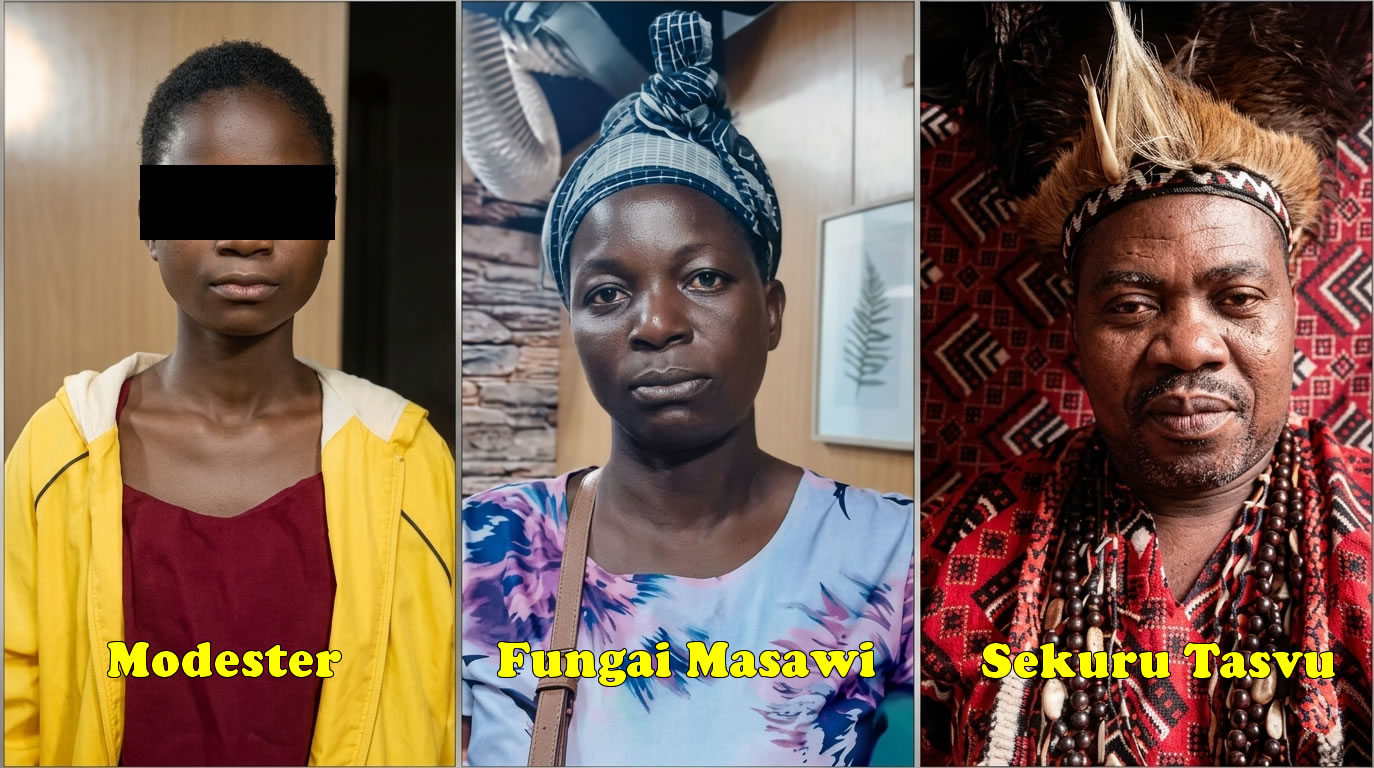
A Child’s Ordeal: Unravelling Allegations of Ritual Abuse in Rural Zimbabwe
In the quiet, often overlooked villages of Zimbabwe, stories sometimes emerge that challenge belief and expose the darkest corners of human experience. One such harrowing account comes from Guruve, a district in Mashonaland Central, where a 13-year-old girl, we now identify as Modester to protect her real identity, alleges years of ritualistic abuse at the hands of her own grandmother. Her story, a disturbing blend of the mundane and the supernatural, paints a grim picture of vulnerability and fear, further complicated by the region’s recent history of violence and alleged ritualistic crimes.
Modester’s ordeal began when she was sent to live with her maternal grandparents in Chief Chiripanyanga’s village, under Chief Chipuriro, in Guruve. From the tender age of seven, throughout her primary school years, she claims she was forced into a bizarre and unsettling ritual. “My mother sent me to the village to live with my grandmother and grandfather, where we were six children, including my older brother and other grandchildren. From Grade One to Grade Seven, as I attended school there, my grandmother would force me to climb the wild loquat tree (muzhanje) in the yard and urinate in the same spot,” Modester recounted. The purpose of this eight-year-long ritual remained a mystery to her, as she was never given a clear explanation.
The Haunting Voices and Spectral Figures
The alleged physical ritual was soon accompanied by terrifying supernatural experiences. Modester described hearing voices calling her name at night, compelling her to venture outside. “During this time, I started hearing voices of people calling me outside at night. When I went out, pushed by a spirit I didn’t know, I would see many people in the field, looking down,” she stated. These spectral figures, she noted, were of all ages, men and women, dressed in black, and remained silent. A female voice, she recalled, would often call her in the dead of night when these apparitions appeared. Even after being removed from the village and relocated to Harare, these nocturnal visitations persisted. “I live with my mother at home with other children, but at night I hear people coming and calling me, and I go out. I see men and women, but they don’t talk to me,” Modester explained. The unsettling phenomena extended indoors, where she claimed to see people unseen by others, accompanied by a strong wind. “Sometimes I feel a very strong wind blowing in the house, and then I know those people have come. I see these people opening and closing doors and walking in the passage of the house. If I try to talk to them, they don’t answer,” she added.
The Disappearing Soil and a Mother’s Desperation
Adding to the mystery was the fate of the soil where Modester was allegedly forced to urinate. She observed that the soil would be left for months to dry before mysteriously disappearing. “The soil from where I urinated could be left for many months to dry, and then suddenly it would disappear,” she said, unaware of its destination. Modester also revealed that some of her cousins living with them experienced similar problems. Eventually, she and her siblings were taken from Guruve to Harare, where she is now attending Form One.
Fungai Masawi, Modester’s 41-year-old mother, confirmed the distressing reports. She had sent her children to the village after their Mozambican father passed away and she separated from him. “I sent these children to the village to my aunt who lived there,” Masawi explained. The alarming news of her daughter seeing people at night and the grandmother’s alleged tree ritual prompted her to retrieve the children last year. Despite attempts to resolve the issue with village elders, nothing was settled. Masawi described the ongoing torment her daughter faces: “Since this child was in the village until now that we are living together in Harare, she hears sounds of people she doesn’t see, and sometimes she sees them. She also hears voices calling her and doors being opened. After she hears these voices, including the wind that will be blowing, she starts to have headaches and eye pain.” The situation has severely impacted Masawi’s personal life, making it difficult to live peacefully with her current husband. She also recounted another horrific incident from the village: “While in the village, this child was once poured urine on her head and face by her grandmother, and her head and face swelled up at that time.” Furthermore, Masawi spoke of a chair in the village home that reportedly moved on its own, and a man who would appear, crying like a cat, causing the children to flee in terror. Exhausted by visits to traditional healers and prophets who offer varied explanations, often attributing her daughter’s experiences to a spirit of seeing evil things, Masawi expressed her frustration. She also revealed a personal tragedy, stating, “I don’t know my mother. I only saw her grave when I was escorted by my grandfather and this aunt to Chinhoyi.”
Grandmother’s Firm Denial
Rosemary Chapfunya, the 64-year-old grandmother, vehemently denied all allegations. “These children, one was born here (in Guruve), one came when she was two years old, they grew up here,” she stated, asserting her long-standing care for them. She dismissed the claims of forcing Modester to urinate in the wild loquat tree (muzhanje), the nocturnal visitations, and the incident of pouring urine on the child as outright falsehoods. “The things about me making this child climb a tree and telling her to urinate in the same spot and everything else that is being said, I don’t know about them. Even the things about her being called by people and seeing them when she goes outside, and the things about me pouring urine on her, those are lies,” Chapfunya insisted. She maintained that she only learned of Modester’s problems, specifically seeing a person in a worksuit, after the children had moved to Harare in October of the previous year. Chapfunya offered her own theory regarding the children’s ailments, suggesting they became sick with seizures after attending their father’s funeral in Mozambique. “The mother of this child went to her husband’s funeral in Mozambique with these children. When they came back, these children were now sick, having seizures. I told her that she should not have taken these children to Mozambique. Where this problem is coming from is no longer known,” she posited, hinting at an external origin for their troubles.
A Traditional Healer’s Grave Warning
Sangoma Sekuru Tasvu, a veteran traditional healer from Harare, offered a chilling interpretation of Modester’s experiences. He suggested that the case involved a high level of black magic. “This is a wealth ritual that was being done to this child. The people she is seeing calling her mean that she was initiated into witchcraft activities,” Sekuru Tasvu claimed. His assessment points to a sinister motive behind the alleged abuse, linking it to practices aimed at acquiring wealth or power through dark rituals.
Guruve’s Shadow: A Disturbing Coincidence
The tragic narrative of Modester unfolds against a backdrop of disturbing events in the Guruve district. Recent news reports from January 2026 detail the trial of a suspected serial killer, Anymore Zvitsva, accused of murdering 19 people over a 10-month period in Guruve. Chillingly, one of the victims identified in court documents is a “Modester Isaac,” killed in April 2025 at Nyakapupu, Guruve. While it is not definitively confirmed that the Modester in this article is the same Modester Isaac from the serial killer case, the shared name, age, and location present a deeply unsettling coincidence. The court heard that Zvitsva confronted Modester Isaac as she herded cattle, forced her into a bush at knifepoint, and raped her. This horrific detail, if linked to the girl in our story, would add an unimaginable layer of trauma to her already alleged ritualistic abuse. The prevalence of such violent crimes, often with suspected ritualistic undertones, highlights a severe issue within the region. Reports from early 2026 also indicate a broader concern about ritual violence and witchcraft accusations in Zimbabwe, with traditional healers like Sekuru Tasvu gaining public attention for their involvement in tackling such complex cases.
The Wider Scourge of Child Abuse and Witchcraft Beliefs
Modester’s story, whether viewed through the lens of alleged ritual abuse or as a potential precursor to a more heinous crime, underscores a pervasive problem in some parts of Africa: the accusation of witchcraft and subsequent abuse of children. Thousands of children across the continent reportedly suffer ritual abuse annually, with those having albinism often being primary targets. While the specifics of Modester’s case differ, the underlying belief in witchcraft and its potential exploitation for malevolent purposes remains a common thread. In Zimbabwe, as in other nations, such beliefs can lead to severe human rights violations, particularly against vulnerable children. The complexity of these cases is often compounded by the involvement of traditional healers, whose interpretations can either help or, in some instances, inadvertently perpetuate harmful practices. The lack of clear resolution in Modester’s case, as noted by her mother, reflects the challenges faced by families attempting to navigate these deeply entrenched cultural and spiritual beliefs within the formal justice system.
A Call for Protection and Justice
The conflicting accounts from Modester, her mother, and her grandmother, coupled with the traditional healer’s stark assessment and the grim backdrop of serial killings in Guruve, paint a picture of a community grappling with profound social and spiritual challenges. Modester’s alleged experiences, whether rooted in ritual, psychological distress, or a combination thereof, demand urgent attention. The potential link to the Modester Isaac who was a victim of the Guruve serial killer further amplifies the need for thorough investigation and protection for children in vulnerable situations. As authorities continue to address violent crime in the region, the deeper issues of alleged ritual abuse and the exploitation of traditional beliefs must also be confronted to safeguard the well-being of children like Modester.