


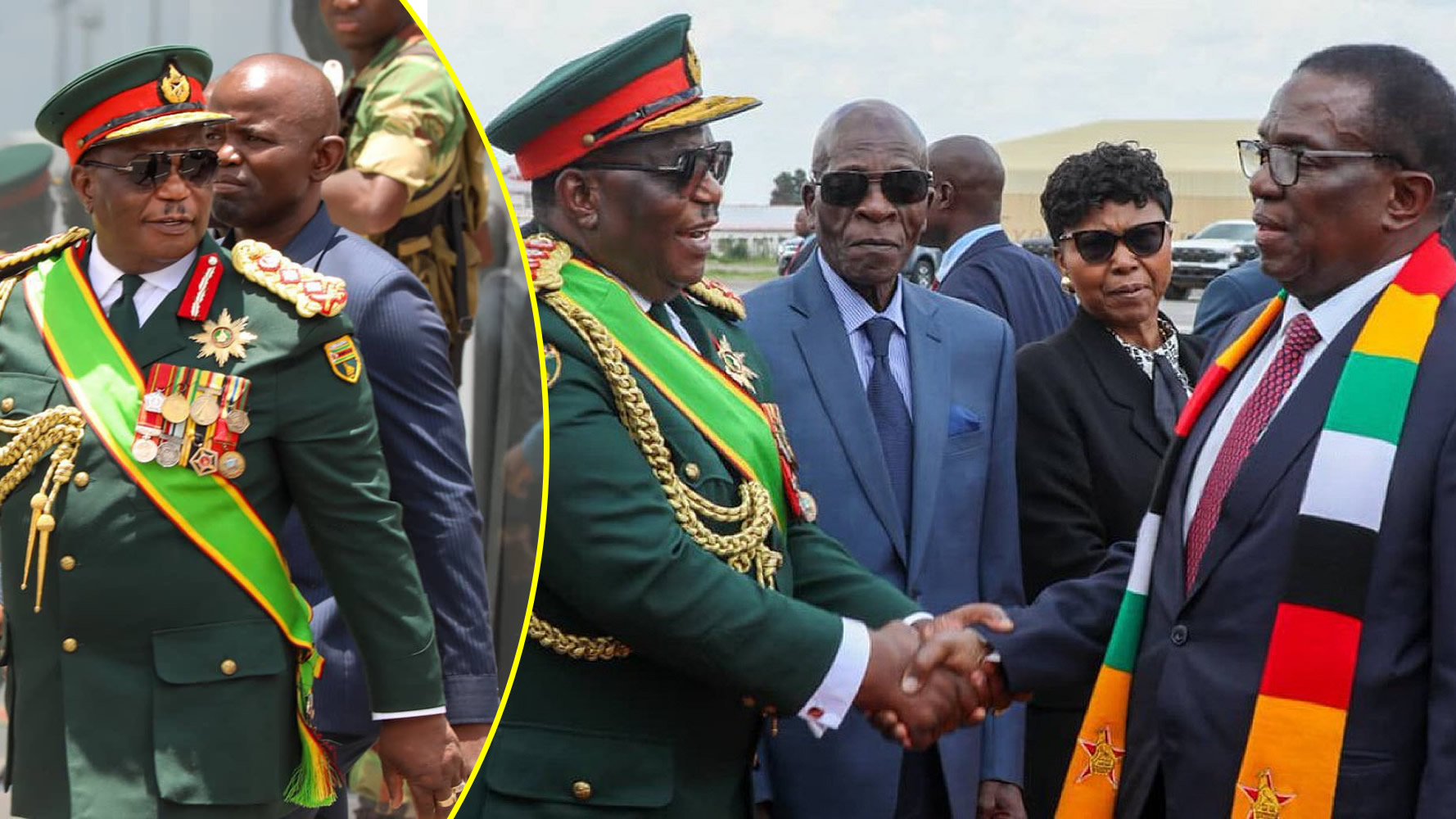
Harare – A simmering power struggle within Zimbabwe’s ruling Zanu PF party has erupted into a dangerous confrontation, with Vice President Constantino Chiwenga at the centre of an alleged plot to unseat him. The escalating tensions, marked by public spats, leaked dossiers, and veiled warnings, paint a vivid picture of a political landscape fraught with instability, reminiscent of the events that led to the ousting of former President Robert Mugabe in 2017.
At the heart of this high-stakes battle is President Emmerson Mnangagwa’s perceived ambition to extend his tenure beyond the constitutionally mandated two terms, a move vehemently opposed by his deputy, General (Retired) Constantino Chiwenga. The proposed Constitutional Amendment Bill No. 3 (CAB3), which seeks to push Mnangagwa’s rule to 2030, has become the flashpoint, exposing deep fissures within the party’s elite and igniting a fierce debate across the nation.
Vice President Chiwenga, a towering figure in Zimbabwean politics and a key architect of the 2017 military intervention, has positioned himself as the guardian of the liberation struggle’s core principles. He has embarked on a renewed campaign, asserting that the fight for Zimbabwe’s independence was primarily for land and the sacred principle of “one-man, one-vote.” This stance directly challenges Mnangagwa’s proposed constitutional changes, which Chiwenga views as an affront to these foundational tenets. The Vice President insists that any amendments to presidential term limits must be subjected to a national referendum, a demand that has been hotly contested within Zanu PF circles.
Mnangagwa’s faction, however, argues that a referendum is unnecessary, contending that the proposed changes do not remove term limits but merely alter the electoral cycle. This argument has been met with strong opposition from civil society organisations and opposition parties, who maintain that elongating Mnangagwa’s tenure requires direct public endorsement through a referendum. The debate over CAB3 has triggered significant controversy, highlighting a fundamental disagreement on the interpretation of democratic principles and the legacy of the liberation struggle.
The implications of an indirect presidential election system, as proposed by Mnangagwa’s camp, have also become a major point of contention. While there is no dispute that the Zimbabwean struggle was fought for land and unqualified franchise, opinions diverge sharply on whether such a system violates the “one man one vote” principle. Critics argue that it reduces voters to mere spectators in the election of their president, thereby undermining the democratic essence of universal adult suffrage. Proponents, however, contend that it merely deepens voters’ right to elect Members of Parliament who, in turn, vote for the President, citing examples like Botswana and South Africa where similar systems are in place. This nuanced debate has deeply divided national opinion, further exacerbating the tensions between the two political heavyweights.
President Mnangagwa, with the backing of Zanu PF and the government, appears determined to extend his rule beyond 2028 to 2030 and implement a series of changes aimed at revamping the political, electoral, and governance systems. A key aspect of these proposed changes is the shift from a direct presidential election system to one where the president is chosen through parliament. Historically, Zimbabwe, following its independence from Britain in 1980, elected its prime minister for a five-year term through parliament under the Lancaster House constitution. A ceremonial president was also elected by parliament for a renewable six-year term, a role famously held by the late Canaan Banana from 1980 until 1987. The constitution was later amended in 1987 to abolish the separate roles of President and Prime Minister, establishing an executive presidency under Robert Mugabe. This historical context adds another layer of complexity to the current debate, with Chiwenga’s faction viewing the proposed changes as a regressive step that undermines the democratic gains of the past.
Chiwenga’s Unwavering Resolve: A History of Defiance
General Chiwenga’s current stance against Mnangagwa is not an isolated incident but rather a continuation of a pattern of bold and fearless actions that have defined his career. His history reveals a man unafraid to challenge authority, even that of a sitting president.
One of the most telling episodes dates back to 2012, when then-President Robert Mugabe reportedly attempted to retire Chiwenga from his position as Commander of the Zimbabwe Defence Forces (ZDF). Chiwenga, who had been appointed to the role on 1 January 2003, should have retired by 31 December 2012, as a service chief is not meant to hold the position for more than 10 years. However, Chiwenga reportedly refused to go, leaving Mugabe helpless and clueless. This defiance ultimately paved the way for the military intervention in November 2017, which Chiwenga spearheaded, leading to Mugabe’s resignation and Mnangagwa’s ascent to power.
Chiwenga’s fearlessness has been evident in more recent incidents as well. On 3 July 2025, during a Zanu PF Central Committee meeting, Chiwenga publicly instructed businessman Kudakwashe Tagwirei to leave the gathering, stating that Tagwirei had not been officially co-opted into the committee. This public dressing-down of a powerful figure, widely known for his close ties to Mnangagwa, sent a clear message about Chiwenga’s authority and his willingness to confront those he perceives as undermining party protocols.
Further demonstrating his unwavering resolve, Chiwenga has not shied away from confronting Mnangagwa directly on matters of corruption. In an explosive Politburo meeting on 17 September 2025, Chiwenga reportedly presented a 17-page dossier detailing grand corruption by Mnangagwa’s monied allies. The dossier named prominent figures such as Kudakwashe Tagwirei, Wicknell Chivhayo, Delish Nguwaya, and Scott Sakupwanya, accusing them of siphoning over US$3.2 billion from state coffers through shadowy deals.
In a powerful and direct statement, Chiwenga reportedly told Mnangagwa, “Comrade President, tirikuti vanhu ava, Kudakwashe Tagwirei, Wicknell Chivhayo, Scott Sakupwanya, and Delish Nguwaya, and their associates, ngavasungwe, immediately for these unprecedented crimes they have committed.” He further warned, “Comrade President, the time for silence and inaction is over, and we cannot allow these criminals who have stolen from our Government coffers and our Party to start using the same resources to bribe fellow comrades and our structures to get their support, defend and protect them.” This stark warning underscored the gravity of the situation and Chiwenga’s determination to address what he saw as a betrayal of the liberation struggle’s ideals.
Mnangagwa’s camp, however, quickly hit back. On 14 October 2025, a rebuttal authored by Zanu PF’s legal secretary and Justice Minister Ziyambi Ziyambi branded Chiwenga’s dossier as “fundamentally flawed, treasonous, and lacking appreciation of party procedures and the national constitution.” Ziyambi accused Chiwenga of attempting to “monopolise credit for the coup” and revealed that Tagwirei had reportedly bankrolled the 2017 operation with five million litres of fuel, food, and US$1.6 million to the party. This exchange highlighted the deep personal and political animosity between the two leaders.
The King Hezekiah Parable: A Prophetic Warning
The simmering tensions between Mnangagwa and Chiwenga were brought into sharp public focus by a sermon delivered by the Vice President. Chiwenga referenced the biblical story of King Hezekiah, who was granted an additional fifteen years of life by God. However, Hezekiah’s extended tenure reportedly led to negative consequences for his successors. This parable was widely interpreted as a thinly veiled warning to President Mnangagwa about the dangers of clinging to power beyond his mandated term. The message resonated deeply within political and social circles, sparking calls for Chiwenga’s resignation from outspoken politician Temba Mliswa, who accused the Vice President of undermining Mnangagwa.
However, the Zimbabwe National Liberation War Veterans Association (ZNLWVA), led by chairman Andrease Ethan Mathibela, swiftly came to Chiwenga’s defence. In a statement issued on 29 April 2026, Mathibela dismissed the calls for resignation as “misplaced and legally unfounded,” arguing that Chiwenga had acted within his constitutional rights. “The mere fact that Honourable Vice President Chiwenga occupies high office does not strip him of his identity as a citizen, nor does it curtail his right to worship, to reflect, and to share his faith within a religious setting,” Mathibela stated. He further emphasised that Zimbabwe’s Constitution guarantees freedom of religion, expression, and association, rights which apply to all citizens regardless of their political position. The war veterans also warned against politicising religious spaces, saying doing so risked undermining national unity and democratic values.
Military Uniforms and Secret Meetings: Signs of a Deepening Divide
The power struggle has also manifested in symbolic acts of defiance and heightened surveillance. On 24 November 2025, Chiwenga and several other retired army generals unexpectedly appeared in full ceremonial army uniforms at the inauguration of General Matatu as the new ZDF Commander. This move, widely seen as a powerful display of military solidarity and a reminder of Chiwenga’s continued influence within the armed forces, reportedly caused considerable discomfort to President Mnangagwa and his allies. The sight of the retired generals in uniform was interpreted by many as a subtle but potent warning, recalling the events of 2017.
Adding to the climate of suspicion and mistrust, reports have emerged that the Central Intelligence Organisation (CIO) has reportedly been instructed to monitor Chiwenga’s secret meetings with army generals. This surveillance underscores the deep paranoia within Mnangagwa’s camp regarding Chiwenga’s intentions and his perceived ability to rally support within the military. Rumours of a “Move on Chiwenga” or a “slow coup” have begun to circulate in the dark corners of Zimbabwean politics, suggesting that the internal dynamics of Zanu PF are becoming increasingly volatile.
The Politburo and Cabinet as Battlegrounds
The internal struggle within Zanu PF has frequently spilled into the Politburo, the party’s highest decision-making body outside of Congress, and even into Cabinet meetings. These forums have become battlegrounds where the ideological and power-based differences between Chiwenga and Mnangagwa’s factions are openly aired.
Recent Politburo meetings have been marked by fierce confrontations, laying bare the widening fracture within the ruling party’s inner circle. A particularly notable incident occurred recently, described by sources as a “fierce confrontation” between Vice President Chiwenga and State Security Minister Lovemore Matuke. The clash was reportedly triggered by Chiwenga’s insistence that any revision to presidential term limits must be put to a national referendum. Matuke, a staunch Mnangagwa loyalist, reportedly rounded on the Vice President, accusing unnamed individuals of “contradicting the party position.” Defence Minister Oppah Muchinguri and Zanu PF Commissar Munyaradzi Machacha reportedly sided with Matuke, further isolating Chiwenga within the Politburo.
During this heated exchange, Chiwenga is reported to have reminded the room of his military credentials, stating pointedly that he is a general who fought to liberate the country “while others sought refuge elsewhere to avoid participating in the liberation struggle.” This remark was widely interpreted as a direct jab at President Mnangagwa, whose own liberation war record has been a subject of historical debate and scrutiny. Such direct and personal attacks within the Politburo underscore the intensity and personal nature of the succession struggle.
Further evidence of Chiwenga’s dissent emerged at the funeral of the late Kumbirai Kangai’s wife, where he invoked the principle of “one man one vote.” This public statement was widely interpreted as a veiled rebuke of the amendment drive and Mnangagwa’s “2030 agenda.” Chiwenga has previously characterised the “2030 agenda” – the push to keep Mnangagwa in power past his term limit – as an “assault on the values of the liberation struggle,” driven by individuals bent on “looting the country’s resources.” These strong words highlight the ideological battle being waged, with Chiwenga positioning himself as the guardian of the liberation struggle’s ideals against what he perceives as a betrayal of those principles for personal gain.
The disagreements have not been confined to the Politburo but have also manifested in cabinet meetings. During discussions regarding the shift to an indirect presidential election system, Vice President Chiwenga reportedly told the Attorney General, in a moment of intense frustration, that “South Africa is no example at all” when the Attorney General cited South Africa as an example of a country with an indirect presidential election system. This public disagreement within a Cabinet meeting further illustrates the depth of the divide between the two factions.
The Road Ahead: Uncertainty and Instability
The Zanu PF succession battle, with its intricate web of political manoeuvring, ideological clashes, and personal animosities, has taken a dangerous turn. The open defiance of Chiwenga, coupled with Mnangagwa’s determination to extend his rule, points to a period of heightened uncertainty and potential instability in Zimbabwe. The echoes of the 2017 coup are palpable, with Chiwenga himself warning that the current conditions mirror those that led to Mugabe’s ousting. As the country grapples with economic challenges and political polarisation, the outcome of this power struggle will undoubtedly shape Zimbabwe’s future for years to come.