


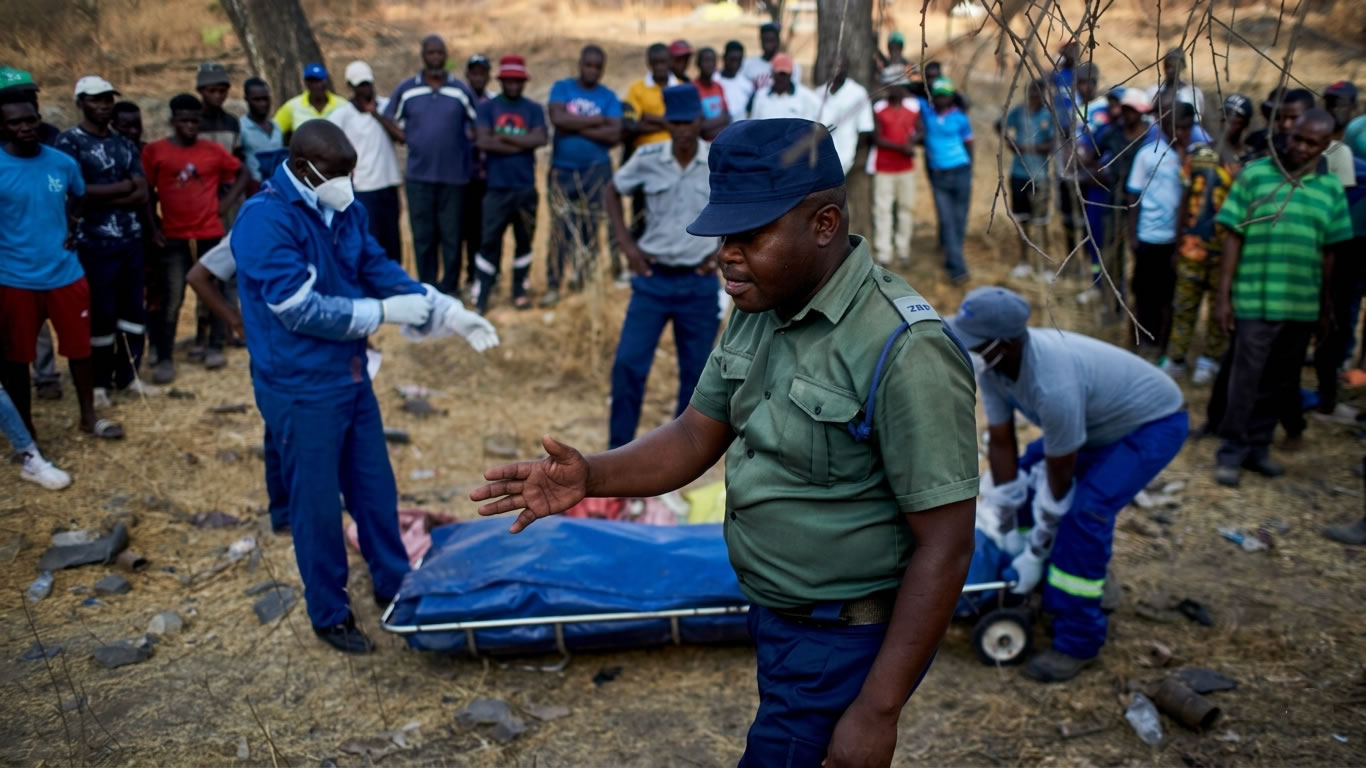
The silence that hangs over the Sabi Vlei mining area in Zvishavane is heavy, not with the peace of the countryside, but with the suffocating weight of earth and unfulfilled promises. Late on a Thursday night in May 2026, the ground beneath the Mazvihwa Mine gave way, swallowing four artisanal miners into a 40-metre abyss. They were searching for the glint of gold; they found a tomb of red soil. This was no freak act of nature. It was a predictable, almost scheduled, disaster in an industry where the lives of the poor are the cheapest commodity available.
As the rainy season continues to saturate the fragile Midlands soil, these “death traps” become even more lethal. The Mazvihwa collapse is merely the latest entry in a grim ledger of mining fatalities that has seen dozens of Zimbabweans buried alive over the past year. While the Zimbabwe Republic Police (ZRP) and the Ministry of Mines express their ritualistic “concern,” our investigation reveals a more sinister reality: a broken, unregulated system where “gold barons” thrive on the blood of the desperate, and where safety is a luxury that no one can afford.
The Midnight Collapse in Zvishavane
The incident at Mazvihwa occurred under the cover of darkness, a time when many artisanal miners—known locally as makorokoza—operate to avoid the erratic patrols of law enforcement. The shaft, a narrow vertical chimney plunging 40 metres into the earth, lacked even the most rudimentary timbering or structural support. When the walls collapsed, there was no warning.
Two men, Emmanuel Sibanda (31) and Philisani Sibanda (26), both from Hlelambili village under Chief Ndube, managed to escape the initial cave-in but sustained life-altering injuries. They are currently fighting for their lives in a local hospital, their bodies were crushed by the very soil they hoped would provide their families with a future. For the other four, the earth remains their final resting place, and their names were added to a list of victims that the state seems all too eager to forget.
“I can confirm the sudden death of a 31-year-old man who died when a mine shaft collapsed,” a police spokesperson stated in a brief, clinical update. But for the families in Hlelambili, there is nothing clinical about their grief. They speak of young men driven by a lack of jobs and a crumbling economy to crawl into holes that they knew were dangerous.
A Trail of Disasters: The Human Toll
The Mazvihwa tragedy is part of a relentless pattern. In October 2025, the nation watched in horror as the bodies of four young men were pulled from a collapsed shaft in Mazowe. They were identified as Alton Sibanda (25), Prince Gobvu (19), Kenneth Mhandire (24), and Tapiwa Meskano (26). Their ages tell a story of a lost generation—men in their prime, forced into the bowels of the earth to scrape a living.
Just a month later, in November 2025, seven more miners were trapped to death at the Base Mineral Block Mine in Silobela. In the same month, six men from the Umbark area in Kadoma were swept to their deaths when a flash flood inundated the shaft they were working in. In February 2026, another three were killed in Mhangura. Each incident follows the same script: inadequate geological surveys, zero ventilation, and a total absence of structural integrity.
|
Date
|
Location
|
Victims
|
Cause
|
|
July 2025
|
Starlake Mine, Mazowe
|
6 Dead
|
Shaft Collapse
|
|
October 2025
|
Umsasa Farm, Mazowe
|
4 Dead
|
Shaft Collapse
|
|
November 2025
|
Silobela, Midlands
|
7 Dead
|
Shaft Collapse
|
|
November 2025
|
Kadoma/Maratonga
|
6 Dead
|
Flooding in Shaft
|
|
January 2026
|
Monapo (Cross-border)
|
4 Dead
|
Illegal Shaft Collapse
|
|
February 2026
|
Mhangura
|
3 Dead
|
Shaft Collapse
|
|
May 2026
|
Mazvihwa, Zvishavane
|
4 Dead
|
Shaft Collapse
|
These are not just statistics; they are fathers, sons, and brothers. The frequency of these accidents suggests that the “safety warnings” issued by Commissioner Nyabadza and other officials are falling on deaf ears—not because the miners are reckless, but because they are hungry.
The Shadow of the ‘Gold Barons’
The term “artisanal miner” suggests a rugged individualist, a lone prospector working for his own benefit. The reality is far more exploitative. Our investigation into the Midlands and Mashonaland Central mining belts reveals that the vast majority of these sites are controlled by “gold barons”—politically connected individuals who hold mining claims but refuse to invest in safety or formal equipment.
These barons provide the miners with the most basic tools—often just picks, shovels, and buckets—and in return, they demand a massive percentage of the gold found. The miners, operating without legal protection, have no choice but to accept these terms. The barons take the lion’s share of the profit while the miners take 100% of the risk.
“The barons don’t care about the shafts,” says a former miner from Shurugwi, who asked to remain anonymous for fear of retribution. “They only care about the grams. If a shaft collapses, they just move to the next one. There are always more boys looking for work.”
This shadow economy is fuel for a massive illicit trade. Estimates suggest that at least three tonnes of gold are leaked from the artisanal sector annually, worth hundreds of millions of US dollars. This “blood gold” bypasses the formal state coffers, flowing instead into the pockets of the elite and international smuggling rings. The lack of regulation isn’t an oversight; it’s a feature of a system that allows those at the top to profit from chaos.
Institutional Corruption and the ‘Legitimacy Curse’
Why is there so little enforcement? The answer lies in the deep-seated corruption that plagues the sector. In many cases, the very people tasked with policing the mines are on the payroll of the barons. There are documented instances of police harassment being used not to enforce safety, but to drive independent miners off lucrative “finds” so that a baron’s crew can take over.
The government’s response has been a mix of empty rhetoric and ineffective bans. Mines and Mining Development Minister Polite Kambamura has spoken frequently about “value addition” and “beneficiation,” but these high-level policy goals mean nothing to a man 40 metres underground in a collapsing hole. The government’s ban on alluvial mining, intended to protect river systems, has largely been ignored because the state lacks the will or the capacity to provide alternative livelihoods.
This is what scholars call the “legitimacy curse.” Because the government struggles with its own mandate and transparency, it cannot effectively govern the informal sector. Instead of formalising artisanal mining—which would involve providing training, safety equipment, and legal titles—the state maintains a state of “controlled illegality.” This allows for maximum exploitation with minimum accountability.
The Rainy Season: A Predictable Massacre
The timing of the Mazvihwa collapse is particularly galling. Every year, as the rains begin, the Midlands province records an increase in deaths. The soil in areas like Zvishavane and Shurugwi is notoriously unstable when saturated. Without timbering—the process of using wooden beams to support the walls of a shaft—a collapse is almost guaranteed.
Yet, the mining continues. The economic crisis in Zimbabwe is so severe that the risk of being buried alive is weighed against the certainty of starvation. “We know the ground is soft,” says a miner in Zvishavane. “But if I don’t go down today, my children don’t eat tonight. The rain is dangerous, but hunger is more dangerous.”
The police have expressed concern about “unsafe mine shafts,” but concern is not a policy. There are no site inspections for artisanal operations, no mandatory safety training, and no emergency response teams equipped to handle deep-shaft rescues. When a collapse happens, it is often fellow miners who have to dig out their comrades with their bare hands, often risking their own lives in the process.
The Missing Voices of the Families
Behind every headline about a mine collapse is a family shattered. In Hlelambili village, the Sibanda family is waiting for news that they already know is bad. They speak of the victims as hardworking men who were “the pillars of the home.”
“Our government tells us that Zimbabwe is open for business,” says a relative of one of the Mazowe victims. “But for us, Zimbabwe is a graveyard. They take the gold, they take the land, and they leave us to bury our children.”
The grief is compounded by the lack of closure. In many artisanal accidents, the shafts are so unstable that recovery efforts are abandoned, leaving the bodies of the miners to rot in the very holes where they died. This is the ultimate indignity—to be forgotten by the state and left in the earth like a discarded tool.
Conclusion: A Call for Real Accountability
The tragedy at Mazvihwa Mine is a loud, echoing indictment of the Zimbabwean state. It is a story of a nation that has failed its most vulnerable citizens. The “blood gold” economy, supported by the greed of barons and the indifference of officials, will continue to claim lives as long as the sector remains in the shadows.
Formalisation is not a complex academic concept; it is a life-saving necessity. It means giving miners legal rights to their claims, providing them with technical support from geological experts, and ensuring that no one goes down a 40-metre shaft without proper support. It means breaking the power of the gold barons and ensuring that the wealth of Zimbabwe’s soil benefits all its people, not just a connected few.
Until that happens, the rains will continue to fall, the ground will continue to soften, and more young men will be buried alive for the sake of a few grams of gold. The Mazvihwa tragedy isn’t just an accident. It’s a crime. And until someone is held accountable, the ledger of death will only grow longer.
The glint of gold in a Zvishavane pan is not worth the life of a single Zimbabwean. It is time for the government to stop expressing “concern” and start enforcing the law. Anything less is an admission that in the eyes of the state, the gold is more valuable than the people who find it.