


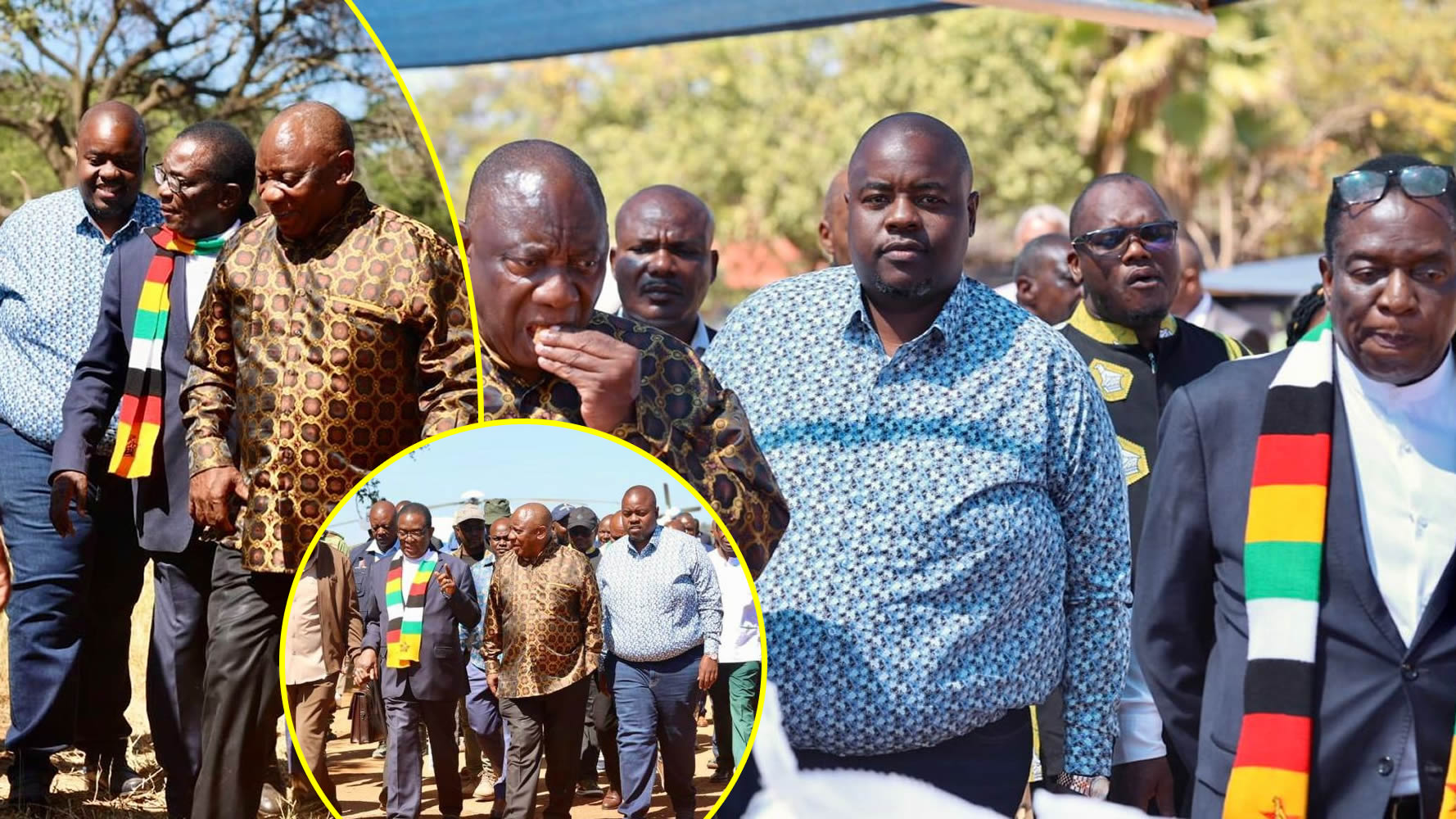
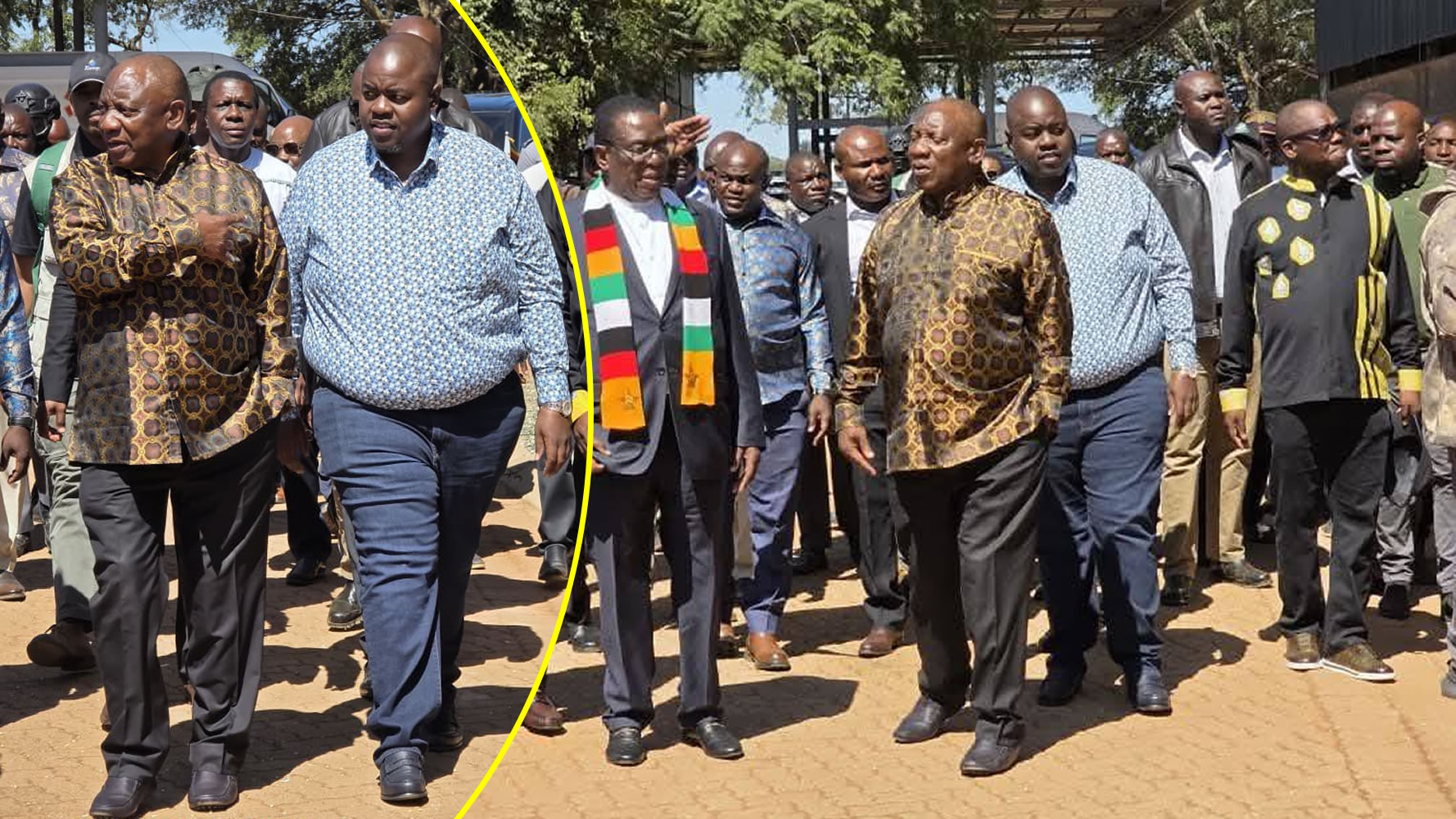
KWEKWE – When the helicopter carrying South African President Cyril Ramaphosa touched down on the dusty landing strip of Precabe Farm in Kwekwe on Sunday, May 3, 2026, the official cameras captured a scene of rustic camaraderie. There was President Emmerson Mnangagwa, clad in his signature scarf, leading his “brother” through fields of ripening maize, inspecting cattle operations, and even stocking a dam with fish. The official narrative from both Pretoria and Harare was simple: a “private working visit” to discuss “bilateral interests” and share a few moments of agricultural respite.
However, behind the carefully curated images of two leaders sharing bread and touring the Midlands countryside lies a far more turbulent reality. Investigative insiders, intelligence officials, and diplomatic sources reveal that the trip was a high-stakes intervention triggered by a triple crisis that threatens to destabilise the entire Southern African region. At the heart of this secret agenda are three explosive issues: a R1.1 billion election tender scandal that refuses to die in South Africa, a controversial constitutional amendment that has brought Zimbabwe to the brink of a massive internal political rupture, and a clandestine agreement between liberation movements to share resources and survival strategies.
The visit, which began with Ramaphosa landing at the Robert Gabriel Mugabe International Airport around 10 am, was initially shrouded in secrecy. For hours, neither Pretoria nor Harare flagged the mission, leading many to believe it was a purely personal excursion. It was only late in the evening that South African officials issued a statement, rebranding the “private” trip as a “working visit” as an afterthought. As one South African intelligence official noted: “It was a private visit. That is why the South African government initially had not announced it until after the fact. Those were party issues and that’s why the trip was initially classified as a private visit on both sides of the Limpopo until Pretoria tried to brand it a working visit as an afterthought.”
The timing of the visit is anything but coincidental. In Pretoria, South Africa’s elite crime-fighting unit, the Hawks, and the Financial Intelligence Centre (FIC) have significantly intensified their cross-border investigation into the Zimbabwe Electoral Commission (ZEC) tender scandal. While the Zimbabwe Anti-Corruption Commission (ZACC) recently moved to clear controversial businessman Wicknell Chivayo of any wrongdoing, citing a lack of “contractual evidence,” their counterparts across the Limpopo are far from finished.
The scale of the alleged corruption is staggering, even by the standards of regional “tenderpreneurship.” Leaked documents and financial trails indicate that over R800 million was transferred from the South African printing firm Ren-Form CC to a web of business accounts linked to Chivayo. These funds originated from a R1.1 billion payment made by the Zimbabwean Treasury to Ren-Form for the supply of electoral materials during the 2023 general elections.
For the average citizen, the numbers are difficult to fathom. In one instance, Ren-Form allegedly invoiced the ZEC R23 million for a central server that retails for approximately R90,000. In another, portable toilets were charged at R68,700 each, despite having a retail value of around R10,000. This “farm visit” likely involved high-level discussions on how to manage the fallout of this investigation, which threatens to expose senior officials in both Harare and Pretoria.
|
Item Description
|
Invoiced Price (Ren-Form)
|
Estimated Retail Price
|
Percentage Inflation
|
|
Central Server
|
R23,000,000
|
R90,000
|
~25,455%
|
|
Portable Toilet (per unit)
|
R68,700
|
R10,000
|
~587%
|
|
Total Contract Value
|
R1,100,000,000
|
Unknown
|
Massive Overspend
|
Joining the two leaders on the helicopter flight to Kwekwe was a coterie of businessmen whose fortunes are closely tied to state patronage: Wicknell Chivayo, Kudakwashe Tagwirei, and Paul Tungwarara. These individuals, known colloquially in Zimbabwe as “Zvigananda,” have collected hundreds of millions of dollars in government contracts and have faced accusations by Vice President Constantino Chiwenga of “capturing the state.” In ANC and Zanu PF circles, however, they are regarded with more reverence as “progressive businessmen” who participate in party initiatives and help bankroll the survival of liberation movements.
The presence of these businessmen at a “private” presidential meeting is a clear signal of their “untouchable” status. Chivayo, who was convicted of fraud in 2004, has consistently maintained his innocence regarding the ZEC deal. He has previously complained about the toll the investigations have taken on his life, stating: “Any reputational damage is almost irreparable. The prolonged investigations, based on fabricated allegations, caused severe and irreparable damage to my business interests and personal reputation over the past two years.”
Despite ZACC’s public pronouncements, Chivayo confirmed that he had not yet received any formal notification that the Zimbabwean investigation had been closed. This lack of transparency has only fueled suspicions that the “clearing” of his name was a tactical move to shield him from the more rigorous South African probe.
South African authorities remain undeterred by the developments in Harare. Thandi Mbambo, the national spokesperson for the Hawks, was unequivocal when speaking to the press this week. “The decision taken in another country will not affect our investigation. The evidence gathered on this side will determine a way forward,” she stated. Mbambo confirmed the unit was actively analysing suspicious transaction reports generated by the FIC, which have been shared with the South African Revenue Service (SARS), the Zimbabwe Revenue Authority (ZIMRA), and Zimbabwe’s Financial Intelligence Unit (FIU).
“We are looking at the suspicious transactions flagged by the FIC. Only when evidence has been gathered will a formal investigation be launched, and we will know as well who is the person of interest,” Mbambo added. The international dragnet appears to be widening even further, with reports suggesting that the United States Justice Department and the Federal Bureau of Investigation (FBI) are also examining aspects of the case.
The ZEC scandal is not just a matter of financial impropriety; it is a major diplomatic headache for President Ramaphosa. A source in Pretoria involved in the probe confirmed the persistence of the investigation: “Our investigation, based on payments transferred by Zimbabwe’s Treasury to Ren Form CC and subsequently channelled to firms linked to Chivayo, is still alive. Investigations of this nature take long to conclude. We are still investigating. Unfortunately, investigations are not run through the press.”
While the financial scandal is a pressing issue, it was perhaps overshadowed by a more immediate political threat: the Constitutional Amendment (No. 3) Bill, or CAB3. This bill, which the Zimbabwean parliament is set to vote on in late May 2026, proposes radical changes to the country’s governance. If passed, it would extend the presidential and parliamentary terms from five to seven years and replace direct presidential elections with a vote by Members of Parliament sitting as an electoral college.
Most controversially, the bill would extend President Mnangagwa’s second and final term by two years, from 2028 to 2030. This move has ignited a fierce internal battle within the ruling Zanu PF party. Vice President Constantino Chiwenga, the retired army general who led the 2017 military intervention that ended Robert Mugabe’s 37-year reign, has reportedly refused to back the bill. Chiwenga’s opposition is rooted in self-interest as much as principle; the proposed electoral college model would drastically reduce his own chances of ever reaching the presidency.
The absence of Chiwenga and the second vice president, Kembo Mohadi, from the Sunday meeting at Precabe Farm was a glaring omission that spoke volumes about the depth of the fracture within the Zimbabwean presidency. According to sources briefed on the discussions, the businessmen present used the meeting to relay to Ramaphosa that Mnangagwa believes he is living under the shadow of a coup being plotted by Chiwenga.
Ramaphosa’s response to these fears was reportedly blunt. An intelligence official familiar with the exchange stated: “Ramaphosa said South Africa, and SADC, will not tolerate another coup in Zimbabwe. That is very clear and well understood by all involved, including Vice-President Constantino Chiwenga who is locked in a succession battle with Mnangagwa.” This “no-coup” policy is a cornerstone of South Africa’s regional strategy, as Pretoria seeks to avoid the chaotic spillover that would inevitably follow another military intervention in Harare.
President Ramaphosa’s intervention was also driven by a cold domestic calculus. South Africa is facing local government elections in November 2026, and any eruption of political instability in Zimbabwe risks triggering a fresh wave of refugees across the Limpopo. This is precisely the kind of development that feeds anti-immigrant sentiment and complicates the electoral fortunes of the African National Congress (ANC), which has already seen its support erode significantly in recent years.
The link between the two nations’ elections goes deeper than mere proximity. For months, the ANC and Zanu PF have been in close contact, exchanging ideas, resources, and logistics. On April 1, 2026, ANC Treasurer-General Gwen Ramokgopa visited Zanu PF in Harare to “strengthen ties between the two liberation movements.” She was hosted by her Zanu PF counterpart, Patrick Chinamasa, and their meeting focused on the influence of “global forces” funding opposition parties in Africa to unseat liberation movements from power.
These high-level party meetings, including a prior courtesy call by Ramokgopa to Mnangagwa in November 2025, have laid the groundwork for a regional survival pact. As one intelligence source explained: “Liberation movements in the region have an agreement, not just to share strategies to remain in power, but also resources. That was part of Ramaphosa’s mission, preceded by those visits by Ramokgopa.” This agreement suggests that the wealth generated by “progressive businessmen” like Chivayo is not just for personal enrichment, but is viewed as a strategic reserve for the political survival of the old guard.
|
Recent High-Level Engagements
|
Date
|
Key Participants
|
Primary Focus
|
|
Courtesy Call
|
Nov 2025
|
Gwen Ramokgopa & Emmerson Mnangagwa
|
Fraternal relations and business participation
|
|
Party-to-Party Meeting
|
Apr 1, 2026
|
Gwen Ramokgopa & Patrick Chinamasa
|
Sustainable funding and counter-opposition strategy
|
|
“Private” Farm Visit
|
May 3, 2026
|
Cyril Ramaphosa & Emmerson Mnangagwa
|
CAB3, coup threats, and ZEC scandal fallout
|
“Ramaphosa came to convey South Africa’s profound concern about the threat of a new political crisis in Zimbabwe which would also carry economic consequences,” a diplomatic source briefed on the engagements revealed. “Pretoria is concerned about what appears to be a build-up to a major fallout between Mnangagwa and Chiwenga whose unpredictable outcome would be felt across the region, especially South Africa.”
The diplomatic source further added: “Even at this late hour, South Africa wonders if Mnangagwa cannot halt the constitutional amendment or delay it for further consultations. The local government elections in November and rising anti-immigrant sentiment are playing on Ramaphosa’s mind, and he doesn’t want to add a refugee influx and political upheaval up north to that list.”
The economic ties between the two nations add another layer of complexity. South African exports to Zimbabwe reached approximately US$4.30 billion in 2025. Any major disruption in Zimbabwe would have an immediate and painful impact on South African businesses. The “farm visit” was therefore a desperate attempt to ensure that the “brotherly catch-up” does not turn into a regional catastrophe.
For the average Zimbabwean, the sight of these two leaders strolling through a farm is a bitter pill to swallow. While they discuss high-level politics and the management of multi-million dollar scandals, the majority of the population continues to struggle with the consequences of an economy hollowed out by corruption and mismanagement. The inflation of basic election materials is a direct assault on the public purse, and the shielding of “tenderpreneurs” only serves to reinforce the perception that some individuals are indeed above the law.
The South African investigation is now seen by many as the only one that truly matters. With ZACC appearing to have abdicated its responsibility to hold the powerful to account, the hope for justice rests with the Hawks and the FIC. The cross-border nature of the money laundering allegations means that even if Chivayo and his associates are “cleared” in Harare, they remain vulnerable to prosecution in Pretoria.
As the May vote on CAB3 approaches, the tension in Harare is palpable. President Mnangagwa finds himself caught between his desire to extend his rule and the growing opposition from within his own party and from a concerned neighbour. The “farm visit” may have provided a temporary platform for dialogue, but it has also exposed the deep-seated fears and the murky deals that underpin the current political landscape.
In the end, the visit to Precabe Farm was less about agriculture and more about survival. It was about two leaders trying to navigate a minefield of their own making—one filled with inflated invoices, secret financial trails, and the looming threat of political upheaval. Whether Ramaphosa’s warning will be heeded remains to be seen, but the “secret connection” between the ZEC scandal and the fight for Zimbabwe’s future has now been laid bare for all to see.
The official statement from South Africa’s presidency late Sunday made no mention of these explosive topics, describing the trip only as a “working visit to discuss issues of mutual and bilateral interests.” It was a classic piece of diplomatic obfuscation, designed to hide the true nature of a mission that was as urgent as it was secretive.
As the sun set over the maize fields of Kwekwe, the two presidents may have shared a final “brotherly” handshake, but the problems they discussed are far from resolved. The Hawks are still circling, the leaked documents are still being analysed, and the political battle for Zimbabwe is only just beginning. The “private” visit to the farm was merely the latest chapter in a long and complex story of power, greed, and the struggle for the soul of a nation.