


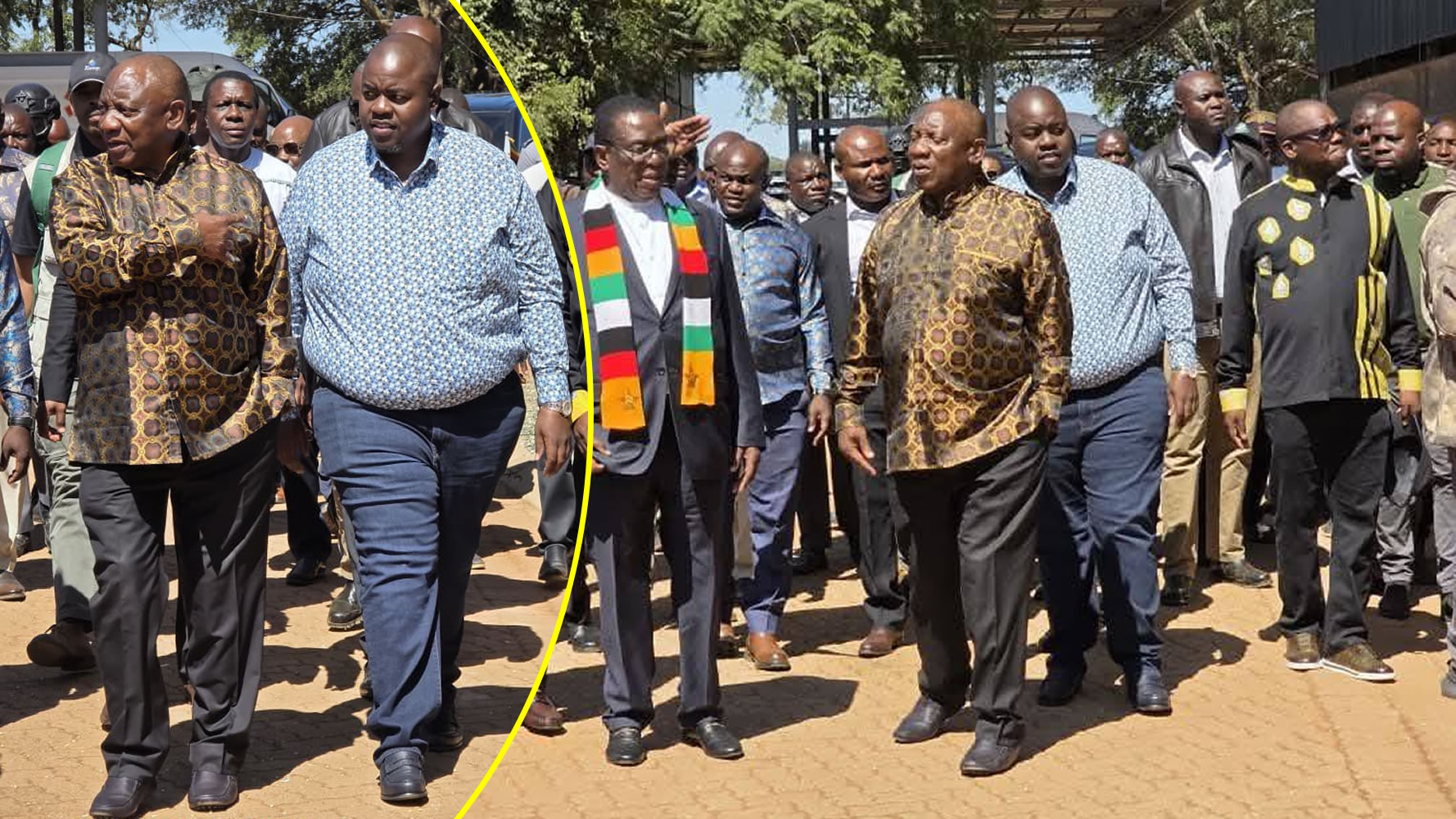
KWEKWE – When the wheels of the South African presidential jet touched down on Zimbabwean soil this past weekend, the official manifest spoke of “private” matters and “agricultural exchange.” President Cyril Ramaphosa, leader of Africa’s most industrialised but energy-starved nation, was whisked away to the dusty plains of Kwekwe. His destination was not a state house or a high-level diplomatic summit, but Precabe Farm, the sprawling private sanctuary of President Emmerson Mnangagwa.
On the surface, the images released to the public were almost pastoral. Two elderly statesmen, clad in casual attire, wandering through paddocks of prize-winning cattle and fields of lush crops. The official narrative was simple: a weekend of livestock production and crop diversification. Yet, for those who follow the intricate and often murky dance of Southern African politics, the optics of the visit were as transparent as a lead curtain. The question echoing from Pretoria to Harare was simple: why would a president grappling with a crumbling national power grid and a fractious coalition government spend his precious weekend looking at cows in a neighbouring country?
The answer, it appears, has very little to do with farming and everything to do with survival—both political and literal. Beneath the veneer of “agricultural diplomacy” lies a high-stakes “quid pro quo” that could redefine the regional power balance for the next decade. Reliable sources close to the closed-door meetings suggest that while the cameras captured the two leaders admiring bulls, the real conversation was focused on a secret energy deal and a mutual pact of political preservation.
The Lithium Leverage and the Energy Exchange
At the heart of this “private” retreat was a desperate need for power—specifically, the kind that flows through electrical wires. South Africa’s energy crisis has reached a point of near-permanent instability, with the national utility, Eskom, struggling to keep the lights on. Meanwhile, Zimbabwe, despite its own internal economic woes, sits on some of the largest lithium reserves in the world. In early 2026, the Mnangagwa administration sent tremors through global markets by fast-tracking a ban on the export of raw lithium and even lithium concentrate.
The ban was framed as a move to encourage domestic refining, but insiders suggest it was also a strategic chess piece. By tightening the grip on this “white gold,” essential for the global electric vehicle revolution and battery storage, Mnangagwa has created a powerful bargaining chip. During the Kwekwe retreat, discussions reportedly centred on giving South African state-backed entities preferential access to these lithium reserves. In exchange, Zimbabwe is looking for South African investment and technical support to ramp up its coal-powered energy exports.
The deal is a classic “energy for legitimacy” swap. Ramaphosa needs a stable and immediate source of electricity to appease a frustrated South African electorate. Zimbabwe, which has been expanding its Hwange thermal power station with international assistance, is positioning itself as a regional energy hub. The “secret deal” allegedly involves a long-term agreement where Zimbabwe will prioritise electricity exports to South Africa at below-market rates, effectively helping Ramaphosa bridge the gap in his own country’s failing infrastructure.
The 2030 Pact: Trading Democracy for Power
However, the energy deal is only half of the story. The “quid pro quo” extends deep into the realm of constitutional law and regional stability. In Zimbabwe, the ruling ZANU-PF party has been moving with clinical precision to ensure President Mnangagwa remains in power beyond the current constitutional limit. The “2030” slogan has become a ubiquitous feature of ZANU-PF rallies, and the recently gazetted Constitution Amendment Bill No. 3 is the vehicle designed to make this a reality.
The bill proposes far-reaching changes, including technical reforms to electoral cycles that would effectively allow Mnangagwa to extend his term by at least two years, or perhaps indefinitely. For this to succeed without triggering a regional pariah status, Mnangagwa needs the endorsement—or at least the strategic silence—of the Southern African Development Community (SADC). As the most influential voice in SADC, South Africa’s stance is decisive.
A stable Zimbabwe is seen as the only way to stem the tide of migration that has seen millions of Zimbabweans cross the border into South Africa, placing an immense burden on social services and stoking domestic tensions.
The Shadow Players: Tagwirei and Chivayo
Perhaps the most telling detail of the Kwekwe visit was not who was on the official guest list, but who was seen in the background. Investigative eyes noted the presence of controversial businessmen Kuda Tagwirei and Wicknell Chivayo. Tagwirei, often referred to as “Queen Bee” due to his vast influence over the Zimbabwean economy and his close ties to the military and presidency, is a man whose name is frequently linked to massive state contracts and energy deals.
Chivayo, another figure whose proximity to the first family has raised eyebrows, was also seen participating in the “farm tour.” The presence of these individuals suggests that the “private” visit was as much a business summit as it was a presidential catch-up. These are the men who facilitate the movement of capital and the execution of state-level projects in Zimbabwe. Their involvement in a “private” farm visit underscores the reality that the line between state business and private interest has become almost non-existent in the Mnangagwa era.
Opposition Fire: The DA Strikes Back
While the two presidents were enjoying their farm retreat, the political atmosphere back in South Africa was anything but serene. The Democratic Alliance (DA), a key partner in South Africa’s Government of National Unity (GNU), has reacted with unbridled fury to the news of Ramaphosa’s “bromance” with a man they describe as a dictator.
In a scathing statement, DA spokesperson on international relations and cooperation, Ryan Smith, condemned the visit in the strongest possible terms. “The DA condemns, in the strongest possible terms, Ramaphosa’s unofficial visit to Zimbabwean President, Emmerson Mnangagwa’s private residence on Sunday,” Smith stated. He argued that the visit was a clear sign that the ANC continues to “sideline our constitutional values of freedom, democracy, and human rights in favour of propping up the African fraternity of despots and dictators.”
The DA’s anger is rooted in the belief that South Africa’s foreign policy under the ANC has been a major contributor to the regional migration crisis. Smith pointed out that “Zimbabwe’s democratic backslide is the sole reason for the immigration crisis South Africa has been subjected to since the late 90s.” He argued that by fraternising with Mnangagwa, Ramaphosa is effectively endorsing the very conditions that drive refugees across the Limpopo River.
“It is not the people of Zimbabwe who are to blame for fleeing to South Africa for a better life,” Smith added. “It is President Ramaphosa and the ANC who continue to ignore human rights abuses and democratic capture in their own backyard out of pure political expediency.” The DA has made it clear that they want a fundamental shift in how South Africa deals with its neighbours, moving away from “quiet diplomacy” and towards a policy that holds leaders accountable for human rights violations.
The Migration Crisis and the GNU Tension
The timing of the visit could not be worse for the internal stability of South Africa’s GNU. Recent weeks have seen a resurgence of xenophobic rhetoric and sporadic attacks against undocumented migrants in South African townships. The presence of over a million Zimbabweans, many of whom are economic refugees, has become a lightning rod for domestic frustration.
Opposition leader Nelson Chamisa, currently operating outside the formal structures of Zimbabwean parliament but still a potent symbol of resistance, has also weighed in. Chamisa condemned the ongoing violence against migrants in South Africa and called for urgent SADC intervention. He pointed out the irony of leaders “drinking tea on farms” while their citizens are being hunted in the streets of neighbouring countries.
For Ramaphosa, the Kwekwe visit is a high-stakes gamble. He is betting that the short-term gains of an energy deal and a “stable” neighbour will outweigh the long-term damage to his reputation as a champion of constitutional democracy. However, the DA has signalled that they will not let this matter rest. By distancing themselves from the visit, they are highlighting the deep ideological rifts within the South African government. “As a member of the Government of National Unity (GNU), the DA rejects the ANC’s attempts to openly fraternise with neighbouring dictators and deny the lived reality of millions of persecuted Zimbabweans,” Smith declared.
A History of “Quiet Diplomacy”
To understand why Ramaphosa would take such a risk, one must look at the long history of the ANC’s relationship with ZANU-PF. Since the era of Thabo Mbeki, South Africa has consistently followed a policy of “quiet diplomacy” toward Zimbabwe. This approach is rooted in the shared history of the liberation struggle, where both parties fought against white minority rule. There is a deep-seated reluctance within the ANC to publicly criticise a fellow liberation movement, even as that movement transforms into an autocratic regime.
However, the “quiet diplomacy” of the past has evolved into something more transactional. In the Mbeki era, the goal was to facilitate a “Global Political Agreement” and a government of national unity in Zimbabwe. Today, under Ramaphosa, the goal appears to be more focused on securing South Africa’s own crumbling infrastructure. The “secret energy deal” is the latest iteration of this policy—a move that prioritises South African national interests over regional democratic standards.
The Global Context: Lithium and the New Cold War
The Kwekwe deal also has global implications. Zimbabwe’s lithium reserves have made it a focal point of competition between the West and China. Most of Zimbabwe’s lithium is currently exported to China, which has invested heavily in the country’s mining sector. By offering South Africa “preferential access,” Mnangagwa is playing a sophisticated game of geopolitical balancing. He is signalling to the world that Zimbabwe is open for business, but only on his terms.
For South Africa, securing a steady supply of lithium is not just about domestic energy; it’s about positioning itself as a leader in the green energy transition on the continent. If South Africa can leverage Zimbabwean lithium to build its own battery manufacturing industry, it could provide a massive boost to its flagging economy. This economic potential is the “sugar-coating” on a very bitter political pill.
The Human Cost of Political Expediency
While the leaders discuss lithium and term extensions, the average Zimbabwean continues to suffer under the weight of a collapsed economy and a repressive political environment. The “Constitution Amendment Bill No. 3” is seen by many as the final nail in the coffin of Zimbabwean democracy. If passed, it will dismantle the few remaining checks and balances on presidential power.
The migration crisis is the most visible symptom of this failure. In South Africa, Zimbabwean refugees live in a state of constant “international limbo,” often without legal documentation and at the mercy of both the state and xenophobic vigilante groups. The DA’s Ryan Smith was blunt in his assessment: “For as long as South Africa refuses to stand up and condemn dictators and human rights abusers on our continent, our country will forever be the only place of asylum for the refugees the ANC continues to create.”
Conclusion: The Legacy of the Kwekwe Retreat
As President Ramaphosa’s jet departed from Zimbabwe, the official statements continued to speak of “fruitful discussions” and “brotherly bonds.” But the reality of what transpired at Precabe Farm will likely be felt for years to come. The “secret energy deal” may provide some short-term relief for South Africa’s power grid, but it comes at a staggering price.
By propping up a regime that is actively dismantling its own constitution, Ramaphosa is undermining the very values that South Africa’s own liberation struggle was built upon. The “quid pro quo” of Kwekwe is a testament to the triumph of political expediency over principle. As the DA and other opposition parties “breathe fire” back home, the question remains: can a nation truly be secure if its prosperity is built on the suppression of its neighbour’s freedom?
The Kwekwe retreat was more than just a visit to a farm; it was a summit of survival. For Mnangagwa, it was about securing the regional endorsement he needs to rule until 2030. For Ramaphosa, it was about finding a way to keep the lights on in a country that is slowly losing faith in his leadership. In the end, the only thing that was truly “private” about the visit was the extent to which both leaders were willing to sacrifice democracy for the sake of power.
The story of the Kwekwe farm visit is a reminder that in the world of high-stakes politics, there is no such thing as a simple weekend in the country. Every cow admired, every field toured, and every hand shaken is part of a larger, more complex, and often darker narrative. As the lights flicker in Johannesburg and the political temperature rises in Harare, the true cost of the “Secret Energy Deal” is only just beginning to be understood.
|
Feature
|
Details
|
|
Location
|
Precabe Farm, Kwekwe, Zimbabwe
|
|
Primary Attendees
|
Cyril Ramaphosa (SA), Emmerson Mnangagwa (Zim)
|
|
Key Business Figures
|
Kuda Tagwirei, Wicknell Chivayo
|
|
Official Agenda
|
Agricultural exchange and livestock production
|
|
Alleged Secret Agenda
|
Energy exports (electricity) and lithium access for SA
|
|
Political “Quid Pro Quo”
|
SA support for Mnangagwa’s “2030” term extension
|
|
Opposition Reaction
|
DA condemns the visit as “propping up a dictator”
|
|
Context
|
Zimbabwe’s 2026 lithium export ban and SA energy crisis
|
This report highlights the growing tension between regional economic needs and the preservation of democratic values. As Southern Africa moves deeper into the 2020s, the “Kwekwe Pact” may well be remembered as the moment when the region’s most powerful nation decided that power—in all its forms—was more important than the principles of freedom and human rights.
The Democratic Alliance has vowed to bring this matter before the South African Parliament, demanding a full disclosure of any agreements signed during the “private” visit. Whether they will succeed in piercing the veil of secrecy remains to be seen. For now, the “Secret Energy Deal” remains a shadow over the future of both nations, a deal signed in the quiet of a farm, far from the eyes of the people it will most profoundly affect.