


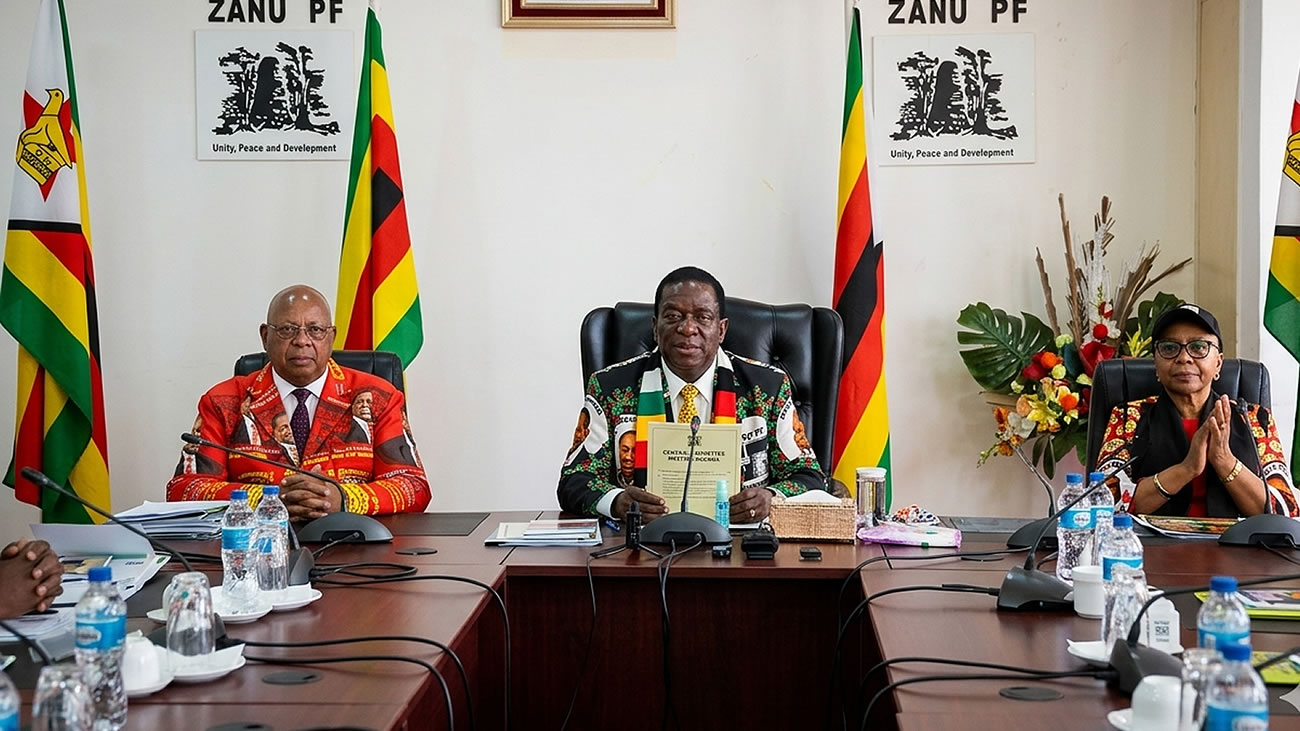
Harare – A palpable tension hung over the ZANU-PF Politburo meeting in Harare this past Wednesday, not for what was said, but for who was conspicuously absent. President Emmerson Mnangagwa presided over the party’s top decision-making body, flanked by secretary Jacob Mudenda and party chairperson Oppah Muchinguri. The seats usually occupied by the nation’s two Vice Presidents, Constantino Chiwenga and Kembo Mohadi, remained empty. This unusual configuration occurred during a crucial session, the last before parliament is set to vote on sweeping constitutional amendments, known as Constitutional Amendment Bill No. 3 (CAB3), which critics argue are designed to extend President Mnangagwa’s rule beyond its constitutional limits.
The official explanation for the Vice Presidents’ absence, offered by Presidency spokesman George Charamba, was that they were on “government assignments.” However, Charamba declined to elaborate further, a reticence that has only fuelled speculation regarding the deepening fissures within the ruling ZANU-PF party.
Behind the veneer of official duties lies a fierce power struggle, with Vice President Constantino Chiwenga reportedly standing in staunch opposition to the proposed constitutional changes. Vice President Kembo Mohadi, on the other hand, has maintained a non-committal stance, adding another layer of intrigue to the unfolding political drama. The absence of these key figures from such a pivotal meeting underscores the gravity of the internal conflict surrounding CAB3, a bill that has become the epicentre of a high-stakes battle for Zimbabwe’s political future.
The Contentious Constitutional Amendment Bill No. 3 (CAB3)
Gazetted on 16 February, the Constitutional Amendment (No. 3) Bill, 2026, proposes significant alterations to Zimbabwe’s foundational legal document. At its core, CAB3 seeks to extend both presidential and parliamentary terms from five to seven years. Crucially, it aims to replace the direct popular election of the president with an election by a joint sitting of parliament, effectively shifting the power of presidential selection away from the electorate. Furthermore, the bill proposes to enlarge the Senate from 80 to 90 members, with the president empowered to appoint an additional 10 senators.
Perhaps the most controversial aspect of CAB3 is its transitional provisions. These clauses state that the new seven-year term would apply to the current president, Emmerson Mnangagwa, despite a general prohibition on the retroactive amendment of term limits under Section 328(7) of the constitution. In practical terms, this means the bill would keep President Mnangagwa in office until 2030, two years beyond the scheduled expiry of his current and constitutionally final term in 2028. This move is particularly notable given that President Mnangagwa turns 84 this year.
Beyond the presidential term extension, CAB3 also seeks to abolish the Zimbabwe Gender Commission and the National Peace and Reconciliation Commission, transferring their functions to the Zimbabwe Human Rights Commission. Additionally, it proposes to strip the Zimbabwe Electoral Commission (ZEC) of its responsibility for the voters’ roll, handing this crucial function to the Registrar-General. The government has framed these changes as “modernising reforms,” asserting that they would “enhance political stability and policy continuity” and facilitate the completion of development programmes. However, critics view these amendments as a blatant attempt to consolidate power and undermine democratic processes.
Chiwenga’s Open Defiance and the ‘Now or Never’ Fight
Vice President Constantino Chiwenga’s public criticism of the plans to extend President Mnangagwa’s rule to 2030 marks a significant escalation from what was previously quiet internal dissent to overt political confrontation. Speaking at a Roman Catholic gathering on 25 April in Murewa, Mashonaland East Province, Chiwenga delivered a thinly veiled warning, framing his remarks around ethical governance and drawing on scripture. He invoked the biblical story of King Hezekiah, a ruler granted an extra 15 years whose kingdom ultimately unravelled. While Chiwenga did not explicitly name Mnangagwa, analysts widely interpreted his message as a direct caution to a president whose allies are aggressively pushing for his term extension.
Eldred Masunungure, a politics lecturer at the University of Zimbabwe, believes that with the constitutional amendment and the Mnangagwa faction’s determination to push it through, Chiwenga recognises this as a “now-or-never moment”. Masunungure told The Africa Report, “Zimbabwe is at a tipping point more than it has ever been since Mnangagwa came to power in 2017.” He added that Chiwenga’s instinct is to “fight publicly rather than remain mum; thus, he is unleashing his fangs, first through the pulpit, with the sermon from St. Paul being the most audacious foray to date.” This suggests that the gloves are off in this high-stakes “gladiation” for power.
The Coup, the Agreement, and the Broken Promise
The roots of this power struggle can be traced back to the November 2017 coup that ousted long-time ruler Robert Mugabe. It was Chiwenga, then a military general, who engineered that coup, ultimately propelling Mnangagwa to the presidency. Sources close to the matter suggest an informal agreement existed between the two: Mnangagwa would serve one term and then step down for Chiwenga to take over. However, as early as 2018, Mnangagwa’s allies began pushing for his extended stay in office, effectively sidelining his deputy.
Since then, Chiwenga has reportedly resisted efforts to extend Mnangagwa’s rule, largely through internal party channels within ZANU-PF. However, the gazetting of CAB3 has, according to political analyst Tendai Ruben Mbofana, “moved the goalposts from rhetoric to law”. Mbofana argues that Chiwenga is now speaking out because “the institutional avenues for internal pushback are closing.” By utilising a church platform, Chiwenga is leveraging moral authority to portray Mnangagwa’s ambition as a “spiritual and national liability” rather than merely a party dispute. Mbofana suggests this serves as a “red alert to the military and the intelligence services that the country’s stability is being gambled for personal longevity”.
Regional Intervention and International Concerns
The political instability brewing in Zimbabwe has not gone unnoticed by its regional neighbours. South African President Cyril Ramaphosa reportedly visited President Mnangagwa at Precabe Farm in Kwekwe, with former ally Rutendo Matinyarare claiming that Ramaphosa cautioned Mnangagwa against both firing Chiwenga and proceeding with CAB3. While Harare described the visit as private, Pretoria characterised it as a “working visit” to discuss bilateral interests.
Matinyarare asserted that Ramaphosa’s intervention was a “crisis management intervention” because Zimbabwe was “on the brink of a coup, if not a civil war”. He argued that Ramaphosa, as the leader of Africa’s most powerful nation, would not undertake an unscheduled trip for a mere weekend off, especially given the immigrant crisis South Africa faces due to Zimbabwe’s poor governance. Matinyarare emphasised that CAB3 has the potential to destabilise Zimbabwe further, leading to an increased influx of refugees into South Africa, a significant political risk for the ANC in an election year.
Furthermore, Matinyarare highlighted the diplomatic implications, stating that Ramaphosa would not support a government condemned by its own Chapter 12 Human Rights institution for “beating, jailing, abducting, and burning the offices of those who oppose the Bill”. He concluded, “Ramaphosa came to tell Harare to stop CAB3 and to not even think about firing the Vice President because this will destabilise Zimbabwe and the region”. This regional concern is amplified by South Africa’s ongoing struggles with xenophobic attacks, reignited by anti-migrant groups like March and March and Operation Dudula. President Mnangagwa, who initially sought re-engagement and a clean human rights record after the 2017 coup, is now in a position where he needs regional support for his proposed term extension.
Crackdown on Dissent and Human Rights Concerns
The push to enact CAB3 has been met with a growing crackdown on dissent and significant human rights concerns. Amnesty International, ahead of public hearings on the bill between 30 March and 2 April 2026, urged Zimbabwean authorities to guarantee freedom of expression and peaceful assembly. The organisation highlighted past incidents of violence and suppression, warning that “restriction of public debate before, during, or after public hearings shuts down genuine participation, accountability, and the rule of law”.
Indeed, there have been several documented instances of repression. In August 2025, three students from Midlands State University were arrested for distributing flyers opposing the constitutional amendment. Prominent opponents of the bill, such as Lovemore Madhuku of the National Constitutional Assembly and Tendai Biti of the Constitutional Defenders Forum, have reportedly been arrested, detained, and even assaulted. The Chapter 12 Human Rights institution has condemned the government for “beating, jailing, abducting, and burning the offices” of those who oppose the Bill. These actions contribute to a “climate of fear” during public hearings and undermine the credibility of the consultative process.
Factional Backlash and Chiwenga’s Strategy
Chiwenga’s public defiance has predictably triggered a backlash from Mnangagwa’s loyalists. Temba Mliswa, a former ZANU-PF provincial chairperson, took to social media platform X to label Chiwenga’s remarks as “treason” and called for his resignation. Similarly, local government minister Daniel Garwe, another Mnangagwa ally, publicly criticised Chiwenga and urged ZANU-PF supporters to pray for Mnangagwa to be granted more years in office. Some members of Mnangagwa’s faction are openly advocating for Chiwenga’s dismissal.
Despite these challenges, Chiwenga is reportedly attempting to build a “coalition of the aggrieved”. This coalition, according to Masunungure, includes the Catholic Church and other mainstream religious denominations, civil society groups, students, disgruntled elements within ZANU-PF, and both serving and retired military personnel, as well as war veterans. Masunungure emphasised that Chiwenga needs a “winning formula” and must construct this coalition now.
Chiwenga’s grip on the armed forces, once formidable, has reportedly weakened, with many of his allies succumbing to Covid, retiring, or being moved into government roles or diplomatic postings abroad by the president. However, Mbofana suggests that the Vice President could still activate his power base to resist the extension of Mnangagwa’s term. One potential strategy for Chiwenga’s camp is to push for a constitutional interpretation that would require two referendums for the amendments to pass, arguing that an incumbent president should not benefit from such changes. This is in direct contrast to ZANU-PF’s apparent attempt to amend the constitution without resorting to a referendum.
The Road Ahead
The upcoming parliamentary vote on CAB3 is set to be a defining moment for Zimbabwe’s political landscape. The deep divisions within ZANU-PF, the open defiance of Vice President Chiwenga, the regional pressure, and the growing concerns over human rights all point to a period of intense political uncertainty. The outcome of this struggle will not only determine President Mnangagwa’s immediate future but also shape the trajectory of democratic governance and stability in Zimbabwe for years to come.