



A New Chapter in Zimbabwe’s Political Landscape
HARARE – The recent appointment of General Philip Valerio Sibanda to the ZANU PF Politburo has ignited a fervent debate across Zimbabwe, drawing both staunch criticism and strategic endorsements. This move, perceived by some as a potential constitutional overreach, raises significant questions about the delicate balance between military influence and civilian political structures, and the broader implications for the nation’s democratic trajectory. Conversely, proponents view it as a calculated manoeuvre by President Emmerson Mnangagwa, designed to consolidate power and ensure stability within the ruling party, particularly amidst ongoing succession dynamics.
General Sibanda, a figure of considerable stature within Zimbabwe’s military establishment, has long been a subject of public interest. His career, spanning decades of service, has been marked by a reputation for professionalism and a perceived neutrality that sets him apart from many of his contemporaries. This latest development, however, thrusts him directly into the heart of ZANU PF’s intricate political machinery, prompting a re-evaluation of his role and future within the country’s leadership. The legal and political ramifications of this appointment are profound, necessitating a deep dive into Zimbabwe’s historical context of military involvement in politics and the potential long-term consequences for its governance.
This article aims to dissect the arguments surrounding Sibanda’s elevation, examining whether it represents a necessary evil for national cohesion or a dangerous precedent for future military interventions in civilian affairs. Furthermore, it will investigate the subtle power dynamics at play within ZANU PF, questioning if this move is a genuine attempt to strengthen the party or a calculated manoeuvre to sideline potential rivals. Public perception and the reactions of various stakeholders, including opposition parties, civil society organisations, and the international community, will also be explored to provide a comprehensive understanding of this controversial development. Is this a sign of a deepening authoritarian grip, or a pragmatic decision in a complex political landscape? We uncover the hidden motives and potential outcomes of this pivotal appointment.
The Man Behind the Uniform: General Philip Valerio Sibanda
Born on 24 December 1954, General Philip Valerio Sibanda’s journey is deeply intertwined with Zimbabwe’s liberation struggle. He left the country in 1973 to join the fight for independence, undergoing rigorous military training in Morogoro, Tanzania, and later in Lebanon under the tutelage of the Palestinian Liberation Organisation. His war alias, Ananias Gwenzi, speaks to a past steeped in revolutionary fervour and dedication. Upon his return, he quickly rose through the ranks, becoming an instructor at the Mbwembwesi training camp and later a commander in the ZIPA, a joint military command of ZANLA and ZIPRA forces.
Sibanda’s post-independence military career saw him integrate into the Zimbabwe National Army, where he distinguished himself, becoming the only ex-ZIPRA cadre to reach the rank of Major-General by 1994. His international experience includes serving as the Force Commander for the United Nations Angola Verification Mission (UNAVEM III) and MONUA (Mission d’Observation des Nations Unies à l’Angola) between 1995 and 1998, roles that underscored his leadership capabilities and commitment to peace. In December 2017, he ascended to the pinnacle of Zimbabwe’s military hierarchy, succeeding General Constantino Chiwenga as the Commander of the Zimbabwe Defence Forces (ZDF), a significant appointment that followed the ‘Operation Restore Legacy’ which led to the resignation of then-President Robert Mugabe.
What truly sets General Sibanda apart, and contributes to his widespread respect, is his perceived professionalism and non-partisan stance. Unlike some of his peers, he has largely managed to steer clear of overt political alignment, earning him a reputation for being calm and collected. A notable incident that highlights this perception occurred during the 2009 Defence Forces Day, where he was reportedly the only army general to salute Morgan Tsvangirai, then Prime Minister in the Government of National Unity. This act, while seemingly minor, was interpreted by many as a powerful symbol of his adherence to constitutional order and respect for civilian authority, even amidst deep political divisions. Throughout his tenure as ZDF Commander, Sibanda reportedly maintained professional and cordial relations with both President Mnangagwa, as Commander-in-Chief, and Constantino Chiwenga, his former boss and close associate, demonstrating a remarkable ability to navigate complex political landscapes without compromising his professional integrity. This clean record and broad respect across the political and military divide position him as a uniquely suitable candidate for higher office.
The Politburo Appointment: A Constitutional Conundrum and its Reversal
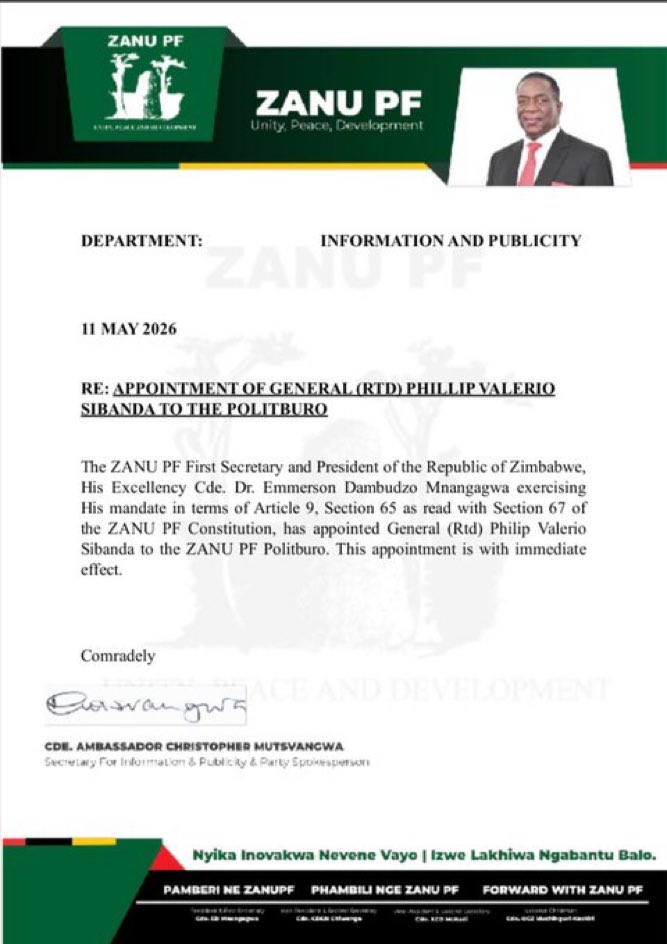
General Sibanda’s initial appointment to the ZANU PF Politburo on 28 October 2023, as an ex-officio member, was met with immediate legal challenges. Critics swiftly pointed out that such an appointment for a serving military officer was a clear violation of Zimbabwe’s constitutional provisions, which mandate a clear separation between the military and partisan politics. The Zimbabwe Lawyers for Human Rights (ZLHR) were among those who raised objections, arguing that the move undermined the principles of a democratic state. In response to the outcry and legal threats, President Mnangagwa swiftly reversed or stayed the appointment in November 2023. This reversal underscored the constitutional imperative to maintain the military’s neutrality and prevent its entanglement in party politics. However, the initial attempt to appoint Sibanda while he was still a serving general highlighted a persistent tension between political expediency and constitutional adherence within Zimbabwe’s governance. The swift legal challenge and subsequent reversal demonstrated the vigilance of civil society organisations in upholding democratic principles, even in the face of powerful political manoeuvres. The incident also served as a stark reminder of the historical precedents of military involvement in Zimbabwean politics, prompting renewed scrutiny of the boundaries between the armed forces and the ruling party.
Now that General Sibanda is no longer a serving military officer, having retired from his position as Commander of the Zimbabwe Defence Forces, the legal impediments to his political appointment have been removed. This development paves the way for his formal integration into the ZANU PF Politburo, and potentially, higher office. The strategic timing of his retirement and subsequent political entry suggests a carefully orchestrated plan, aimed at leveraging his respected status and military background for political ends. This move is particularly significant given the ongoing succession debates within ZANU PF, where the influence of key figures and their alignment with various factions can dramatically alter the political landscape. Sibanda’s clean record and perceived impartiality could make him a unifying figure, capable of bridging divides within the party and presenting a more palatable image to the wider public.
Kembo Mohadi: Health Concerns, Resignation, and the Succession Puzzle
The political trajectory of Vice President Kembo Mohadi has been marked by both resilience and vulnerability, making his position a critical element in the unfolding succession drama. At 74 years of age, Mohadi’s health has been a recurring subject of public discussion and concern. Reports of him collapsing during a rally in Gutu in October 2023, and more recently during a lecture at the University of Zimbabwe on 31 May 2024, have fuelled speculation about his capacity to continue in such a demanding role. These incidents, widely reported in local media, have brought his physical well-being into sharp focus, prompting questions about the sustainability of his tenure as Vice President. It is widely rumoured that Mohadi has expressed a desire to retire due to his advanced age and health challenges, but his requests have reportedly been unapproved, largely due to the intricate and often volatile nature of ZANU PF’s internal succession battles.
Mohadi’s role in the succession matrix is particularly crucial because he is widely regarded as a neutral figure, unaligned with either the faction supporting President Mnangagwa or that backing Vice President Constantino Chiwenga. This neutrality has made him an indispensable balancing act within the party, preventing the factional fights from escalating into unmanageable chaos. His departure, therefore, would inevitably create a vacuum, potentially intensifying the power struggles within ZANU PF. The history of his political career further underscores his significance. In March 2021, Mohadi resigned from his position as Vice President following a series of sexual misconduct allegations that garnered significant media attention. However, after President Mnangagwa was re-elected for a second term, Mohadi was re-appointed, highlighting the critical nature of his role in maintaining party stability and the delicate balance of power. This re-appointment, despite the controversy, demonstrated how crucial his presence was to the ruling party’s internal dynamics, particularly in the absence of a clear, universally accepted successor.
The potential for General Sibanda to step into Mohadi’s shoes is now a significant point of discussion. With Sibanda’s retirement from the military, the path for his formal political appointment has been cleared, making him a viable candidate for the Vice Presidency. This move could be a strategic solution to the succession dilemma, allowing Mohadi to retire gracefully while introducing a respected and influential figure into the top echelons of ZANU PF. The implications of such a transition are far-reaching, potentially reshaping the future leadership of Zimbabwe and influencing the country’s political stability for years to come. The question remains whether Sibanda’s entry will indeed smooth over the factional divides or merely introduce a new dynamic into an already complex political landscape.
The Unity Accord: A Historical Imperative and Sibanda’s Candidacy
The 1987 Unity Accord, signed between Robert Mugabe’s ZANU and Joshua Nkomo’s PF-ZAPU, remains a cornerstone of Zimbabwe’s political architecture, particularly concerning the distribution of power within the executive. This historic agreement, forged in the aftermath of the Gukurahundi massacres, aimed to foster national unity and reconciliation by merging the two liberation movements into a single political entity, ZANU PF. A key provision of this accord stipulated that of the two Vice Presidents, one must originate from the former ZANU (ZANLA forces) and the other from the former ZAPU (ZIPRA forces). This constitutional arrangement was designed to ensure equitable representation and to acknowledge the contributions of both liberation armies to Zimbabwe’s independence.
General Philip Valerio Sibanda, a distinguished former ZIPRA combatant, fits this historical and political requirement perfectly. As one of the most senior and respected former ZIPRA members still alive, his candidacy for the Vice Presidency aligns seamlessly with the spirit and letter of the Unity Accord. His appointment would not only honour the foundational principles of the agreement but also provide a sense of continuity and inclusivity within the ruling party. In a political climate often fraught with factionalism and regional tensions, Sibanda’s ZIPRA background could serve as a unifying factor, appealing to a broader base of support and reinforcing the party’s commitment to national unity. His military background, coupled with his perceived neutrality, further strengthens his appeal as a candidate capable of bridging historical divides.
Should Kembo Mohadi’s retirement be approved, Sibanda’s elevation to Vice President would be a logical and strategically sound move. It would allow ZANU PF to adhere to the provisions of the Unity Accord while introducing a figure who commands respect across various political and military spectra. This adherence to historical agreements is not merely symbolic; it is a crucial element in maintaining political legitimacy and stability in a country where historical grievances can easily resurface. Sibanda’s deep roots in the liberation struggle and his association with ZIPRA provide him with an unassailable claim to this position, making him a formidable and widely acceptable candidate for the role. The Unity Accord, therefore, provides a powerful historical and political justification for his potential ascent, positioning him as a natural successor within the established framework of Zimbabwean politics.
The “Straight Jacket” Statement: Military Influence and Presidential Succession
The indelible mark of military influence on Zimbabwe’s political landscape is perhaps best encapsulated by the infamous “straight jacket” statement, delivered by then-Commander of the Zimbabwe Defence Forces, General Vitalis Zvinavashe, on 9 January 2002. This pronouncement, made just months before a hotly contested presidential election, served as a stark warning to any aspiring leader who did not align with the military’s interpretation of the liberation struggle’s objectives. Zvinavashe declared:
“Let it be known that the highest office in the land is a straight jacket whose occupant is expected to observe the objectives of the liberation struggle. We will, therefore, not accept, let alone support anyone with a different agenda that threatens the very existence of our sovereignty, our unity and our fundamental interests.”
This statement, widely interpreted as a direct threat to opposition leader Morgan Tsvangirai, underscored the military’s self-appointed role as the ultimate arbiter of political power in Zimbabwe. It effectively communicated that the armed forces would not countenance a leader without liberation credentials, irrespective of the democratic outcome. Indeed, despite Tsvangirai’s electoral successes in subsequent years, he never managed to ascend to the presidency, a reality often attributed to the military’s unwavering stance. The “straight jacket” declaration has since become a chilling reminder of the military’s pervasive influence and its capacity to shape political outcomes, often overriding the popular will.
In this context, General Philip Valerio Sibanda’s military background and his respected standing within the armed forces become paramount. In Zimbabwe, the tacit approval of the military is often considered a prerequisite for assuming the presidency. If the army is not content with a particular individual becoming their Commander-in-Chief, their inauguration as the nation’s president would be an arduous, if not impossible, task. Sibanda’s generally clean record and his ability to maintain professional relationships across political and military divides make him an ideal candidate in this regard. He is widely respected, not only by his former comrades but also by elements within the opposition, a rare feat in Zimbabwe’s polarised political environment. This broad acceptance within the military and political spheres positions him as a figure who could potentially garner the necessary support to navigate the complex path to the presidency.
His perceived neutrality, coupled with his deep military roots, makes him a formidable contender for future leadership. Unlike some of his more overtly political counterparts, Sibanda has cultivated an image of a disciplined and professional soldier, committed to the welfare of the nation rather than partisan interests. This perception could be crucial in securing the military’s backing, a factor that has historically proven decisive in Zimbabwean presidential politics. The “straight jacket” statement, therefore, serves not only as a historical precedent but also as a contemporary lens through which to understand the critical importance of military endorsement in the quest for Zimbabwe’s highest office. Sibanda’s profile aligns well with the implicit requirements set forth by Zvinavashe, making him a strong candidate for not just the Vice Presidency, but potentially the ultimate leadership role.
Power Dynamics within ZANU PF: Sidelines and Strategic Moves
The internal power dynamics within ZANU PF are a complex web of alliances, rivalries, and strategic manoeuvres, all aimed at securing influence and positioning for future leadership. President Mnangagwa’s decision to bring General Philip Valerio Sibanda into the Politburo, and potentially elevate him to the Vice Presidency, can be viewed through the prism of these intricate power struggles. One prevailing interpretation is that this move is a calculated effort by Mnangagwa to consolidate his own power base and, crucially, to sideline potential rivals, particularly Vice President Constantino Chiwenga.
Chiwenga, a powerful figure in his own right and a key architect of the 2017 ‘Operation Restore Legacy’ that brought Mnangagwa to power, has long been considered a formidable contender for the presidency. However, recent developments suggest a growing divergence between the two leaders, with various reports indicating a subtle but persistent power struggle. By introducing Sibanda, a respected military figure with a clean record and perceived neutrality, Mnangagwa could be strategically introducing a new dynamic into the succession equation. Sibanda’s presence could dilute Chiwenga’s influence, offering an alternative centre of power and potentially disrupting Chiwenga’s long-held ambitions. This strategy would allow Mnangagwa to maintain a delicate balance, preventing any single faction from becoming overly dominant and thereby strengthening his own position at the helm of the party.
Furthermore, Sibanda’s appointment could be a move to address the ongoing factionalism within ZANU PF. The party has historically been plagued by internal divisions, often along lines of loyalty to different leaders. By bringing in a figure like Sibanda, who is widely respected across various divides, Mnangagwa could be attempting to foster greater unity and cohesion within the party. His perceived impartiality could make him an acceptable compromise candidate, capable of bridging the gap between warring factions and presenting a more unified front. This would not only strengthen ZANU PF’s internal stability but also enhance its public image, particularly in the run-up to future elections.
However, another perspective suggests that Sibanda’s elevation is not merely about sidelining rivals but is a genuine attempt to strengthen the party by bringing in competent and respected individuals. His military background and experience in national and international peace-keeping missions provide him with a unique skill set that could be invaluable to the party and the nation. In this view, Mnangagwa is not just playing political chess but is genuinely seeking to enhance the quality of leadership within ZANU PF, preparing for a future where stability and competence are paramount. The true motives behind this strategic move will likely unfold over time, but its immediate impact on the power dynamics within ZANU PF is undeniable, setting the stage for a fascinating period in Zimbabwean politics.
Public Perception and Stakeholder Reactions
The appointment of General Philip Valerio Sibanda to the ZANU PF Politburo, and the broader implications for his potential ascent to higher office, have elicited a diverse range of reactions from various stakeholders within Zimbabwe and beyond. Public perception, often shaped by historical experiences and current political realities, is a critical factor in determining the legitimacy and acceptance of such a significant political development. While some view Sibanda’s potential rise with optimism, seeing him as a unifying and professional figure, others express deep-seated concerns about the continued militarisation of civilian politics and the erosion of democratic norms.
Opposition parties have largely voiced strong objections, decrying the move as a further consolidation of power by the ruling ZANU PF and a blatant disregard for constitutional principles. Their primary concern revolves around the blurring of lines between the military and political structures, arguing that it undermines the independence of state institutions and creates an uneven playing field for democratic competition. They often point to the historical role of the military in influencing electoral outcomes and suppressing dissent, fearing that Sibanda’s elevation could entrench these practices. These parties advocate for a clear separation of powers and a return to civilian rule, where political leadership is determined solely through democratic processes, free from military interference.
Civil society organisations (CSOs) have echoed similar concerns, emphasising the importance of constitutionalism and good governance. They argue that the integration of military figures into high-ranking political positions, even after retirement, sets a dangerous precedent, potentially paving the way for increased authoritarianism. CSOs are particularly vigilant about safeguarding democratic institutions and ensuring that the military remains subservient to civilian authority. They often call for greater transparency and accountability in political appointments, urging the government to prioritise merit and democratic principles over political expediency. Their advocacy plays a crucial role in holding the government accountable and raising awareness about potential threats to democratic freedoms.
Conversely, some segments of the public, particularly those who value stability and order, may view Sibanda’s potential leadership positively. His reputation for professionalism and his perceived neutrality could be seen as a welcome change from the often-polarised political landscape. For those weary of political infighting and instability, a strong, disciplined leader with military backing might offer a sense of security and direction. This perspective often stems from a desire for pragmatic governance and a belief that a military figure can bring efficiency and discipline to the administration. The narrative of Sibanda as a unifying figure, capable of transcending factional divides, resonates with those who yearn for national cohesion and progress.
The international community, while often cautious in its pronouncements, is likely to be closely monitoring these developments. Concerns about democratic backsliding, human rights, and the rule of law are frequently raised by international bodies and foreign governments. The appointment of a military general to a prominent political role could trigger scrutiny, particularly from Western nations and international organisations that advocate for democratic reforms. While they may acknowledge the internal political dynamics at play, their primary focus will remain on adherence to international democratic standards and the protection of fundamental freedoms. The perception of Zimbabwe’s political trajectory on the international stage will undoubtedly be influenced by how this transition is managed and its impact on the country’s democratic institutions.
Ultimately, the reactions to General Sibanda’s potential ascent are multifaceted, reflecting the complex political, historical, and social fabric of Zimbabwe. The interplay between domestic expectations and international scrutiny will shape the narrative surrounding his leadership, determining whether his rise is seen as a step towards greater stability or a further entrenchment of authoritarian tendencies. The coming months will undoubtedly reveal the true extent of his influence and the long-term consequences of this pivotal appointment for the nation’s democratic future.
Conclusion: A Pivotal Moment for Zimbabwe
General Philip Valerio Sibanda’s journey from a decorated liberation fighter and military commander to a prominent figure within ZANU PF’s Politburo marks a pivotal moment in Zimbabwe’s political history. His potential ascent to the Vice Presidency, and even the ultimate leadership, is a development fraught with both promise and peril. On one hand, his widely acknowledged professionalism, perceived neutrality, and adherence to the Unity Accord offer a compelling narrative of a unifying figure capable of stabilising a fractured political landscape. His military background, far from being a hindrance, could be seen as an asset in a country where the armed forces play a decisive role in political transitions, as evidenced by the enduring legacy of the “straight jacket” statement.
On the other hand, his integration into the highest echelons of civilian politics raises legitimate concerns about the continued militarisation of state institutions and the potential erosion of democratic principles. Critics fear that such appointments could further entrench authoritarian tendencies, undermining the delicate balance of power and stifling genuine democratic competition. The delicate health of Vice President Kembo Mohadi and the intricate factional battles within ZANU PF only add layers of complexity to this unfolding drama, making Sibanda’s role even more critical.
President Mnangagwa’s strategic manoeuvring, whether aimed at consolidating his own power, sidelining rivals like Chiwenga, or genuinely strengthening the party with competent leadership, has undeniably set in motion a chain of events that will reshape Zimbabwe’s political future. The reactions from opposition parties, civil society organisations, and the international community underscore the high stakes involved, highlighting the ongoing tension between political expediency and democratic ideals.
As Zimbabwe stands at this crossroads, the coming period will be crucial in determining the nation’s trajectory. Will General Sibanda’s rise usher in an era of stability and national cohesion, or will it deepen the concerns about military influence and democratic governance? The answers will depend not only on the actions of key political actors but also on the vigilance of civil society and the continued engagement of the international community. This is not merely a story of political appointments; it is a narrative that speaks to the very soul of Zimbabwe’s democratic aspirations and its ongoing quest for a just and equitable future.