


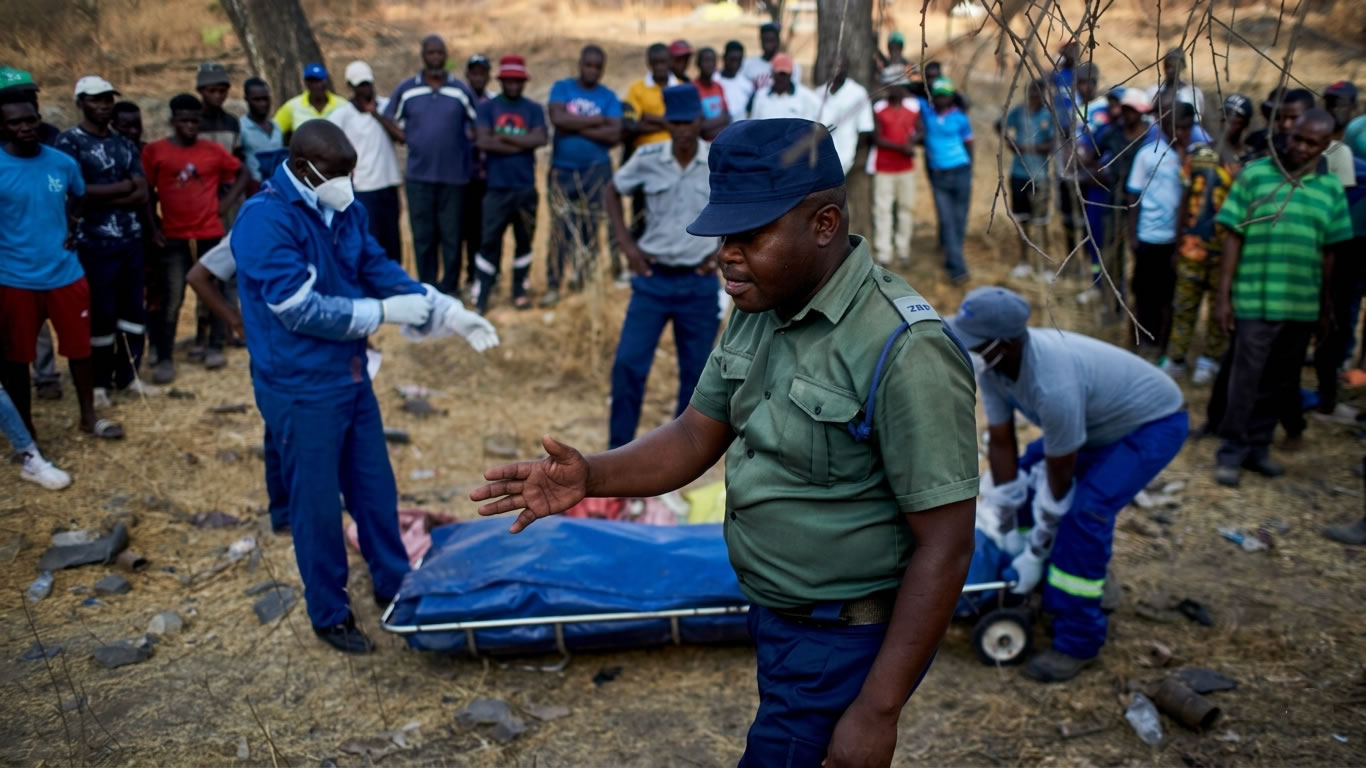
Goromonzi – In a tale of extraordinary human endurance against the unforgiving depths of the earth, Pardon Ruvengo, a 23-year-old miner from Guernsey Gold Mine in Goromonzi, has emerged from a collapsed shaft after an astonishing eight days. His survival, a beacon of hope amidst the grim realities of Zimbabwe’s artisanal mining sector, comes with a heavy heart, as his colleague, 21-year-old Innocent Mhere, perished beside him. This harrowing incident casts a stark light on the escalating dangers faced by thousands of informal miners across the nation, a crisis further underscored by a spate of recent fatalities in similar circumstances.
Ruvengo’s ordeal began when the shaft at Guernsey Gold Mine gave way, trapping him and Mhere in a subterranean tomb. For eight days, cut off from the world above, Ruvengo battled starvation, dehydration, and the crushing despair of watching his friend succumb to the harsh conditions. His younger brother, 18-year-old Kudakwashe Junior, who had joined them at the mine to earn money for his education, narrowly escaped the collapse, becoming the bearer of the devastating news to their family.
“I want to believe God has a reason for giving me another chance to live,” Ruvengo recounted yesterday, speaking after his discharge from a private hospital where he had spent three days recovering. His voice, though weak, carried the weight of his experience, a testament to the psychological and physical toll of his entrapment. The collapse had plunged them into an abyss where time lost all meaning. With no food or clean water, he and Mhere resorted to collecting urine in a small container and drinking it to survive. “I watched my friend lose his life beside me,” he said, the memory visibly etched on his face. “At some point, I was about to feed on my faeces to survive.”
His vivid dreams, where relatives and colleagues discussed rescue plans, offered a surreal escape from the grim reality. “It’s amazing — God’s grace. I believe God had a reason for rescuing me,” he affirmed, a flicker of hope in his eyes. Hospital staff, witnessing his miraculous recovery, celebrated his discharge, with some even posing for photographs. One nurse, in a moment of light-heartedness, joked that he should marry her, declaring, “a man who survives eight days underground is a miracle.”
Back in Munorwei Village under Chief Bota in Zaka, his survival has been met with disbelief and joyous gatherings at the Ruvengo homestead. “Everyone at the village is yet to believe that Pardon is alive,” shared his 47-year-old father, Kudakwashe Ruvengo. He recounted how Pardon’s mother, who had been emotionally distraught, regained her strength after speaking to her son during his resuscitation. “As we speak, some villagers are still gathered at our homestead waiting to witness the miracle. It’s God who gives life,” he added, his voice filled with gratitude.
Kudakwashe also revealed that the family was informed of the accident by Pardon’s younger brother, Kudakwashe Junior, who had managed to escape the tunnel moments before its collapse. The teenager had joined his elder brother at the mine with the hope of raising funds for his education, having recently passed his Ordinary Level examinations. This detail highlights the desperate economic circumstances that often drive young Zimbabweans into the perilous world of artisanal mining.
Pardon, the eldest of five children and an active member of the ZCC Mbungo Church, has unequivocally stated his intention to abandon mining. Instead, he plans to pursue a driver’s licence and train to operate earth-moving machinery, a safer and more sustainable livelihood. “I want to thank God, my colleagues, friends, relatives, and the staff at Pacific 24-Hour Hospital for being used by the Creator for my survival,” he expressed, before departing Harare with his father for Zaka, where his community eagerly awaited his return.
The Dark Underbelly of Zimbabwe’s Gold Rush: A National Crisis
Ruvengo’s miraculous survival, while a cause for celebration, serves as a poignant reminder of the pervasive dangers within Zimbabwe’s artisanal and small-scale mining (ASM) sector. This sector, a significant contributor to the nation’s gold output, is also a hotbed of unregulated activity, poor safety standards, and frequent fatalities. The allure of gold, often the only viable path to economic survival for many, draws thousands into dangerous, often illegal, operations, where rudimentary tools and a lack of proper safety equipment are the norm.
Recent incidents paint a grim picture of this ongoing crisis. Just days before Ruvengo’s rescue, on 6 May 2026, three artisanal miners tragically lost their lives at Temstan Mine in Pickstone, Chegutu. A massive boulder fell on them while they were working in a 100-metre-deep vertical shaft, a stark illustration of the extreme conditions faced by these miners. The Zimbabwe Republic Police confirmed the incident, noting that the miners were prospecting for gold when the collapse occurred. Rescue teams recovered their bodies, which were then transported to Chegutu District Hospital mortuary for post-mortem examinations. Investigations into the circumstances surrounding this collapse are ongoing, yet the pattern of poorly supported shafts and limited safety equipment continues to emerge as a recurring theme in such tragedies.
This incident in Chegutu is not isolated. Between January and May 2025, Zimbabwean authorities recorded a staggering 59 fatal mining accidents, resulting in 70 deaths. This marks a concerning increase compared to the 58 accidents recorded in the previous period. The Midlands province, in particular, has been severely affected, recording 37 deaths in the 2025/2026 rainy season alone due to flooding and flood-related accidents. Among these tragic incidents were seven artisanal miners who were trapped and drowned after a mining shaft was inundated by heavy rains. These figures underscore the urgent need for enhanced safety regulations and their stringent enforcement across the country’s mining operations.
The human cost of this unregulated gold rush extends beyond individual tragedies. Families are left without breadwinners, and communities grapple with the emotional and economic fallout. The story of Kudakwashe Junior, driven to the mines to fund his education, is a common narrative, reflecting the broader societal pressures that push individuals into such high-risk occupations. The government’s efforts to step up mine inspections, particularly after the fatal Chegutu accidents, are a welcome development, but much more is needed to address the systemic issues plaguing the ASM sector.
A Call for Greater Accountability and Sustainable Solutions
The recurring nature of these mining disasters necessitates a comprehensive approach that prioritises the safety and well-being of artisanal miners. This includes, but is not limited to, stricter enforcement of existing mining regulations, provision of adequate safety equipment, and training programmes on safe mining practices. Furthermore, there is a critical need to formalise the artisanal mining sector, integrating it into the mainstream economy to ensure better oversight and support for miners.
The economic imperative driving artisanal mining cannot be ignored. For many, it represents the only immediate source of income. Therefore, any solution must also address the root causes of poverty and unemployment that compel individuals to undertake such dangerous work. Diversifying economic opportunities and investing in alternative livelihoods could significantly reduce the pressure on individuals to engage in hazardous mining activities.
Organisations working in the mining sector, both governmental and non-governmental, have a crucial role to play in advocating for and implementing these changes. The stories of Pardon Ruvengo and Innocent Mhere, and the countless others who have lost their lives or suffered injuries, should serve as a powerful impetus for collective action. It is imperative that the lessons from these tragedies are learned and translated into tangible improvements in mining safety and worker protection.
As Pardon Ruvengo embarks on a new chapter, leaving behind the dark and dangerous world of mining, his survival stands as a testament to human resilience. Yet, it also serves as a stark reminder of the urgent need to reform a sector that continues to claim too many lives. The gold that fuels Zimbabwe’s economy must not be stained with the blood of its people.
The narrative of Pardon Ruvengo and Innocent Mhere is not merely a story of survival and loss; it is a microcosm of a much larger socio-economic crisis gripping Zimbabwe. The nation, rich in mineral resources, has seen a surge in artisanal and small-scale mining activities, particularly in gold. This informal sector, often operating outside the purview of formal regulations, has become a lifeline for many struggling with high unemployment rates and limited economic opportunities. However, this lifeline is fraught with peril.
Artisanal miners, often referred to as ‘makorokoza’, work in extremely hazardous conditions. They frequently employ rudimentary tools and methods, digging narrow, unstable shafts that are prone to collapse. The lack of proper geological surveys, engineering expertise, and safety equipment turns every descent into a gamble with death. Beyond collapses, miners face risks from inadequate ventilation, leading to suffocation, and exposure to toxic chemicals like mercury, used in gold extraction, which poses severe long-term health consequences. The absence of protective gear, such as helmets, safety boots, and headlamps, further exacerbates their vulnerability.
The economic drivers behind this dangerous pursuit are complex and deeply rooted. For many rural communities, artisanal mining offers the quickest, if not the only, route to immediate income. A good day in the mine can yield enough to feed a family for a week, a powerful incentive in a country where formal employment is scarce and poverty is widespread. This desperation often overrides concerns for personal safety, pushing individuals, including young people like Kudakwashe Junior, into the depths of the earth. The dream of striking it rich, or simply earning enough to survive, overshadows the ever-present threat of disaster.
Moreover, the informal nature of the sector makes it difficult for authorities to monitor and regulate. While the government has expressed intentions to formalise artisanal mining, progress has been slow. The vastness of mining areas, coupled with limited resources for inspection and enforcement, means that many operations continue unchecked. This regulatory vacuum allows unsafe practices to persist, contributing to the alarmingly high rates of accidents and fatalities. The economic benefits, while significant for individual miners and the national gold output, come at an unacceptably high human cost.