


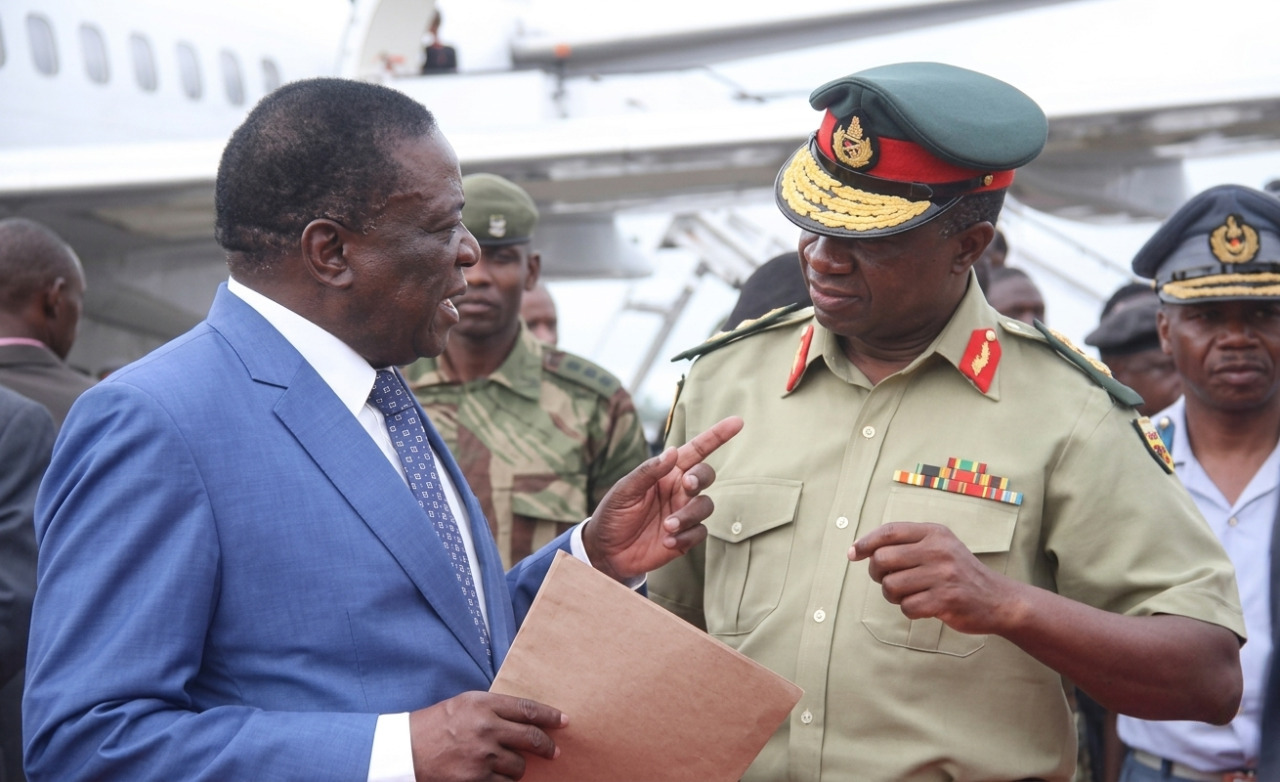
President Emmerson Mnangagwa’s recent appointment of retired General Philip Valerio Sibanda to the ZANU-PF Politburo has cast a long shadow over Zimbabwe’s political landscape. While presented as a routine party appointment, this move signifies a profound and troubling militarisation of the ruling party’s inner circle. This investigative article will delve into the strategic implications of placing a former army chief at the very heart of ZANU-PF’s decision-making body, exploring the legal and constitutional controversies that inevitably arise when recently retired military personnel assume partisan political roles.
More critically, we will connect this appointment to the ongoing ‘2030 Agenda’ – the concerted effort to extend President Mnangagwa’s presidential term. The central question remains: Is General Sibanda being strategically positioned to enforce party discipline and suppress internal dissent regarding the third-term bid? By examining the historical role of the military in Zimbabwe’s politics, particularly the pivotal events of November 2017, this piece will scrutinise whether this appointment is a preemptive manoeuvre to secure military backing for impending constitutional amendments. Unpacking the intricate power dynamics within both the Politburo and the broader military establishment, this analysis aims to provide readers with a critical understanding of the forces currently shaping Zimbabwe’s precarious political future.
The Appointment of a Military Veteran to the Party’s Core
On 11th May 2026, President Emmerson Mnangagwa officially appointed General (Rtd) Philip Valerio Sibanda to the ZANU-PF Politburo, the party’s highest decision-making body. The announcement was made by ZANU-PF spokesperson Christopher Mutsvangwa, who stated that the appointment was effective immediately. Mutsvangwa affirmed, “The Zanu PF First Secretary and President of the Republic of Zimbabwe, His Excellency Cde. Dr. Emmerson Dambudzo Mnangagwa, exercising his mandate under Article 9, Section 65 as read with Section 67 of the Zanu PF Constitution, has appointed General (Rtd) Philip Valerio Sibanda to the Zanu PF Politburo. This appointment is with immediate effect”.
This is not the first time such an appointment has been attempted. In late 2023, while Sibanda was still the active Commander of the Zimbabwe Defence Forces (ZDF), President Mnangagwa had appointed him as an ex-officio Politburo member. However, that move was swiftly withdrawn following widespread criticism and legal challenges, which highlighted its violation of Section 208(2) of the Zimbabwean Constitution. This section explicitly prohibits members of the security services from participating in partisan political activities or advancing the interests of any political party. Sibanda officially retired from military service in November 2025, paving the way for this latest appointment. While technically retired, critics argue that the rapid transition from the highest military office to a top party position still contravenes the spirit of a non-partisan security service, as enshrined in the Constitution.
General Philip Valerio Sibanda: A Profile in Uniform
General Philip Valerio Sibanda, known by his war alias Ananias Gwenzi, is a highly decorated military figure with a long history in Zimbabwe’s liberation struggle. His military training took place in Morogoro, Tanzania, under the tutelage of figures like Retired Brigadier Ambrose Mutinhiri. Sibanda was a combatant in ZIPRA (Zimbabwe People’s Revolutionary Army), the armed wing of ZAPU, during the liberation war.
His career post-independence saw him rise through the ranks, eventually succeeding Constantino Chiwenga as the Commander of the ZDF in 2017. Throughout his tenure, Sibanda cultivated a reputation as a “calm and stabilising presence” within the military establishment. He is often described as an “intellectual” and a “man with no scandals,” a rare distinction among Zimbabwe’s political and military elite. His origins in the Midlands province, the same region as President Mnangagwa, also suggest a potential regional loyalty that could be exploited in the intricate web of ZANU-PF politics.
The ‘2030 Agenda’: Mnangagwa’s Quest for Extended Rule
At the heart of the current political machinations is President Mnangagwa’s ‘2030 Agenda,’ a determined push to extend his presidential term beyond the constitutionally mandated two terms, which would typically end in 2028. The agenda is often articulated through slogans such as “ED2030” and “Mnangagwa will still be there in 2030,” indicating a clear intent to remain in power. This extension would necessitate significant constitutional amendments, a process that requires considerable political leverage and control within the ruling party and parliament.
The drive for the 2030 Agenda has been gaining momentum, with various ZANU-PF provincial structures passing resolutions in support of the term extension. Notably, the Midlands, Masvingo, and Mashonaland West provinces have been at the forefront of this campaign. These resolutions are crucial as they provide a veneer of grassroots support for what is essentially a top-down political manoeuvre. However, this agenda has not been without its challenges, both from within the party and from civil society.
The Military’s Enduring Shadow in Zimbabwean Politics
The Zimbabwean military has historically played a disproportionately influential role in the nation’s political affairs, often blurring the lines between state security and partisan politics. This deep entanglement dates back to the liberation struggle, where the armed wings of ZANU (ZANLA) and ZAPU (ZIPRA) were intrinsically linked to their political counterparts. After independence, this alliance was institutionalised, with the military often viewing itself as the ultimate “guardian of the revolution”.
One of the earliest and most brutal examples of military intervention in post-independence politics was the Gukurahundi massacres between 1982 and 1987. During this period, the North Korean-trained Fifth Brigade was deployed to suppress perceived opposition in Matabeleland and Midlands, resulting in widespread atrocities. This event established a chilling precedent for the use of military force to achieve political objectives.
More recently, the military’s influence was starkly evident during the 2008 general elections. Following Robert Mugabe’s first-round loss to opposition leader Morgan Tsvangirai, the military reportedly launched “Operation Makavhoterapapi” (Where did you put your vote?). This campaign of intimidation and violence effectively forced Tsvangirai to withdraw from the presidential run-off, securing Mugabe’s continued rule. These incidents underscore a consistent pattern of military intervention to safeguard ZANU-PF’s hold on power, often at the expense of democratic processes and human rights.
Operation Restore Legacy (2017): A Blueprint for Militarisation
The events of November 2017, euphemistically termed “Operation Restore Legacy,” represent the most overt and significant military intervention in Zimbabwe’s recent history. This military-led operation ultimately resulted in the removal of long-time President Robert Mugabe and the ascension of Emmerson Mnangagwa to power. The operation was ostensibly aimed at rooting out “criminals” surrounding Mugabe, but it was widely understood as a move to prevent the G40 faction, led by Grace Mugabe, from succeeding the ageing president.
General Philip Valerio Sibanda played a crucial, albeit less public, role in this coup. As the then-Commander of the Zimbabwe National Army (ZNA), he was the one who famously announced the end of the operation, stating that “normal police duties are to begin” after the military had effectively sidelined the pro-Mugabe police force. His involvement provided a veneer of professionalism and order to what was essentially a military takeover. While Constantino Chiwenga, then ZDF Commander, was the political face of the coup, Sibanda’s operational command was indispensable. Following the coup, many military leaders, including Chiwenga (who became Vice President), Sibusiso Moyo, and Perence Shiri, transitioned into key cabinet and party positions, further cementing the “Military-Party Alliance”. This established a clear blueprint for the integration of military figures into the highest echelons of political power.
Factionalism and Mnangagwa’s ‘Insurance Policy’
ZANU-PF has a long history of intense internal factionalism, and the current political climate is no exception. The primary struggle is between President Mnangagwa and his deputy, Vice President Constantino Chiwenga. Chiwenga, who led the 2017 coup, has long been seen as Mnangagwa’s heir apparent and reportedly expects to succeed him in 2028. Mnangagwa’s pursuit of the 2030 Agenda directly obstructs Chiwenga’s ambitions, intensifying the power struggle.
In this context, General Sibanda’s appointment to the Politburo is widely interpreted as a calculated move by Mnangagwa to consolidate his power and neutralise Chiwenga’s influence. As Nehanda Radio observed on 12th May 2026, “In appointing Sibanda, President Emmerson Mnangagwa is executing a sophisticated insurance policy against his deputy, Constantino Chiwenga”. Sibanda, despite his military background, is perceived as less overtly partisan than Chiwenga and has a reputation for being a “man with no scandals.” This makes him an ideal counterweight to Chiwenga, who commands significant loyalty within certain segments of the military.
The ZANU-PF internal dynamics can be broadly categorised into various factions: the ‘Lacoste’ faction (aligned with Mnangagwa and supported by the military and war veterans), the now-defunct ‘G40’ faction (aligned with Grace Mugabe and previously supported by elements of the police), and a more recent ‘Uniforms vs. Civvies’ dynamic, where military-background leaders compete with traditional civilian politicians. By bringing Sibanda into the Politburo, Mnangagwa is effectively securing a loyalist from the military’s top brass, ensuring that a significant portion of the security establishment remains aligned with his 2030 agenda, thereby weakening Chiwenga’s power base within the military-party alliance.
Legal and Constitutional Controversies: A Spirit Betrayed?
The legal and constitutional implications of General Sibanda’s appointment are a subject of intense debate. While his retirement in November 2025 technically removes him from active military service, critics argue that the rapid transition into a high-ranking political position still violates the spirit, if not the letter, of the Zimbabwean Constitution. Section 208(2) and (3) of the Constitution are clear: “Members of the security services must not be partisan, must not belong to any political party or organisation, and must not further the interests of any political party or cause”. Furthermore, Section 211 reiterates the principle of military neutrality.
Legal experts contend that the intent behind these constitutional provisions is to ensure a clear separation between the armed forces and partisan politics, thereby safeguarding the military’s professional integrity and its role as a neutral protector of the state, rather than a tool of the ruling party. Dr Vusumuzi Sibanda, a legal analyst, commenting on the broader constitutional amendments related to the 2030 term extension bid in February 2026, highlighted how such shifts could “significantly alter Zimbabwe’s electoral system”. The concern is that by appointing recently retired generals to key party positions, the ruling elite is effectively circumventing the constitutional safeguards designed to prevent the militarisation of civilian governance.
A Climate of Suppression: Recent Incidents
The push for the 2030 Agenda has coincided with a noticeable increase in political tensions and incidents of suppression. Reports from March 2026 detailed a “brutal assault on Madhuku in Harare,” which was cited as a chilling example of the state machinery being abused to silence dissent. In October 2025, a hall in Harare was reportedly torched during a protest against the third-term bid, highlighting the volatile atmosphere surrounding the issue. There have also been accounts of state agents disrupting union meetings, such as one in Tsholotsho, further illustrating a pattern of suppressing any opposition to the ruling party’s agenda.
These incidents paint a picture of a political environment where the ruling party is prepared to use coercive measures to ensure its objectives are met. The appointment of a figure like General Sibanda, with his military background and reputation for discipline, could be seen as a move to further entrench this climate, ensuring that any internal or external opposition to the 2030 Agenda is met with a firm, potentially militarised, response.
Conclusion: A Deepening Militarisation
General Philip Valerio Sibanda’s appointment to the ZANU-PF Politburo is far more than a mere administrative reshuffle; it is a strategic move with profound implications for Zimbabwe’s political future. It represents a deepening militarisation of the ruling party, further blurring the already indistinct lines between the military, the party, and the state. This appointment serves multiple purposes for President Mnangagwa: it strengthens his hand in the ongoing power struggle with Vice President Chiwenga, secures military loyalty for his contentious 2030 Agenda, and provides a formidable figure to enforce party discipline and suppress dissent.
The historical trajectory of military involvement in Zimbabwean politics, from Gukurahundi to Operation Restore Legacy, demonstrates a consistent pattern of the armed forces acting as the ultimate guarantor of ZANU-PF’s power. Sibanda’s inclusion in the Politburo formalises this role, moving it from covert influence to overt participation at the highest level of party decision-making. While the legality of the appointment, given his recent retirement, remains a point of contention, its political significance is undeniable.
As Zimbabwe approaches the critical juncture of 2028 and the potential constitutional amendments required for the 2030 Agenda, the presence of a seasoned military commander like Sibanda in the Politburo signals a clear intent by President Mnangagwa to maintain a firm grip on power. The implications for democratic governance, the rule of law, and the prospects for a truly civilian-led political process are significant. The militarisation of ZANU-PF, epitomised by this appointment, suggests a future where military backing remains paramount in shaping the nation’s destiny.