


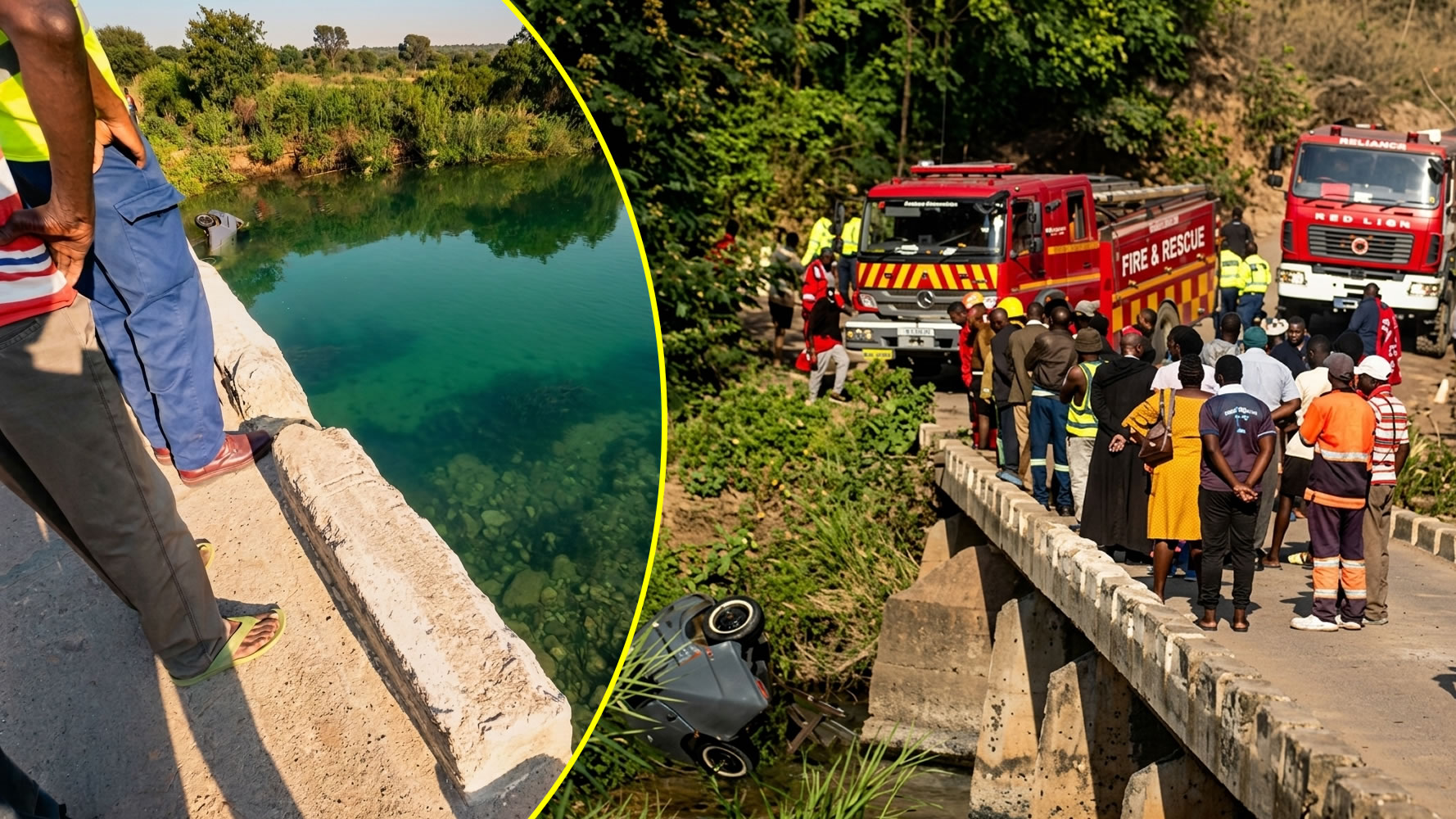
HWANGE – The morning mist had barely lifted from the valley when the quiet of the Deka Bridge was shattered by the screech of tyres and the sickening crunch of metal. In a tragedy that has left families across the Matabeleland North province in mourning, at least eight people were killed instantly on Saturday morning when a commuter omnibus, commonly known as a kombi, veered off the road and plunged into the depths of the Hwange River.
The vehicle, a white Toyota Hiace, was reportedly transporting fifteen congregants from the Roman Catholic Church who were returning from a spiritual gathering in Makwa. What was meant to be a journey of faith and fellowship ended in a watery grave for many of those on board. As the kombi approached the narrow bridge, witnesses described a scene of sudden, frantic movement before the vehicle breached the barriers and disappeared into the murky waters below.
Rescue teams, including divers from the Hwange Colliery Company and the Zimbabwe Power Company (ZPC), arrived to find a harrowing sight. The kombi was almost entirely submerged, with only its roof visible above the waterline. “When I arrived at the scene, the accident had just happened,” one witness, still visibly shaken, told reporters. “The kombi was almost submerged in the river. Some bodies had already been recovered from the water.”
By midday, eight bodies had been retrieved and laid on the riverbank, draped in blankets as police officers worked to identify the deceased. Two other passengers are feared to be trapped within the wreckage, which remains lodged in the riverbed. Amongst the chaos, five survivors were pulled from the wreckage, including the driver and three young children. They were rushed to Hwange Colliery Hospital, where several remain in critical condition, fighting for their lives against the trauma of the impact and the effects of near-drowning.
Preliminary investigations by the authorities suggest a catastrophic mechanical failure. It is alleged that the vehicle’s brakes failed as it descended the slope toward the bridge, leaving the driver powerless to stop the heavy kombi from careening into the river. This incident, however, is not an isolated tragedy but rather the latest entry in a grim ledger of accidents that have turned the Bulawayo-Victoria Falls road into one of the most dangerous stretches of tarmac in Southern Africa.
The highway, once a pride of the nation’s infrastructure, has devolved into what locals and frequent travellers now describe as a “jungle” and a “death trap.” For those who navigate the route between the country’s second-largest city and its premier tourist destination, the dangers are multifaceted. Potholes, some large enough to swallow a tyre whole, litter the road, forcing drivers into dangerous “slalom” manoeuvres that often lead to head-on collisions with oncoming traffic.
Adding to the peril is the frequent spill of coal from haulage trucks servicing the mines in Hwange. These spills, combined with the region’s dust, create a slippery surface that becomes treacherous during the light rains or even under the morning dew. Furthermore, the road cuts through several wildlife corridors. Drivers must contend not only with mechanical failures and poor road surfaces but also with the sudden appearance of elephants and buffaloes, particularly during the twilight hours.
According to police reports, the accident occurred around 4:00 PM. It is believed that Nyengetera was momentarily blinded by the excessively bright, non-standard LED headlights of an oncoming Isuzu truck. In his attempt to regain control while blinded, he found his path blocked by a stationary kombi that had stopped on the bridge to avoid its own collision. The massive Shacman truck veered wildly, crashed through the bridge’s railings, and plummeted into the Ngezi River. Like the victims in Hwange, Nyengetera was trapped inside his submerged cab; his body was only retrieved the following day by the Police Sub Aqua Unit.
The Ngezi Bridge has earned an unenviable reputation as a graveyard for heavy vehicles. In October 2025, two other chrome-laden haulage trucks plunged into the same river after a similar encounter with a stationary vehicle on the bridge. These recurring disasters point to a systemic failure in bridge design and maintenance. The barriers, intended to prevent vehicles from leaving the roadway, have proven woefully inadequate against the weight of modern haulage trucks and even smaller passenger vehicles.
“We once again reiterate our message to motorists that they exercise maximum caution when driving,” said Midlands Police spokesperson Mr Emmanuel Mahoko following the Ngezi tragedy. Yet, for many, the blame lies less with the drivers and more with the crumbling state of the nation’s arteries. The Bulawayo-Victoria Falls highway, in particular, has seen a surge in wildlife-vehicle collisions this year, prompting the Zimbabwe Parks and Wildlife Management Authority (Zimparks) to launch a campaign to curb the rising death toll.
The human cost of this infrastructure crisis was perhaps most poignantly illustrated on April 2, 2026, when a single accident on the Harare-Masvingo Road wiped out almost an entire family. Lilian Maranda Mujuru and her five children—Nokutenda, Makanaka, Ronald Junior, Rufaro Shalom, and Kayden—were travelling to a church conference when their Toyota Corolla collided with a Mercedes Benz truck near Mvuma. All six died instantly. The youngest victim, Kayden, was only three years old.
The statistics for the 2026 Easter holiday period paint a bleak picture of the national situation. Thirty people lost their lives on Zimbabwean roads during the break, an increase from the twenty-four deaths recorded in 2025. While the total number of accidents slightly decreased, the severity of the crashes has risen, with pedestrians making up more than half of the fatalities.
Back at the Deka Bridge in Hwange, the recovery operation continues. The Roman Catholic community is in mourning, struggling to process the loss of so many faithful members in a single, violent moment. The survivors face a long road to recovery, both physically and psychologically, after witnessing their friends and family members disappear beneath the water.
The Hwange River accident serves as a brutal reminder of the fragility of life on Zimbabwe’s roads. Whether it is the failure of brakes on a pilgrim-filled kombi, the blinding lights of a truck on the Ngezi Bridge, or the unavoidable potholes of the Victoria Falls highway, the risks remain unacceptably high. As the wreckage of the white Toyota Hiace is eventually hauled from the mud, the questions remain: how many more lives must be lost before the “death traps” are dismantled, and how many more families must be broken before the nation’s roads are made safe?
For now, the people of Hwange can only wait for the next report, the next siren, and the next tragedy on a road that seems to demand a heavy toll from all who travel it. The Hwange River flows on, silent and indifferent to the lives it has claimed, while the survivors are left to pick up the pieces of a Saturday morning that changed everything.