


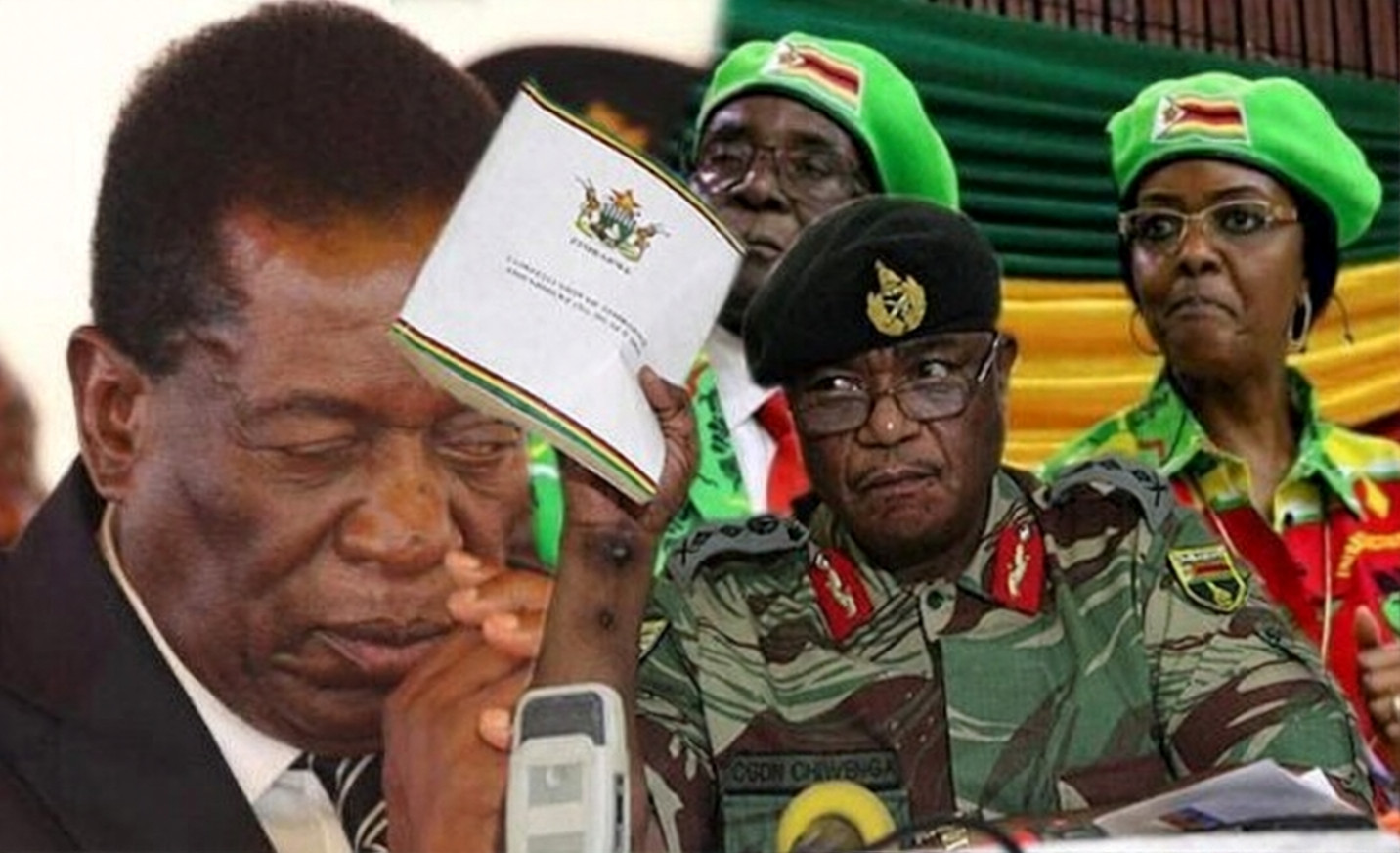
HARARE — In the high-stakes theatre of Zimbabwean politics, the most dangerous games are played in the shadows, far from the public handshakes and revolutionary slogans. At the heart of this unfolding drama stands Vice President Constantino Chiwenga, the “Iron General” whose 2017 military intervention unseated Robert Mugabe and fundamentally reshaped the nation. Yet, as the dust of that transition settles, a new and perhaps more treacherous battle is being fought. Recent developments suggest that Chiwenga’s anticipated ascent to the presidency is being systematically undermined by a “Shadow Cabinet” of loyalists surrounding President Emmerson Mnangagwa, turning the path to the throne into a labyrinth of tactical sabotage.
The appointment of Retired General Philip Valerio Sibanda to the ZANU-PF Politburo on 11 May 2026 serves as the most potent signal yet of this internal friction. Sibanda, who succeeded Chiwenga as the Commander of the Zimbabwe Defence Forces (ZDF), was formally inducted into the party’s supreme decision-making body, a move that many analysts view as a direct counter-weight to Chiwenga’s military influence. By bringing a soldier of Sibanda’s professional rectitude into the civilian political arena, Mnangagwa has effectively diluted Chiwenga’s monopoly over the voice of the barracks. As one seasoned analyst noted, “By bringing Philip Valerio Sibanda out of formal military retirement and placing him squarely within the party’s supreme decision-making organ, President Emmerson Mnangagwa has quietly moved to prevent Chiwenga from becoming politically inevitable.”
This strategy of institutional encirclement is not merely about personnel; it is about the very nature of power in what has become known as the “Barracks Republic.” Zimbabwe today exists in a state where the lines between the military and the cabinet room have all but dissolved. The liberation war’s command culture has become the permanent scaffolding of governance, creating a system where transition is never a simple ballot but a high-stakes negotiation between generals and politicians. This “security rule” ensures that any challenge to the status quo is met with a sophisticated array of administrative and coercive hurdles.
At the centre of the tension is the “ED2030” campaign—a movement pushing for President Mnangagwa to remain in office beyond his constitutional term. The slogans “Third Term” and “2030” are more than just chants at provincial rallies; they are political weapons designed to freeze Chiwenga in a state of perpetual deputy-ship. Figures like Midlands strongman and State Security Minister Owen “Mudha” Ncube and ZANU-PF Spokesperson Christopher Mutsvangwa have been at the forefront of this push, advocating for constitutional amendments that would bypass the 2028 electoral deadline.
Chiwenga’s response to this systematic squeeze has been a masterclass in disciplined, tactical silence. At major public events, while provincial delegates enthusiastically demand that Mnangagwa stay until 2030, the Vice President’s body language remains cold and detached. When forced to speak, he skilfully sidesteps personal endorsements of a third term. During a recent party gathering, he redirected the focus, stating, “It is therefore essential that we use this conference to develop resolutions that drive industrialisation and propel our economic trajectory.” His allies quietly remind the party structures that the nation’s founding rules should not be bent for personal preservation, framing the 2030 push as a threat to regional stability.
The influence of a “Shadow Cabinet” within the ruling party is further bolstered by a network of patronage capital. The conspicuous presence of politically connected businessmen like Wicknell Chivayo and Kudakwashe Tagwirei at state functions—and even at the President’s private Precabe Farm in Kwekwe — illustrates how state power has been privatised. Chivayo, whose ongoing tender scandals and leaked audios have exposed the raw underbelly of state patronage, serves as a symbol of the financial network being weaponised to insulate the presidency. Factional insiders understand that this wealth is a war chest designed to buy the loyalty of traditional leaders, church groups, and party structures, effectively pricing Chiwenga out of the political market.
The “Shadow Cabinet” operates as a parallel structure, ensuring that key administrative and security decisions are filtered through a lens of absolute loyalty to the incumbent. This includes the systematic politicisation of the officer corps, a strategy that mimics subjective civilian control. By dividing the loyalty of the military elite, the presidency complicates any future hopes for a cohesive, military-backed succession. The elevation of Sibanda, a figure with deep roots in ZIPRA, also exploits historical liberation war dynamics, potentially peeling away segments of the security apparatus that value institutional discipline over factional loyalty to Chiwenga’s ZANLA-dominated base.
The transition of power in Zimbabwe has never been a straightforward affair. The 2017 coup, dubbed “Operation Restore Legacy,” was the moment the military mask truly fell. When Chiwenga held his press conference on 13 November 2017, he did not speak as a subordinate officer; he spoke as the guardian of the revolution. However, the precedent of 2017 has poisoned the well of succession. Future leadership contests are no longer about ideological consensus but about the ability to command various security cliques. The formalisation of Sibanda’s role suggests that the party no longer sees the need to maintain even a facade of civilian leadership, as the spectre of the “counter-coup” hangs over every cabinet meeting.
The broader Zimbabwean electorate, trapped in a deteriorating economy defined by currency volatility and collapsing social services, watches this elite power struggle with profound exhaustion. The introduction of the gold-backed Zimbabwe Gold (ZiG) currency in April 2024 has done little to restore public confidence, as high-level corruption scandals continue unabated. For the ruling class, however, the contest is not about governance; it is about post-Mnangagwa political survival. The “security rule” that now governs the nation ensures that the ultimate arbiter of power remains the gun, even when it silently changes seats in a boardroom.
The opposition, once a formidable counter-hegemonic movement, has degenerated into a fractured and structurally hollow enterprise. Since the departure of Nelson Chamisa from the Citizens Coalition for Change (CCC), the opposition has been mired in “strategic ambiguity,” leaving it virtually impotent while ZANU-PF consolidates its hegemony. This fragmentation plays directly into the hands of the ruling party, allowing it to manage its internal fissures without fear of a coordinated external challenge. As one commentator observed, “In the unforgiving arena of state power, sentiment is a fleeting luxury, but structures almost always defeat sentiment.”
As the “Iron General” faces a narrowing window for his pathway to the presidency, the next few months could determine the fate of the nation. He must either accept a managed retirement under a rewritten constitution or leverage his remaining structural influence within the security establishment to force an orderly transition. The systematic sabotage of his path to power has placed him on the defensive, forcing him to play an asymmetrical political game on terrain engineered to disadvantage him.
In the “Barracks Republic,” liberation movements are born from the gun, but their greatest test is whether they can ever truly return to the barracks. For Zimbabwe, that transition remains a haunting uncertainty. The final act of this succession battle is fast approaching, and in the shadowed corridors of power, silence is no longer an effective shield. Whether Chiwenga can seize the throne or will be consigned to the status of a kingmaker-turned-casualty remains the most pressing question in Zimbabwean politics today.
The story of Zimbabwe’s succession is not just a tale of two men; it is a documentary-style look at a nation where the art of the checkpoint has been mastered, but the purpose of the road has been forgotten. As the “Shadow Cabinet” reinforces its defences, the “Iron General” stands at a historical crossroads, where the weight of his past may either be his greatest asset or his ultimate undoing.
Key Developments in the ZANU-PF Succession Matrix
|
Event
|
Date
|
Significance
|
|
Operation Restore Legacy
|
November 2017
|
Military intervention led by Chiwenga to unseat Mugabe.
|
|
Appointment of VP Chiwenga
|
December 2017
|
Chiwenga transitions from military to civilian presidium.
|
|
Introduction of ZiG Currency
|
April 2024
|
Attempt to stabilise the economy; met with public scepticism.
|
|
Sibanda’s Politburo Appointment
|
11 May 2026
|
Mnangagwa appoints Retired General Sibanda to the Politburo.
|
|
ED2030 Campaign Escalation
|
Ongoing
|
Push by Mnangagwa loyalists for a third term or term extension.
|
The “Barracks Republic” is not merely a metaphor; it is the lived reality of a nation where the transition of power is a high-stakes negotiation. As the “Iron General” eyes the throne, he finds himself ensnared in a web of patronage, tribalism, and institutional inertia. The path to power he envisioned in 2017 has grown exceptionally narrow, and the “Shadow Cabinet” continues to tighten its grip on the levers of the state.
In this theatre of elite paranoia, the ultimate victor may be the one who can navigate the tapestry of Zimbabwean power without unravelling the fragile state itself. For the average citizen, the hope for a democratic transition remains a distant dream, overshadowed by the grey silhouettes of the security state. The next few months will reveal whether the “Iron General” can break through the sabotage or if the “Shadow Cabinet” has successfully blocked his path to the throne forever.