


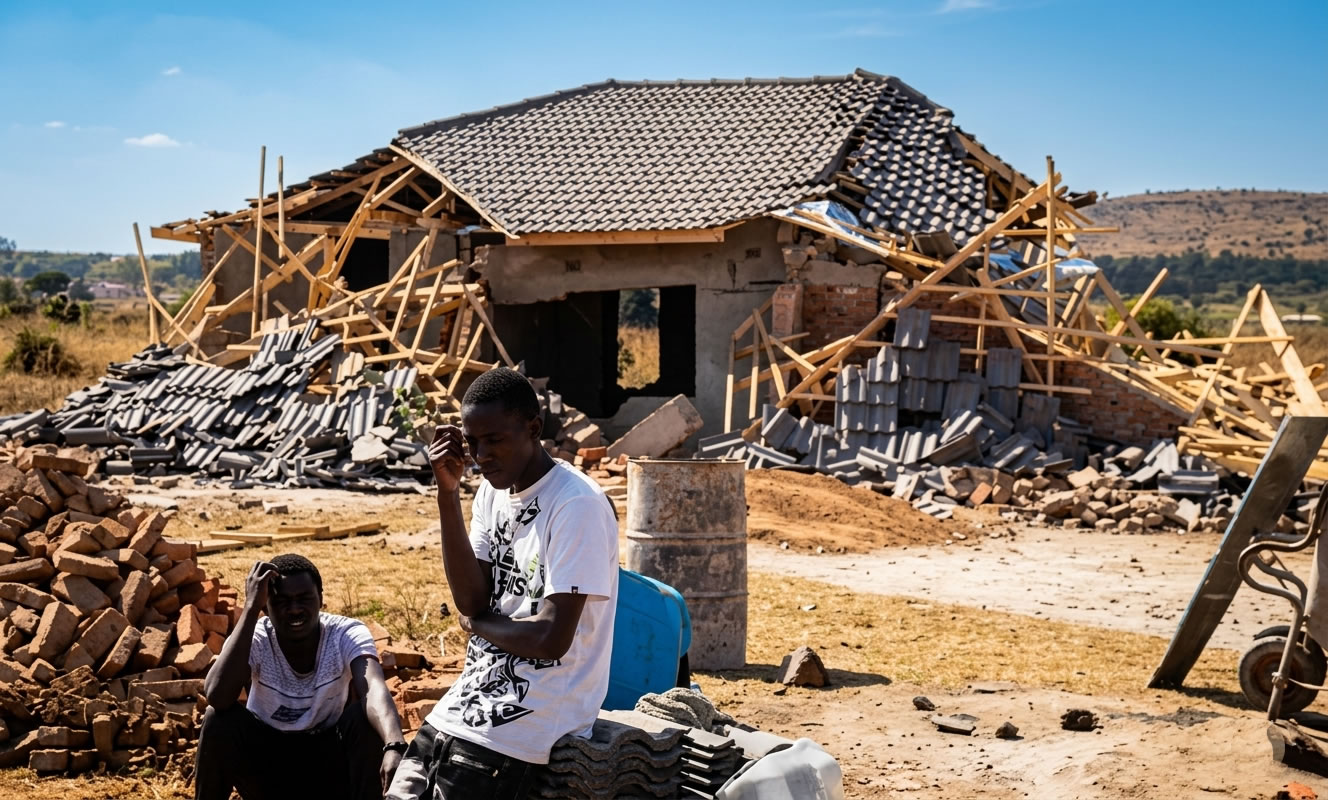
Across Zimbabwe, a stern message is being delivered to those involved in the illegal parcelling out of state and communal lands: the government’s patience has worn thin. A nationwide crackdown, spearheaded by provincial authorities, has commenced, leading to evictions and arrests of individuals implicated in what have become notoriously known as “Sabhuku deals”. While the government frames this as a necessary measure to restore order, an in-depth investigation reveals a more intricate narrative of desperation, exploitation, and systemic corruption that has left countless families destitute.
In Manicaland province, the impact of this crackdown is particularly acute. Advocate Misheck Mugadza, the Minister of State for Manicaland Provincial Affairs and Devolution, recently announced that recipients of land acquired through these illicit allocations are being evicted without compensation, while the perpetrators face rigorous prosecution. This directive echoes President Emmerson Mnangagwa’s uncompromising denunciation of illegal land parcelling across the nation, underscoring the gravity with which the issue is now being treated at the highest levels of government. Minister Mugadza, speaking at an all-stakeholders meeting, directed law enforcement and relevant state agencies to restore order in land distribution across the province’s seven districts, making it clear that the unlawful parcelling out of land by unauthorised individuals will no longer be tolerated.
“I direct all stakeholders as follows – the Zimbabwe Republic Police and National Prosecuting Authority to intensify arrests and prosecutions of traditional leaders, middlemen and implicated officials. There is zero tolerance for corruption,” Minister Mugadza declared. He further emphasised that the Environmental Management Agency (EMA) must enforce Environmental Impact Assessment (EIA) requirements and environmental protection laws, particularly in ecologically sensitive areas. “Wetlands, riverbanks and forests are not for sale,” he asserted, highlighting the broader environmental implications of these unregulated settlements.
The crackdown specifically targets the widespread practice where some village heads, chiefs, politically connected intermediaries, and self-styled land barons illegally parcel out communal or state land to desperate home seekers. These transactions occur without legal authority, proper title deeds, or approved development plans, creating a fertile ground for future disputes and human suffering. The Lands, Agriculture, Fisheries, Water and Rural Development ministry has issued a stern warning to traditional leaders against selling State land, reiterating that such actions are illegal.
Obert Jiri, the ministry’s permanent secretary, underscored this point: “Several village heads have already been convicted of this crime. Village heads should not sell land. It’s meant to be preserved for families within their areas. Protect it for your children. There’s no room for selling it to outsiders. This land belongs to future generations”. Despite these clear directives, the allure of quick money often overrides legal and ethical considerations for some traditional leaders.
The human cost of these illicit deals is starkly evident in places like Mushandike, Masvingo province. When bulldozers rolled in, the life Esther Mativenga had painstakingly built was reduced to rubble. “It is like a thief in the night stole everything,” she recounted, struggling to contain her pain. “This was not just a house; it was our future. We poured everything we had into it, believing sabhuku’s word”. Her neighbour, John Mbava, a carpenter who had just completed his family’s four-room home, echoed her despair: “They took away more than bricks and mortar. They took away our hope”.
These poignant stories are not isolated incidents but rather symptomatic of a nationwide phenomenon. From Chiredzi to Hwange, the evidence is clear: Sabhuku land deals are destabilising families and entire communities. In Domboshava, settlements sprout overnight, only to be declared illegal months later. The same tragic pattern repeats in Seke, Kadoma, Chimanimani, Chihota, Gokwe, Matobo, Lupane, Nkayi, and Bulilima, where desperate land seekers pay hefty fees, only to discover their landholdings have no legal standing.
The desperation of citizens seeking land is a critical factor fuelling this crisis. The prohibitive cost of urban land has pushed many homeseekers towards surrounding rural and peri-urban areas, placing immense pressure on local resources and social services. Areas like Domboshava and Goromonzi, within commuting distance of Harare, have become hotspots for these transactions, making vulnerable citizens easy prey for unscrupulous individuals. Jotamu Ruwona from Seke, a victim of such practices, revealed the insidious nature of these deals: “I was asked to pay US$2 500 to US$3 000 per hectare by a village head. The money was to be shared among the district administrator, lands officer and village head. They promised to backdate the paperwork to hide the illegal transaction”.
This testimony highlights the systemic failures that have transformed Zimbabwe’s rural lands into a lucrative black market. The legal frameworks governing communal land ownership are frequently manipulated. Under the Constitution (Section 282) and the Communal Lands Act, rural land is vested in the President and administered through established legal structures. Traditional leaders are designated as custodians of the land and cultural heritage, with a responsibility to manage communal land and protect the environment. However, they possess no legal authority to commercially sell or permanently allocate it.
Despite these clear legal provisions, glaring loopholes persist. The absence of clear title deeds in many rural areas allows customary allocation practices to be twisted into commercial sales. The syndicates orchestrating these scams are often sophisticated, involving a network of corrupt council officials, lands officers, and traditional leaders. This raises a crucial question: are the sabhukus merely the visible face of a much deeper rot? Critics and anti-corruption watchdogs contend that while traditional leaders are undoubtedly complicit, they frequently serve as “fall guys” for powerful, politically connected land barons. These barons operate with a degree of impunity, leveraging land as a political asset for voter mobilisation and patronage, particularly in the high-demand peri-urban areas.
Even Dr Anxious Masuka, the Minister of Lands, has acknowledged the rampant corruption among ministry officials who parcel out farms after receiving bribes. These syndicates occupy land they have no legal right to, proceed to develop it, and then allocate properties to unsuspecting members, often demanding hefty bribes. When the government eventually intervenes, it is often the vulnerable families and the local headmen who bear the brunt of the law, facing demolitions and arrests, while the true masterminds remain largely untouched.
The consequences extend beyond individual families, destabilising entire communities and eroding trust in both traditional and governmental institutions, as noted by Professor Samuel Nyathi, a rural development expert. Dr Lucia Moyo, a development economist, adds that illegal allocations undermine rural development, food security, and national growth objectives, as access to land is fundamental to livelihoods.
Recent enforcement actions underscore the scale of the problem. Between January and mid-February 2024, Operation “No to Land Barons and Illegal Settlements” resulted in 3,775 arrests, with 985 convictions. In Kadoma, Sabhuku Ignatius Tazvivinga faces fraud charges for allegedly selling land owned by the Kadoma City Council, using forged affidavits to legitimise sales. In Matabeleland North province, police recently arrested 155 land barons and illegal settlers in Umguza, Bubi, Lupane, and Hwange. In Chivhu, a security blitz led to the eviction of 73 families.
Civil society organisations, while acknowledging the need for law enforcement, caution against heavy-handed approaches. They advocate for due process, transparency, and consideration for compensation for affected families, many of whom were victims rather than willing participants in fraud. The challenge lies in balancing the imperative for legal enforcement with the protection of vulnerable citizens.
Addressing the pervasive issue of Sabhuku land deals requires a multi-pronged strategy that extends beyond mere demolitions and arrests. Experts call for strengthening enforcement through fast-tracking prosecutions of sabhukus and land barons, alongside providing clear, accessible information on legal land acquisition to protect prospective buyers. Digitising land records and developing modern information systems are crucial to verify ownership and prevent multiple sales of the same plot. Public awareness campaigns, through various media, are also vital to educate communities about the dangers of illegal allocations.
Furthermore, empowering traditional leaders through training on their legal boundaries and responsibilities is essential to ensure authority is exercised within the confines of the law. The government must also provide alternative, affordable land access by expanding transparent housing schemes, thereby reducing the desperation that drives citizens into the hands of land barons and sabhukus.
For families like Esther Mativenga’s, the pain is raw, but a spirit of resilience endures. “We may have lost our homes, but we have not lost hope,” she stated, standing amidst the ruins of what once symbolised her family’s security. Her story serves as both a warning and a call to action. Unless the authorities decisively close the gaps that allow Sabhuku deals to thrive, and hold all implicated parties accountable, the cycle of exploitation, eviction, and despair will continue to destabilise families across Zimbabwe. The fight for their homes, and their dignity, has just begun, but the scars run deep.