


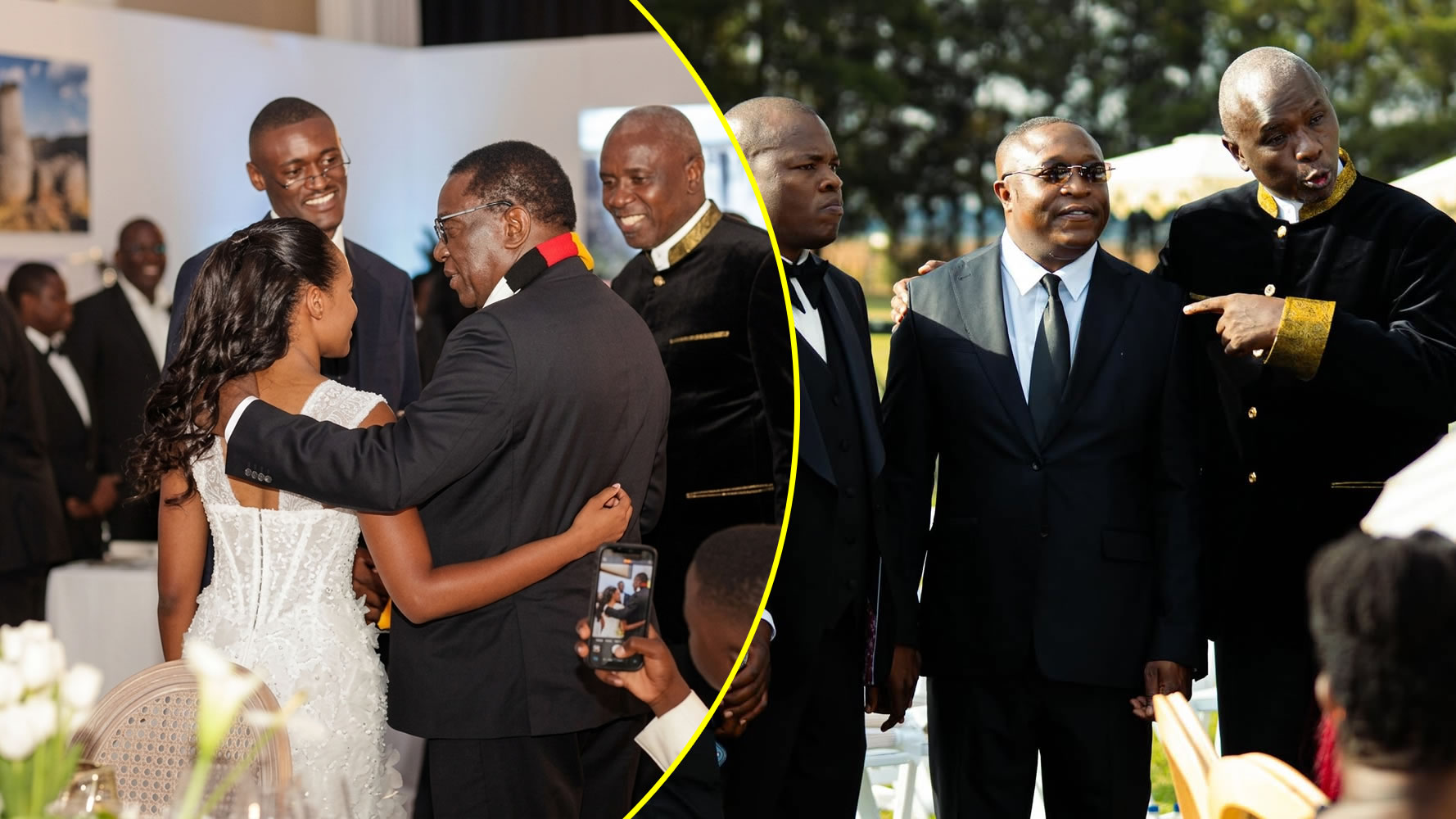
HARARE – The opulent Hollywood-style wedding of Taonanyasha John Tagwirei and Poneso Tinomuda Janda was never intended to be a mere private union between two young Zimbabweans. Held at the Harare Polo Grounds, the event morphed into a political spectacle of such magnitude that it has effectively become a historical document, mapping the current interface between political power, business, and influence peddling in modern Zimbabwe. Whilst the champagne flowed and the legendary American R&B group Boyz II Men serenaded the elite, the underlying tensions within the corridors of power were palpable, revealing a deepening rift between the nation’s most powerful businessman and the First Family.
At the heart of the controversy is the presence—and notable absence—of the Mnangagwas. Although President Emmerson Mnangagwa eventually made an appearance, it was described by those in attendance as a “reluctant and brief” cameo. Sources familiar with the inner workings of the President’s office suggest that First Lady Auxillia Mnangagwa had explicitly advised the President against attending the ceremony. Her absence was not merely a scheduling conflict; it was a calculated snub that has intensified speculation regarding the deteriorating relationship between the Tagwirei empire and the First Family.
The President’s arrival, late in the evening and notably brief, was reportedly the result of intense lobbying. Youth Minister Tinotenda Machakaire is said to have played a pivotal role in persuading a hesitant Mnangagwa to attend, even if only for a short duration. Witnesses noted that Machakaire had to intervene again to encourage the President to address the guests before his abrupt departure. This lack of enthusiasm was mirrored by the absence of most provincial ministers and the failure of senior ZANU-PF officials to formally introduce the President upon his arrival. Even the President’s son, Sean Mnangagwa, who attended earlier in the day, was reportedly called away prematurely, further signalling the First Family’s desire to distance themselves from the spectacle.
This frostiness is rooted in the recent emergence of an explosive and revealing leaked audio recording that has thrown Zimbabwe’s political landscape into turmoil. The recording, which features a prominent cleric and a friend discussing the inner workings of the “kingmaker,” contains sweeping assertions about Kudakwashe Tagwirei’s influence over the state. In the audio, claims are made that Tagwirei allegedly boasts of being the “kingmaker” who is consulted on cabinet appointments and major government decisions. Most damagingly, the recording suggests that Tagwirei meets the President twice every week and believes he has secured the passage of Constitution Amendment Bill No. 3, which critics argue is designed to reshape the succession framework in his favour.
The audio recording alleges that Tagwirei claimed: “I am the next president.”
Such declarations, whether authentic or the product of elite gossip, have clearly rankled the First Lady and the President’s inner circle. The recording further alleges that Tagwirei views Vice-President Constantino Chiwenga — who was conspicuously absent from the wedding — as the “main obstacle” to his future ambitions. The cleric in the audio claims that once the constitutional changes are passed, a “second war” would be launched to neutralise the Vice-President’s influence.
Whilst the political elite navigated these treacherous waters, the wedding itself served as a concentrated and ostentatious display of “crony capitalism.” The scale of the gifting was nothing short of staggering, especially when viewed against the backdrop of a broken economy and grinding penury. Reports indicate that Kudakwashe Tagwirei and his wife, Sandra, gifted the newly-weds 33 hectares of prime land in Umwinsidale, Harare, valued at approximately US$15 million, alongside US$2.5 million in cash.
This massive donation opened the floodgates for what can only be described as a “Zviganandas” club — a gathering of the ultra-wealthy who owe their fortunes to political proximity and state tenders. The breakdown of high-value gifts presented to the couple reveals a stunning array of assets:
|
Donor
|
Gift Description
|
Estimated Value (US$)
|
|
Tagwirei Family
|
33 Hectares of Land & Cash
|
$17,500,000
|
|
Pedzisayi Scott Sakupwanya
|
Cash
|
$500,000
|
|
Tino Machakaire
|
Defender Octa Luxury SUV
|
$500,000
|
|
AgriFora’s Manungo Brothers
|
Cash
|
$300,000
|
|
Obey Chimuka & Wife
|
Cash
|
$275,000
|
|
Wicknell Chivayo
|
Cash & Luxury Handbag
|
$270,000
|
|
George Guvamatanga & Wife
|
Cash & 25 Pedigree Heifers
|
$250,000+
|
|
Everton Mlalazi
|
Cash
|
$150,000
|
|
President Mnangagwa’s Sons
|
Cash
|
$100,000
|
|
Stanley Kondongwe
|
Cash
|
$100,000
|
|
G6 Business Consortium
|
Cash
|
$100,000
|
|
Koala
|
Cash
|
$100,000
|
|
Makomo Resources
|
Cash
|
$50,000
|
𝐙𝐯𝐢𝐠𝐚𝐧𝐚𝐧𝐝𝐚 𝐋𝐨𝐨𝐭𝐢𝐧𝐠 𝐏𝐚𝐫𝐭𝐲: 𝐇𝐨𝐰 𝐓𝐚𝐠𝐰𝐢𝐫𝐞𝐢’𝐬 𝐒𝐨𝐧 𝐖𝐞𝐝𝐝𝐢𝐧𝐠 𝐁𝐞𝐜𝐚𝐦𝐞 𝐙𝐢𝐦’𝐬 𝐃𝐢𝐬𝐩𝐥𝐚𝐲 𝐨𝐟 𝐖𝐞𝐚𝐥𝐭𝐡 𝐚𝐧𝐝 𝐏𝐨𝐰𝐞𝐫
🔴Politics, Money, Power Play, and Tone-Deaf Symbolism
By Tichaona Shumba and Thulani Sibanda
THE explosive… pic.twitter.com/j63HcmGntW— TheNewsHawks (@NewsHawksLive) May 29, 2026
The presence of figures like Wicknell Chivayo and Scott Sakupwanya—both of whom have been the subject of recent Zimbabwe Anti-Corruption Commission (ZACC) investigations and “Gold Mafia” allegations—further cemented the event’s reputation as a gathering of “tenderpreneurs” rather than bona fide businesspeople. Chivayo’s contribution included a US$20,000 luxury designer handbag for the bride, a gesture of flamboyant excess that has become his trademark.
The contrast between this unchecked opulence and the reality of life for ordinary Zimbabweans is where the private celebration becomes intensely political. Whilst the Tagwirei wedding featured a surprise live performance by Boyz II Men—a “has-been” group from a different generation, whose presence reflected the groom’s father’s tastes rather than the couple’s—millions of Zimbabweans are struggling to survive.
In the public hospitals, such as Parirenyatwa, women are still reported to be sleeping on cold floors due to a lack of beds and basic resources. In the high-density suburbs of Glen View and Budiriro, residents endure weeks without reliable water, leading to recurring fears of cholera and other waterborne diseases. The graduates of Chitungwiza are found selling airtime by the roadside, and thousands of young Zimbabweans continue to flee the country for the United Kingdom, South Africa, and Australia in search of the dignity that their own economy denies them.
The wedding, therefore, acted as a mirror reflecting a nation spatially segregated by wealth. In the manicured lawns of Borrowdale Brooke and Umwinsidale, private boreholes and armed security details define elite life. Less than 30 kilometres away in Epworth, raw sewage snakes through settlements that lack even the most basic infrastructure. This is not merely inequality; it is a plutocracy where the state itself appears fragile and the institutions of governance have been hollowed out by patronage.
The leaked audio further suggests that Tagwirei’s influence extends into the very fabric of the state’s security and judicial apparatus. The recording alleges that the businessman claimed to have influence over senior military commanders, intelligence officials, police bosses, and members of the judiciary. Such claims, if true, point to a “captured state” where the traditional boundaries between the executive, the military, and private capital have vanished.
Political analyst Gabriel Manyati argues that the scale of the reported gifts struck a nerve because of the “public performance of wealth.” He notes that in many African societies, wealth was traditionally redistributed through communal feasting and bridewealth. However, the modern Zimbabwean elite spectacle resembles a hyper-capitalist branding exercise. To announce a US$500,000 gift in a struggling economy is not an act of generosity; it is a signal of hierarchy, access, and power.
The First Lady’s decision to snub the event suggests that the Mnangagwas are increasingly wary of being seen as subordinates to Tagwirei’s “kingmaker” ambitions. The First Lady, who has built her own public profile through charitable works and a carefully managed image of “Mother of the Nation,” likely recognises the toxic optics of such a display. The association with “tenderpreneurs” who are under active investigation for looting state resources is a political liability that the First Family seems increasingly unwilling to bear.
Furthermore, the tension highlights a brewing succession battle. With President Mnangagwa’s term limits approaching, the question of who will lead ZANU-PF next has become the dominant theme in Zimbabwean politics. Tagwirei’s alleged claim that he is the “next president” and his reported moves to control the small-scale mining sector through legislative influence suggest a businessman who is no longer content with being the power behind the throne. He wants the throne itself.
The absence of Vice-President Chiwenga, a man with deep roots in the military and a formidable political base of his own, is perhaps the most telling detail of all. If the leaked audio is correct in identifying Chiwenga as Tagwirei’s “main obstacle,” then the Vice-President’s snub of the wedding was a clear declaration of war. The “Zviganandas” club may have gathered to celebrate a marriage, but they found themselves in the middle of a battlefield.
As Zimbabweans dissected the wedding photos on social media, the emotional reaction was a complex mixture of fascination, envy, and outrage. Whilst some admired the success, many saw the vulgarity of spending millions on a single day in a country where the average civil servant earns a pittance. The memes comparing wedding gifts to monthly salaries flooded WhatsApp groups, turning the ceremony into a national referendum on the morality of wealth in a broken state.
Ultimately, the Tagwirei wedding was a carefully orchestrated display of power play and tone-deaf symbolism. It confirmed what many have long suspected: that power in Zimbabwe is concentrated within a narrow, interconnected elite universe where business, politics, and patronage overlap seamlessly. The golden gilded cage of the Harare Polo Grounds may have protected the guests from the harsh realities of the streets, but it could not hide the deepening fractures within the ruling establishment.
The Mnangagwas’ unhappiness is a signal that the era of the “kingmaker” may be facing its greatest challenge yet. Whether this leads to a genuine crackdown on cronyism or merely a reshuffling of the oligarchic deck remains to be seen. What is certain, however, is that the Tagwirei wedding will be remembered not for the love it celebrated, but for the secrets it revealed and the political storm it helped to brew.