


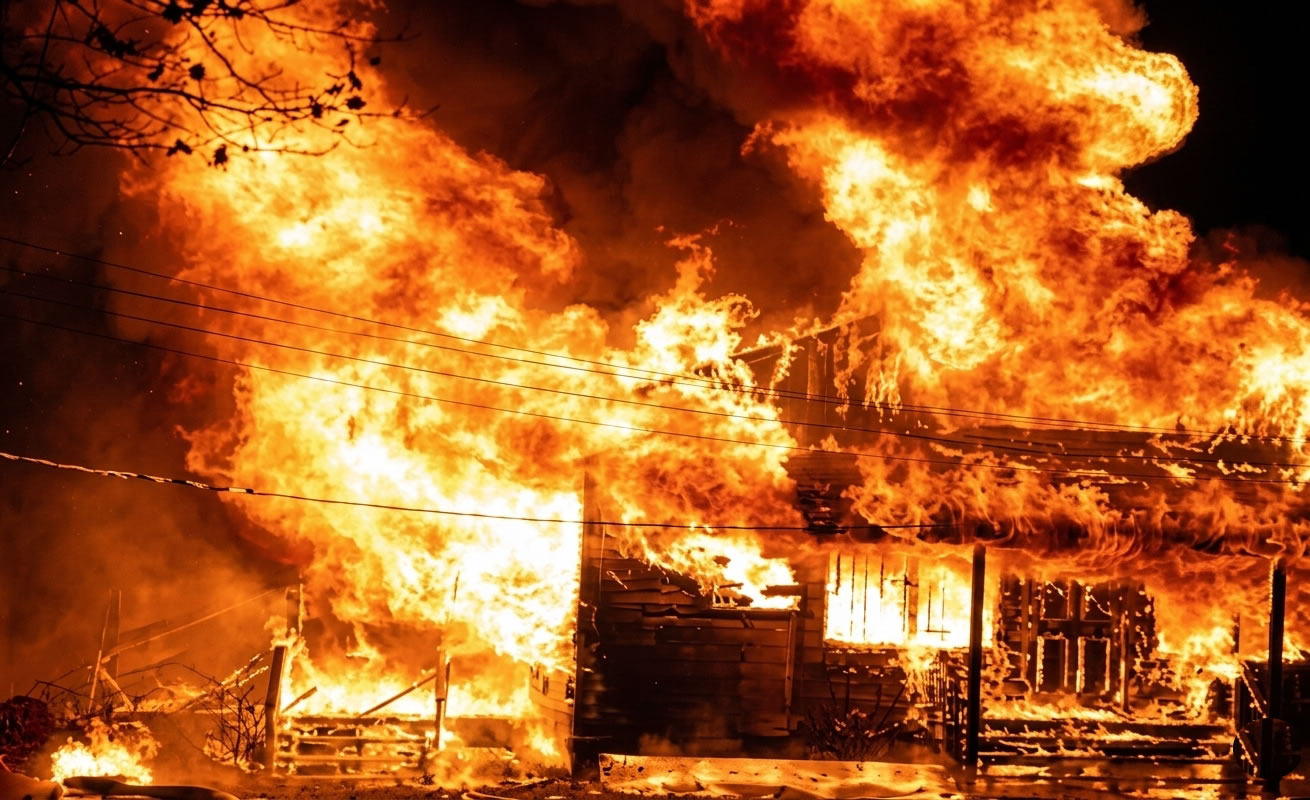
KWEKWE – A petrol bombing incident at Bishop Ngoni Mwazha’s farmhouse in Kwekwe has left property valued at over US$150,000 in ashes, casting a stark light on the long-running and often acrimonious succession battle within the African Apostolic Church (AAC). The attack, which occurred on Sunday night, 24 May 2026, around 11:00 PM, is being investigated by police, but many observers believe it is inextricably linked to the deep divisions that have plagued the church and the Mwazha family for years.
Bishop Ngoni Mwazha, the eldest son of the late Archbishop Paul Mwazha, the revered founder of the African Apostolic Church, was not present at the time of the incident. He and his wife, Desiree Kwaramba-Mwazha, had travelled to Harare on Saturday morning. Their daughter, Loveness Mwazha, who had remained at the main house, narrowly escaped harm. A worker was also present in a nearby cottage, but was unharmed.
Recounting the terrifying ordeal, Desiree Kwaramba-Mwazha stated, “At around 11 PM, she heard a loud noise from outside and the sound of a window being broken. At first she thought it was ordinary criminals, but moments later she saw a ball of fire inside the house.” Loveness, startled by the sudden eruption of flames, fled the house and raised the alarm with workers on the farm. Despite their valiant efforts, they were unable to extinguish the rapidly spreading inferno. The police and Fire Brigade were eventually called, but by the time they arrived, a significant portion of the 13-room house had already been consumed by the blaze.
The scale of destruction is immense. The family reported that a wide array of their possessions, including household goods, kitchen utensils, beds, blankets, bags of maize and beans, and other invaluable items, were utterly destroyed. The financial loss, estimated at over US$150,000, represents a devastating blow to the family. While no physical injuries were reported, the psychological impact of such a targeted and destructive act is undoubtedly profound.
This act of arson, however, is not an isolated event but rather a chilling escalation in a protracted power struggle that has gripped the African Apostolic Church since at least 2020. The roots of this conflict lie in the succession of Archbishop Paul Mwazha, who passed away on 20 November 2025, at the remarkable age of 107. Even before his demise, the question of who would inherit his mantle had ignited fierce disputes among his sons and other senior church figures.
The internal strife became public in May 2020, when a violent altercation erupted at Archbishop Paul Mwazha’s Hatfield residence. This incident involved his second-born son, Bishop Alfred Kushamisa Mwazha, and other family members, all vying for control of the church’s leadership. This initial clash set the stage for a series of legal battles that would unfold over the subsequent years, tearing the once-unified church into multiple factions.
Throughout 2020 and 2021, the High Court and Supreme Court were embroiled in adjudicating these disputes. Notably, the courts nullified Bishop Alfred Kushamisa Mwazha’s appointment as leader, a decision that further inflamed tensions within the family and the church. The legal wrangling continued into 2022, with a High Court injunction being issued against Alfred and his associates, prohibiting them from holding unauthorised services at various church shrines. This injunction underscored the deep schism and the extent to which legal avenues were being pursued to resolve what was fundamentally a spiritual and familial disagreement.
The feud continued to simmer, occasionally boiling over into public confrontations. In September 2023, faction leader Simbanechako Sveta, alongside Paul Chari, publicly accused the police of “taking sides” in the ongoing feud, specifically against rival faction leader Ernest Mhambare. This accusation highlighted the pervasive nature of the conflict, extending even to allegations of external interference and bias.
The passing of Archbishop Paul Mwazha in November 2025, while perhaps anticipated, did little to quell the storm; instead, it intensified the succession dispute. The power vacuum created by his death immediately reignited the rivalries, leading to further fragmentation within the African Apostolic Church. Just two months later, in January 2026, Bishop Ngoni Mwazha, the very individual whose home has now been petrol-bombed, found himself in court. He faced charges of contempt for allegedly defying the earlier High Court injunctions that prohibited unauthorised services at church shrines. This legal entanglement further illustrates the complex and often contentious landscape of the church’s leadership struggle.
Adding another layer of tragedy to the unfolding drama, Bishop Alfred Kushamisa Mwazha, a central figure in the succession battles, passed away in March 2026 at the age of 80. His death, while marking the end of one of the key protagonists, did not bring peace to the fractured church. Instead, it left a void that could potentially exacerbate the struggle for control, as the remaining factions regroup and reassess their positions.
The African Apostolic Church, once a unified spiritual body, has now splintered into at least three distinct factions, each claiming legitimacy and vying for the loyalty of its congregants. This internal strife has not only led to numerous legal battles but has also, tragically, been punctuated by incidents of violence and public confrontations. The petrol bombing of Bishop Ngoni Mwazha’s home, therefore, appears to be a grave escalation in a conflict that has already seen its share of turmoil and discord.
Police investigations into the Kwekwe arson attack are currently underway. However, the incident has undeniably raised serious questions about the safety of those involved in the church’s leadership dispute and the potential for further violence. The destruction of property worth US$150,000 is not merely a financial loss; it is a stark symbol of the deep-seated animosity and the destructive consequences of a power struggle that has spiralled out of control. The community, both within and outside the church, watches with bated breath, hoping for a resolution that brings peace and justice, and prevents further such devastating acts.
This incident is a grim reminder that the battle for leadership within the African Apostolic Church is far from over. It is a complex tapestry woven with threads of faith, family, power, and property, and the recent petrol bombing has added a chilling new dimension to this already volatile narrative. The authorities face a challenging task in unravelling the truth behind this attack, especially given the intricate web of historical grievances and ongoing disputes that characterise the Mwazha family and the church they founded.
As the investigation proceeds, the focus will undoubtedly turn to whether this act of arson was a random criminal act or a calculated move directly linked to the protracted succession dispute. The answer to this question will not only determine the fate of those responsible but will also have profound implications for the future of the African Apostolic Church and its deeply divided congregation. The call for peace and unity within the church has never been more urgent, as the flames that engulfed Bishop Ngoni Mwazha’s home threaten to consume the very fabric of the institution itself.