


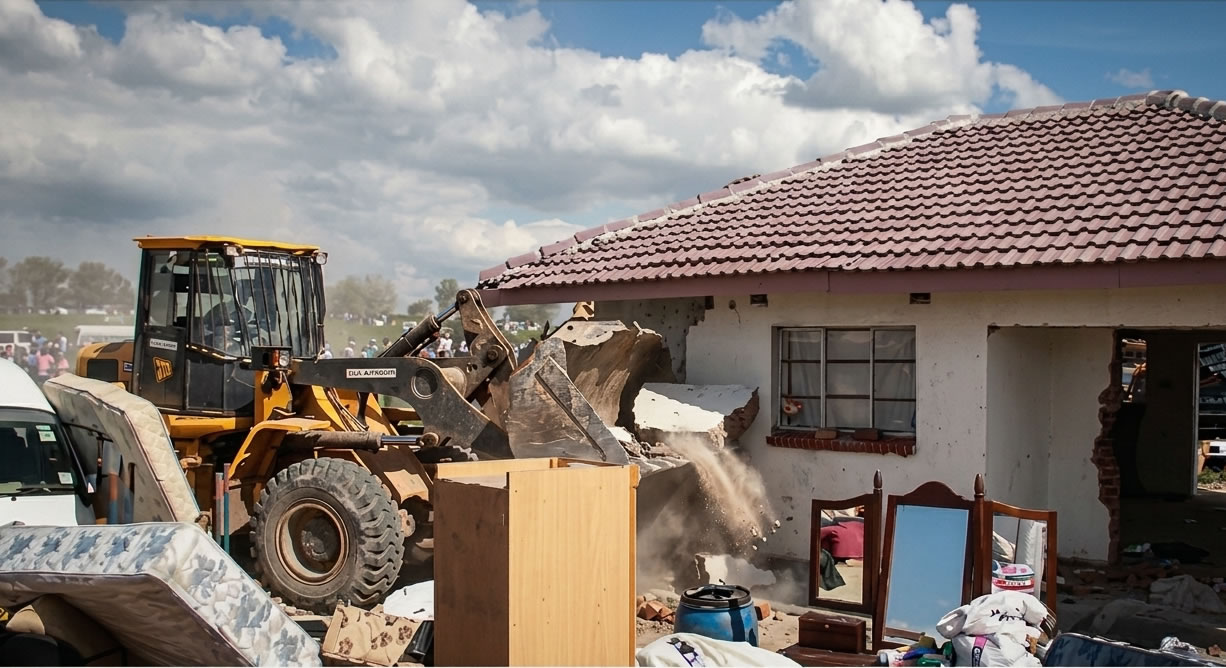
This weekend the quiet suburb of Whitecliff in Harare was shattered by the roar of heavy bulldozers, backed by armed riot police. By the end of the day, over 300 families were left homeless, their houses reduced to rubble, and their lifetime savings completely destroyed. While the official narrative from the Ministry of Local Government frames this as a routine cleanup of illegal structures built on state land, a deeper investigation reveals a far more sinister reality. This is not a simple urban planning enforcement; it is a coordinated land heist orchestrated by a powerful syndicate of politically connected land barons, corrupt council officials, and ministry elites. Ordinary, desperate home seekers were lured into a carefully designed trap, only to be discarded when the land became valuable to the elites.
The destruction in Whitecliff is the latest flashpoint in a recurring housing tragedy across Zimbabwe, where the quest for homeownership has been turned into a deadly gamble. For years, housing cooperatives run by individuals with deep connections to the ruling ZANU-PF party assured buyers that their settlements were fully regularised. They collected millions of US dollars in cash from poor civil servants, vendors, and informal traders, promising them a secure future. Our investigation reveals that these land barons knew all along that the land was zoned for public infrastructure and was never approved for residential use. When the Ministry decided to clear the area, these politically connected barons quietly vanished with the money, leaving the innocent buyers to face the bulldozers alone.
The Illusion of Regularisation
To understand how hundreds of families fell victim to this scheme, one must examine the cooperative networks that sold these stands. These entities operated under the guise of legitimate housing associations, often using names associated with the liberation struggle to project authority and patriotism. In Whitecliff, the occupants moved onto Stand Number 10139 along Bulawayo Road and Ordlands Road starting in 2020. They were led to believe they had the backing of the state, particularly after receiving permission from the Ministry of Transport and Infrastructural Development.
For nearly five years, these families invested their hard-earned money, brick by brick, into building permanent structures. They paid monthly subscriptions to cooperative leaders, who pocketed the funds while producing fraudulent allocation letters and municipal documents. The general manager of Eddie Pfugaris Properties, Percy Chitima, confirmed that these structures were erected without the company’s consent and had been constructed rapidly after the occupation began. The land, in reality, belonged to Eddie Pfugaris Properties, which had been fighting a quiet legal battle to reclaim its property.
While the private developers sought justice through the courts, the cooperative leaders assured residents that “regularisation” was underway. This term, frequently weaponised by land barons, refers to the official process where illegal settlements are retroactively approved by local authorities. In reality, it served as a powerful marketing tool to extract more cash from unsuspecting buyers. The illusion shattered on November 8, 2024, when the Ministry of Transport and Infrastructural Development quietly withdrew its authority. This paved the way for Eddie Pfugaris Properties to enforce an eviction order granted by Harare Magistrate Talent Mutasa. The court order had remained unenforced since January 2025, a delay that allowed cooperative leaders to continue collecting money from unsuspecting victims until the very day the bulldozers arrived.
The Anatomy of the Land Syndicate
The Whitecliff tragedy is not an isolated incident but a textbook operation of a highly organised land syndicate operating across Zimbabwe’s urban centres. These syndicates rely on a triad of actors: politically connected “land barons”, corrupt municipal planners, and high-ranking ministry officials. Together, they exploit the desperate shortage of affordable housing in Harare, where the municipal waiting list has languished with hundreds of thousands of names for decades.
|
Actor
|
Role in the Syndicate
|
Illicit Benefit
|
|
Politically Connected Land Barons
|
Invade private or state land, establish fake housing cooperatives, and sell illegal stands to desperate home seekers.
|
Millions of US dollars in untaxed cash, political influence, and voter mobilisation.
|
|
Corrupt Council Officials
|
Provide fraudulent layout plans, issue fake municipal water connections, and leak information about impending demolitions.
|
Substantial bribes, properties, and protection from political superiors.
|
|
Ministry Elites
|
Issue temporary “letters of authority” to create a veneer of legitimacy, and delay enforcement actions until political goals are met.
|
Kickbacks from land sales and control over prime urban real estate.
|
This structural corruption has been documented in various government-commissioned inquiries, though their findings are rarely acted upon. A 2019 inquiry commissioned by President Emmerson Mnangagwa into the sale of state land in and around urban areas since 2005 observed that “land was either invaded by home seekers, invaded by war veterans for agricultural purposes, which subsequently morphed into urban settlements, or allocation to cooperatives, trusts and land developers by the responsible ministry, who pocketed proceeds”.
The inquiry explicitly noted that “aspiring or sitting Members of Parliament created new urban settlements as a way of mobilising political support, and use of names of top ruling party leadership to exert undue influence on government institutions and processes”. Despite these damning findings, the report was kept hidden from the public for years, only being released after a High Court order compelled its disclosure in May 2026.
Selective Law Enforcement and Victim Criminalisation
Perhaps the most distressing aspect of the Whitecliff demolitions is how the state uses selective law enforcement to punish the victims whilst protecting the actual perpetrators. Following the demolitions, the police and the judiciary have failed to arrest a single land baron behind the Whitecliff scheme, choosing instead to criminalise the homeless families. The law is swiftly applied to flatten houses, but it remains remarkably sluggish when it comes to prosecuting the politically connected elites who sold the land.
This pattern of selective justice is visible in other recent land scandals. For instance, in October 2025, the Zimbabwe Anti-Corruption Commission (ZACC) arrested two senior ZANU-PF officials in Hopley, Harare, for defrauding home seekers of US$1.5 million. Phinias Muchichwa, the ZANU-PF chairperson for the Godfrey Chidyausiku District, and Anderson Frendson, the branch security chief for the Josiah Magama Branch, had illegally subdivided a 9.3-hectare piece of land owned by Sunshine Developments (Pvt) Ltd and sold stands to over 200 people for US$300 each. While these arrests were publicised, they represent only a fraction of the illicit trade, and critics argue that such prosecutions are often the result of internal party factionalism rather than a genuine commitment to justice.
In most cases, the masterminds of these schemes quietly vanish with the money, leaving innocent buyers to face the bulldozers alone. When the state intervenes, it is almost always to enforce demolition orders rather than to recover the stolen funds for the victims. This selective enforcement sends a clear message to ordinary Zimbabweans: property rights are protected for the elites and private corporations, but human rights and shelter are disposable commodities for the poor.
The Human Cost of the Heist
Behind the complex legal arguments and political posturing lie the shattered lives of ordinary citizens. The human cost of the Whitecliff demolitions is immeasurable. Families who spent decades saving to build a modest home have seen their life’s work reduced to a pile of broken bricks in a matter of minutes.
The tragedy mirrors previous demolitions, such as the Budiriro 5 demolitions in December 2020, where 134 households were flattened in the middle of the rainy season. In that incident, residents had bought their plots from the Tembwe Housing Cooperative, contributing US$3,600 each since 2010. When the bulldozers arrived, families were left to huddle in the heavy rain, watching their investments wash away.
One of the victims of the Budiriro demolitions, Chengeto Tapfuma, a 59-year-old grandmother caring for four orphaned grandchildren, described her despair at the time:
“It seems like a vital organ was forcibly extracted from my fragile body. Speaking to anyone, even you journalists, is helpless because nobody is willing to listen and help us anyway.”
Years later, the residents of Whitecliff are experiencing the exact same agony. They are left with no shelter, no compensation, and no recourse. The state’s failure to provide alternative accommodation or immediate humanitarian relief exacerbates the crisis, leaving vulnerable children and the elderly exposed to the elements.
A Cycle of Political Patronage
The timing of these demolitions and land allocations is rarely accidental. Investigative journalists and political analysts have long pointed out that the ruling elite uses the poor as cash cows during election cycles, only to destroy their lives when the political dust settles.
During election campaigns, land barons affiliated with the ruling party are given free rein to parcel out land in peri-urban areas. They encourage informal settlements, promising regularisation and protection from municipal authorities in exchange for votes and financial contributions. These settlements become reliable voter banks for the ruling party in urban areas that have traditionally voted for the opposition.
However, once the elections are over and political power is secured, the protection evaporates. The state, often citing “urban planning compliance” or “the restoration of order,” unleashes the bulldozers. The very officials who stood on campaign stages promising title deeds are nowhere to be found when the demolition notices are served.
The scale of the impending crisis is staggering. The Harare City Council has reportedly identified over 22,000 illegal housing stands across the city. The municipality intends to demolish over 5,000 illegal houses in high-density suburbs, including Kuwadzana, Budiriro, Glen View, and Belvedere, citing dozens of court orders. If these plans are executed, tens of thousands of citizens will be cast into homelessness, further straining an already collapsed social service system.
The Way Forward: Breaking the Cartels
The housing tragedy in Whitecliff and across Zimbabwe will not be resolved by simply flattening houses. Demolitions only address the symptoms of a deeply corrupt and broken land administration system while punishing the wrong people. To break this cycle of corruption and human suffering, several fundamental reforms are urgently required:
First, there must be an immediate halt to all demolitions until a comprehensive, independent audit of all urban land allocations is conducted. Victims of land scams must be protected, and those who built in good faith should be assisted in regularising their structures where planning laws permit, or provided with adequate alternative land and compensation.
Second, the criminal justice system must redirect its focus from the victims to the perpetrators. The police and the Zimbabwe Anti-Corruption Commission must aggressively prosecute the land barons, corrupt council planners, and ministry officials who facilitate these illegal sales. The assets of these corrupt actors must be seized and used to compensate the families whose homes have been destroyed.
Third, the process of land allocation and housing cooperative registration must be digitised and made fully transparent. Home seekers must have easy, public access to land registries to verify the ownership and zoning status of any property before making payments.
Until the structural corruption that fuels these land cartels is dismantled, homeownership in Zimbabwe will remain a deadly gamble. The rubble of Whitecliff stands as a grim monument to a system that enriches the politically connected at the expense of the poor, leaving ordinary citizens to pay the ultimate price for the greed of the elites.