


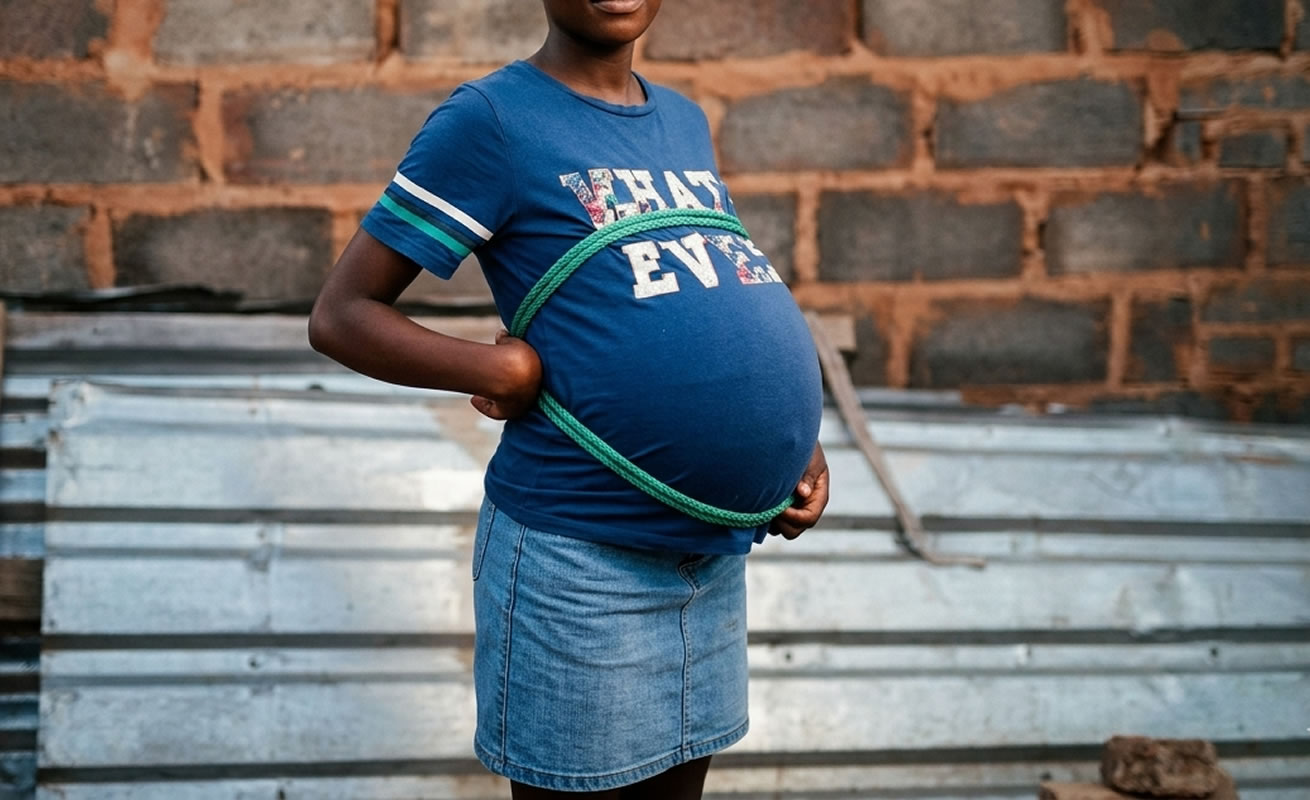
BULAWAYO – A sombre atmosphere has descended upon the suburb of Entumbane following a series of events that have left neighbours and local authorities grappling for answers. On a quiet Sunday at Mpilo Central Hospital, an 11-year-old girl became a mother, bringing a baby girl into a world that has already treated her with unimaginable cruelty. The circumstances of her pregnancy, involving alleged habitual sexual abuse by her stepfather, have sparked a heated debate about child protection, the weight of poverty, and the failure of the family unit.
The biological mother of the child has offered a defence that many find impossible to reconcile with the law or basic morality. Despite the girl’s tender age — a stage of life where the law clearly states she is incapable of giving consent — the mother insists that no crime was committed.
“She was not raped, she agreed to have sex with her dad,” the woman said, in her clinical words that are devoid of the protective instinct usually expected of a parent. When pressed on whether she believed it was normal for a child to “consent” to such acts with a parental figure, she became defensive. “I am busy at the moment; I cannot comment. I will take care of my daughter and her baby,” she stated before ending the conversation.
This case is not an isolated incident in Zimbabwe. It is a symptom of a deeper, darker malaise that continues to haunt the nation’s communities. Investigative efforts have uncovered a trail of similar horrors where the very people tasked with protecting children have become their primary predators.
The Breadwinner Dilemma
In Entumbane, the whispers among neighbours suggest a chilling reason for the mother’s stance. Many believe the case was withdrawn from the police because the stepfather was the sole provider for the household. In a country where economic hardship is a daily reality, the “breadwinner” status often becomes a shield for abusers, bought with the silence of those who fear starvation more than they fear the trauma of their children.
“This bad man was not arrested,” one neighbour remarked, speaking on the condition of anonymity for fear of retribution. “We are not sure if it is the hospital authorities who reported the matter or if the girl finally gathered the courage to report to the police, but we are told the woman withdrew the case. She made a bad call if this is true because as a mother, you must be prepared to die for your children.”
The woman has reportedly barred the 11-year-old from speaking to anyone outside their home, further isolating the young victim. Meanwhile, the stepfather has vanished. Attempts to contact him resulted in a “number no longer in use” message, a common tactic for those evading justice.
A Pattern of Predatory Behaviour
The tragedy in Bulawayo echoes a case from Plumtree that only recently reached its conclusion in January 2025. There, a 42-year-old man was sentenced to 20 years in prison for the repeated rape of his daughter. His abuse began in 2013 when she was just 13 years old. Much like the Entumbane case, he used his position as the family’s provider to enforce silence.
“He threatened the complainant by saying that, if she reported him she would lose a breadwinner,” a statement from the National Prosecuting Authority of Zimbabwe (NPAZ) revealed. The girl eventually fell pregnant and gave birth in 2016, all while the abuse continued. She eventually fled to Botswana, only returning in late 2024 to finally seek justice, fearing her father would turn his predatory gaze toward her own eight-year-old daughter.
These stories highlight a recurring theme: the weaponisation of poverty. When a man provides the food on the table, some families appear willing to sacrifice the safety of their daughters to keep that table full.
The Statistics of Silence
The prevalence of teenage pregnancy in Zimbabwe remains a significant hurdle for social services. Current data suggests a national prevalence rate of 23.2 per cent. However, these figures are often skewed by the fact that many cases involving incest or child abuse go unreported. Rural areas are particularly vulnerable, recording rates as high as 29.9 per cent, compared to 14.6 per cent in urban centres like Bulawayo.
In a recent six-month period, nearly 700 girls aged between 10 and 14 sought antenatal care across the country. Furthermore, over 4,500 learners dropped out of school in a single year due to pregnancy. These are not just numbers; they represent thousands of interrupted childhoods and a cycle of poverty that is almost impossible to break.
The Role of the Authorities
Entumbane Councillor, Khalazani Ndlovu, expressed concern over the recent birth at Mpilo Hospital, though she admitted she had not been formally briefed on the specifics. “Cases of this nature are usually handled through the police Victim Friendly Unit, which ensures that survivors are properly supported and that investigations are carried out in a sensitive manner,” she explained.
Ndlovu emphasised the importance of the Victim Friendly Programme in protecting victims while investigations continue. However, when a parent—the natural guardian of the child—actively works against the investigation, the system often stalls. The withdrawal of a case by a legal guardian can leave the police with little room to manoeuvre, even when the evidence of abuse is as visible as a newborn baby.
Mpilo Central Hospital’s public relations department stated they were still looking into the matter, but no official statement has been released. The silence from the institution is matched by the militant attitude of the girl’s mother.
“Why are you so concerned about my child’s pregnancy? Why do you want to write about this? Who told you she was raped?” she asked, firing questions with a defensive anger that suggested she viewed the media’s interest as an intrusion rather than a call for justice.
Broken Trust in the Church and Home
The rot extends beyond the family home and into institutions traditionally seen as safe havens. In March 2025, a pastor from the Apostolic Faith Mission (AFM) in Zimbabwe was convicted of incest after it was discovered he was in a sexual relationship with his stepdaughter. The conviction served as a grim reminder that even spiritual leaders are not exempt from the predatory impulses that are tearing at the fabric of Zimbabwean society.
Similarly, in April 2026, reports emerged of a 10-year-old girl giving birth to her stepfather’s baby. In that instance, as in the Bulawayo case, the mother was accused of being complicit in the abuse, prioritising her relationship with the man over the safety of her child.
These incidents point to a disturbing trend where the “breadwinner” or “authority figure” is given a free pass to commit atrocities. The legal system, while equipped with the Criminal Law (Codification and Reform) Act, often finds itself at odds with a culture of silence and economic dependency.
A Community in Turmoil
While the legal battles and police investigations continue, the 11-year-old girl in Entumbane is now a mother. Well-wishers have stepped in to donate food and clothing for the baby, a small gesture of kindness in a situation defined by its absence.
The psychological toll on a child forced to undergo the physical and emotional rigours of childbirth cannot be overstated. Experts in child protection argue that “consent” is a concept that cannot exist in a relationship defined by such a vast power imbalance. An 11-year-old does not have the cognitive or emotional maturity to understand the consequences of sexual activity, let alone “agree” to it with a father figure.
The mother’s insistence that her daughter “agreed” is viewed by many as a form of secondary abuse—a betrayal of the fundamental duty of care. It shifts the burden of guilt onto the victim, further traumatising a child who has already lost her innocence.
The Long Road to Justice
As the police continue their enquiries, the case remains a stark reminder of the work that needs to be done. Zimbabwe has intensified its efforts to combat child sexual abuse, but legislation alone is not enough. There is a need for a societal shift that prioritises the protection of the vulnerable over the preservation of the “breadwinner.”
The story of the 11-year-old mother from Entumbane is a tragedy written in the ink of poverty and betrayal. It is a story that will be told in the corridors of Mpilo Hospital and the streets of Bulawayo for a long time, serving as a grim testament to a childhood stolen and a system that, in this instance, failed to intervene before it was too late.
The child and her baby are now at home, under the care of a mother who refuses to acknowledge the crime that brought them there. For the neighbours who watched the girl grow up, the disappointment is palpable. They hope that the authorities will find a way to break through the wall of silence, ensuring that the man responsible faces the full weight of the law, regardless of who puts the bread on the table.
In the end, the cost of that bread has proven to be far too high.