


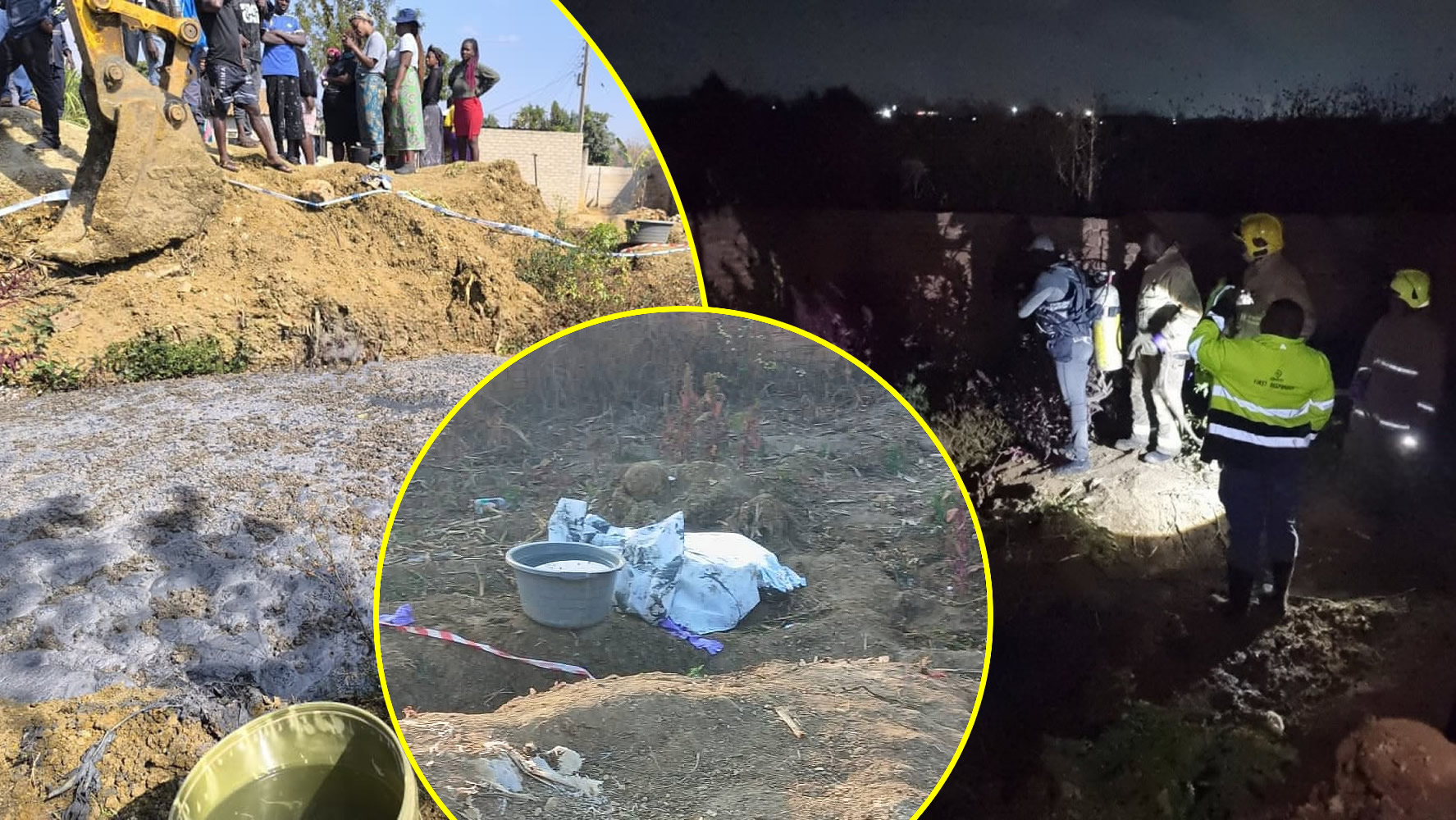
THE SILENT PITS OF HARARE: THREE LIVES LOST TO BUDIRIRO’S SEWER TRAP
HARARE – The sun had barely begun to set over Budiriro 3 this past weekend when the routine of a suburban Saturday was shattered by yet another discovery that has laid bare the lethal consequences of municipal neglect. What began as a desperate rescue mission for a single fallen youth ended in a grim harvest of three corpses, pulled from the thick, black sludge of an open sewer excavation.
The incident, which has left the high-density suburb reeling, has once again turned the spotlight on the Harare City Council and its increasingly hazardous infrastructure. For the residents of Budiriro, the “sewer pool” was not a natural occurrence but a man-made death trap — a deep pit left unguarded and unmarked by council workers who had reportedly been “repairing” a burst sewer line days earlier.
A Rescue Mission Turned Recovery
The tragedy unfolded with deceptive simplicity. Two young men were walking home from the local shops, navigating the familiar but treacherous paths that weave through the suburb. In the fading light, the surface of the sewer pool — caked with dried mud and debris — appeared solid. One of the young men stepped forward, expecting firm ground, only to vanish instantly into the viscous depths.
His companion, horrified, immediately raised the alarm, summoning emergency services to the scene. When the rescue divers arrived, they expected to find one victim. What they found instead was a harrowing testament to how long this pit had remained a silent predator in the community.
“Emergency Services came, and the diver went into the pool looking for the young man,” a source at the scene, who requested anonymity for fear of victimisation, recounted. “Instead, the rescue diver retrieved the body of a young woman who had reportedly disappeared around 6pm the previous day while going to local shops.”
The crowd that had gathered at the perimeter of the pit fell into a stunned silence as the diver emerged for a second time, this time with the body of an older man whose presence in the pool was entirely unknown to the authorities. It was only on the third attempt that the body of the young man who had fallen in minutes earlier was finally recovered.
The Anatomy of Negligence
The discovery of three bodies in a single pit is not merely a freak accident; it is a damning indictment of the “open excavation” culture that has come to define Harare’s municipal works. Residents in Budiriro 3 allege that the pit had been left open for several days without any protective fencing, warning tape, or lighting.
“We have seen them do this time and again,” said another resident. “They dig a hole, they fail to fix the pipe, or they fix it and leave the hole open to ‘settle’. But when it rains, or when the sewer continues to leak, these holes fill up with filth. They look like solid ground because of the scum on top. It is a trap, plain and simple.”
Harare Mayor Councillor Jacob Mafume, visibly shaken by the scale of the tragedy, has ordered an immediate and “in-depth” probe into the circumstances surrounding the deaths.
“The incident is shocking,” Mayor Mafume stated during a brief address. “We need to understand why this excavation was left in such a state and why there were no safeguards to protect the public. We cannot have our citizens losing their lives in the very infrastructure meant to serve them.”
However, for many, the Mayor’s words ring hollow. The City of Harare has long been accused of reactive rather than proactive management. Stanley Gama, the Harare City Council spokesperson, confirmed that investigations are underway but remained cautious about assigning blame before the “full facts” are established.
“We are working to establish the circumstances,” Gama said. “Police are currently withholding the names of the deceased pending notification of next of kin.”
A Pattern of Perilous Infrastructure
To understand the gravity of the Budiriro incident, one must look at the broader context of Harare’s decaying sewer system. This is not an isolated tragedy but the latest chapter in a long history of municipal failures that have turned the city’s suburbs into obstacle courses of raw effluent and open pits.
Only a year ago, in August 2025, the city was forced to confront the deaths of two of its own employees at the Glen View sewer treatment plant. In that instance, the workers were overcome by toxic sewer gases—a direct result of working in poorly maintained and inadequately ventilated environments. The preliminary findings then, as now, pointed toward a lack of adherence to basic safety protocols.
Going further back, the ghosts of Budiriro’s past continue to haunt the present. In 2009, four schoolboys, aged between seven and 12, drowned in a rain-filled pit in Budiriro 4. That pit, like the one in Budiriro 3, was a remnant of incomplete works. Despite the outcry at the time and the promises of “never again,” the city’s approach to public safety remains lethally inconsistent.
In January 2024, another body was discovered floating in a sewer pond in the city, remaining unclaimed for three months. These incidents paint a picture of a city where the sewer system has become a dumping ground for the forgotten and a trap for the unwary.
The Resident’s Burden
For the people of Budiriro, Kuwadzana, and Glen View, the “stench of failure” is both literal and metaphorical. Sewer bursts are a daily occurrence. In some areas, residents have reported walking on top of raw sewage for over five years. The health implications are well-documented; Budiriro was the epicentre of the devastating cholera epidemic in 2008, and the threat of waterborne diseases remains a constant shadow over the community.
“We pay our rates, but what do we get?” asked a mother of three living near the site of the latest tragedy. “We get dirty water that smells like the sewer, and we get holes in the ground that swallow our children. When the young woman went missing on Friday, we looked everywhere. We never thought to look in the council’s hole because we assumed, perhaps naively, that it wouldn’t be deep enough to kill.”
The young woman, who had been missing since 6pm the previous evening, was simply walking to the shops—a mundane task that ended in a horrific struggle for breath in a pool of filth. The older man, whose identity remains a mystery to many in the immediate vicinity, may have been there even longer.
The Investigative Questions
As the police and council begin their respective probes, several critical questions remain unanswered:
- Why was the excavation left open? Standard operating procedures for municipal works require that any excavation in a public thoroughfare be backfilled immediately or secured with rigid fencing and warning lights.
- Was there a report of the missing woman? If the woman was reported missing on Friday evening, why was the nearby council pit not inspected as a potential hazard site?
- What is the state of the council’s “Emergency Services”? While the divers eventually recovered the bodies, the fact that two additional corpses were found during a search for a third suggests a lack of regular monitoring of known hazard sites.
The Harare Residents’ Trust (HRT) has been vocal in its criticism of the council’s “lackadaisical” approach to infrastructure. Precious Shumba, the director of HRT, has previously accused the city leadership of prioritising political grandstanding over the basic provision of services.
“The deaths in Budiriro are a result of systemic negligence,” a representative from a local residents’ association added. “The council workers often lack the proper materials to complete jobs, so they leave them half-done. They lack the fuel to return to sites, so the pits stay open. And the management lacks the oversight to ensure that safety standards are met.”
A City at a Crossroads
Harare, once known as the “Sunshine City,” is currently a city of shadows. The infrastructure, built for a fraction of the current population, is screaming under the pressure of decades of underinvestment and mismanagement. The Mayor’s call for an investigation must lead to more than just a report that gathers dust on a shelf. It must lead to a fundamental shift in how the city handles its “pits of death.”
The names of the three victims will soon be released, and they will be buried by grieving families who will be left to wonder how a walk to the shops could end in such a grotesque fashion. The young man who tried to save his friend, only to see the diver pull out two other strangers first, will carry the trauma of that discovery for a lifetime.
As the investigation proceeds, the residents of Budiriro 3 are not holding their breath for a quick resolution. They have seen the cycles of “shock,” “probes,” and “promises” before. Instead, they are taking matters into their own hands, marking the pits themselves with branches and stones, doing the work the council failed to do.
The tragedy in Budiriro is a stark reminder that in the absence of accountability, the very ground we walk on can become a grave. The sewer pool of Budiriro 3 is no longer just a site of municipal failure; it is a monument to the three lives lost to a city that forgot how to protect its people.
Until the Harare City Council addresses the rot—both in its pipes and in its protocols—the residents of this city will continue to walk with one eye on the ground, fearing the next “mud hole” that might be their last.
Timeline of Negligence: A History of Sewer-Related Tragedies in Harare
- 2009: Four boys drown in an open pit in Budiriro 4.
- 2024: Unclaimed body found in a sewer pond, highlighting poor monitoring.
- August 2025: Two council workers die from toxic fumes at the Glen View sewer plant.
- June 2026: Three bodies recovered from a single sewer excavation in Budiriro 3.