


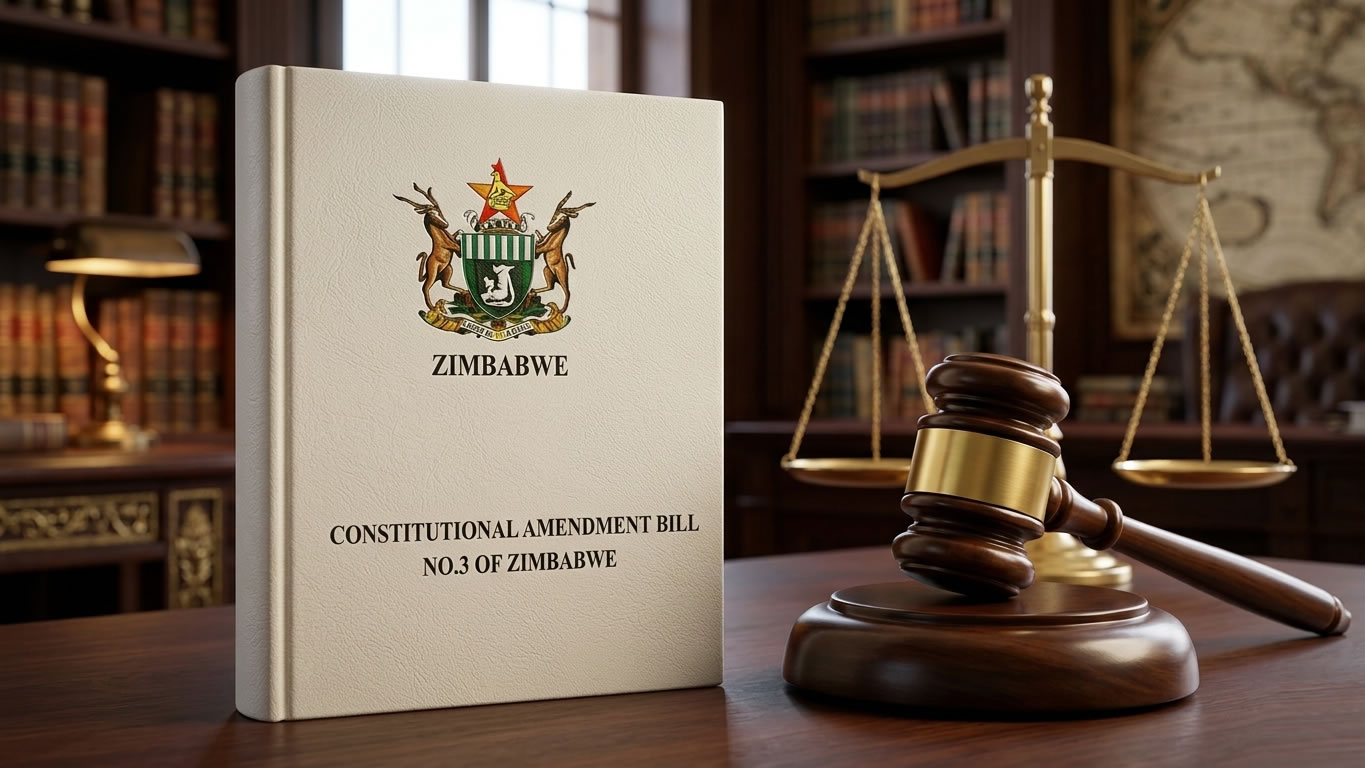
HARARE — A startling political storm is brewing in Zimbabwe as the controversial Constitution Amendment No. 3 Bill (CAB 3) faces unprecedented resistance from multiple fronts. The proposed legislation, widely viewed as a vehicle to extend President Emmerson Mnangagwa’s tenure to 2030 — a campaign dubbed “ED2030″—has encountered fierce opposition. From a sudden ultimatum by self-styled Citizens Coalition for Change (CCC) secretary-general Sengezo Tshabangu to a barrage of constitutional challenges and chilling death threats against dissenting voices, the push for CAB 3 has plunged the nation into a high-stakes political crisis.
The most shocking development in recent days has been the unexpected stance taken by Tshabangu. While his aligned legislators were initially among the most vocal supporters of CAB 3 during National Assembly debates, Tshabangu has now issued a stark ultimatum to the ruling Zanu PF party. He has given them until midnight Tuesday to secure a political agreement, warning that failure to do so will risk the Bill’s defeat in Parliament.
This sudden friction underscores the burgeoning political leverage of Tshabangu’s bloc. Although Zanu PF commands a comfortable majority in the National Assembly, the ruling party requires the support of Tshabangu-aligned legislators to secure the critical two-thirds majority needed in the Senate to pass the amendment.
Tshabangu disclosed the impasse via his spokesperson, Nqobizitha Mlilo, making it clear that his caucus will not automatically endorse the proposed changes. They are demanding “meaningful and good-faith concessions” before taking a final stance.
“We are not simply going to be an implementation arm of a Zanu PF conference resolution. We are not voting cows,” Mlilo warned. He insisted that Zanu PF must offer a “sincere, broad-based political settlement” that serves the national interest rather than a partisan agenda.
Despite the friction, Tshabangu described the nature of the talks as professional, noting that engagements with the Minister of Justice, Legal and Parliamentary Affairs, Ziyambi Ziyambi, and the Zanu PF Chief Whip, Pupurai Togarepi, have been “cordial” and “respectful.” However, the core of the dispute remains unresolved, and Tshabangu’s bloc has positioned itself as the gatekeeper of the Senate, demanding a solid and irrevocable political settlement.
The resistance to CAB 3 is not limited to Tshabangu’s faction. Across the political divide, Members of Parliament are openly criticising the Bill, vowing to vote against it despite intense pressure.
The Ruwa MP, Honourable Thomas Muwozori, has been vocal in his opposition, stating unequivocally that he does not support the Constitutional Amendment No. 3 Bill. He argued that if the Zimbabwe Electoral Commission (ZEC) performed poorly in the past, the solution is to improve it, not replace it. He explicitly rejected the proposal to move voter registration from ZEC to the Registrar-General’s Office.
Similarly, the Budiriro South MP, Honourable Darlington Chigumbu, has boldly declared that his constituency has rejected the proposed changes. During parliamentary debates, he stated, “People of Budiriro rejected CAB 3.”
Another prominent voice of dissent is Honourable Maxwell Mavhunga, the MP for Chitungwiza South, who has also openly opposed the CAB 3 law. The message from these legislators is clear: they have said NO to the 2030 agenda, and they are demanding that President Mnangagwa listen to the will of the people.
The ruling Zanu PF party, acutely aware of the growing dissent within its own ranks and the opposition, has reportedly threatened to recall all MPs who vote against the Bill. This heavy-handed tactic reveals the party’s desperation and confirms that there are indeed legislators who are prepared to defy the party line.
The push for CAB 3 has taken a dark and dangerous turn, with reports of death threats being issued against those who oppose the Bill. The situation reached a boiling point when parliamentary proceedings on the contentious Bill were abruptly suspended after legislators raised serious security concerns.
Shockingly, even the ruling party’s Chief Whip, Pupurai Togarepi, revealed that he had personally received threats, including messages circulating on social media. The fact that a senior figure within Zanu PF is receiving death threats highlights just how deadly and volatile the CAB 3 plot has become.
Unidentified individuals, reportedly travelling in a white Toyota Fortuner, delivered a parcel to Matete’s residence. The parcel contained a picture of a bullet and a message demanding that he withdraw his court application. Despite the terrifying ordeal, Matete remains resolute.
“I am shaken but fine,” Matete said. “I won’t withdraw.”
The legal hurdles facing CAB 3 are as formidable as the political ones. In an unprecedented nationwide legal push, every one of Zimbabwe’s 210 Members of Parliament has been served with a constitutional challenge by a registered voter from their own constituency.
These applications place each MP on individual legal notice that supporting CAB 3, without the referendum required for entrenched constitutional provisions, could expose them to legal action in their own name. The filings argue that Parliament may only amend the Constitution in accordance with the procedures set out in Section 328, and that MPs cannot simply vote to bypass those safeguards.
At the centre of the challenge is CAB 3’s proposal to extend the term of Parliament from five years to seven years. The applicants contend that Section 328(7) prevents any amendment to a term-limit provision from benefiting an incumbent office-holder if it has the effect of extending the time that person may remain in public office. In practical terms, sitting MPs cannot lawfully vote themselves two extra years in office and then benefit from that extension.
The filings also challenge the proposal to change how the President is elected, transferring the choice from citizens directly to Members of Parliament sitting jointly as the Senate and National Assembly. The applicants argue that this would impair voters’ political rights under Section 67 of the Constitution.
Adding fuel to the fire is a startling new report from the joint portfolio Committees on the Constitution Amendment (No. 3) Bill, which has revealed statistical anomalies and alleged legal gymnastics. While the report claims a “majority” mandate, a deep dive into the numbers suggests a manufactured consensus.
Following a mere four-day “blitz” of nationwide hearings, only 54,231 citizens were recorded as physical attendees, yet written submissions reached a staggering 540,037. The Zimbabwe Constitutional Movement (Zicomo) has rejected these figures, describing the discrepancy as “constitutional vandalism” and demanding an independent audit.
In Masvingo and the Midlands provinces, the report recorded thousands of supportive submissions with zero dissenting voices—a “perfect” consensus that stands in stark contrast to email submissions, where 1,472 individuals opposed the Bill compared to only 760 in support.
Perhaps the most significant obstacle to the ED2030 agenda comes from within the military establishment. A powerful faction aligned with Vice-President Constantino Chiwenga, backed by former military generals, is strongly against CAB 3 and has warned Mnangagwa multiple times.
However, the talks reportedly reached a deadlock. According to sources, Mnangagwa brushed off their concerns, responding with a dismissive phrase: “Whoever wins, wins.”
This defiant stance from the President has only deepened the fractures within the ruling elite. Devine Mafa, founder of the Zambezia Economic Movement, recently noted that divisions within the opposition reflect deeper failures dating back to the 2017 military intervention. He claimed some opposition figures are positioning themselves for another military-influenced transition, calculating that Chiwenga might make a move against Mnangagwa.
Mafa called for organised civilian resistance against CAB 3 through public demonstrations and diaspora-led pressure campaigns, arguing that the Constitution does not provide for the military removal of a sitting president.
As the deadline for Tshabangu’s ultimatum approaches and the legal challenges mount, the fate of CAB 3 hangs in the balance. The proposed amendments, which include extending presidential terms, hollowing out the Zimbabwe Electoral Commission, and increasing the number of Senators, are viewed by many as a direct assault on the nation’s democratic architecture.
With MPs vowing to vote NO, civil society activists standing firm against death threats, and a fractured military establishment watching closely, the push for ED2030 has ignited a political firestorm that could reshape Zimbabwe’s future. The coming days will be critical in determining whether the controversial Bill will be derailed or if the ruling party will force it through, regardless of the cost.