


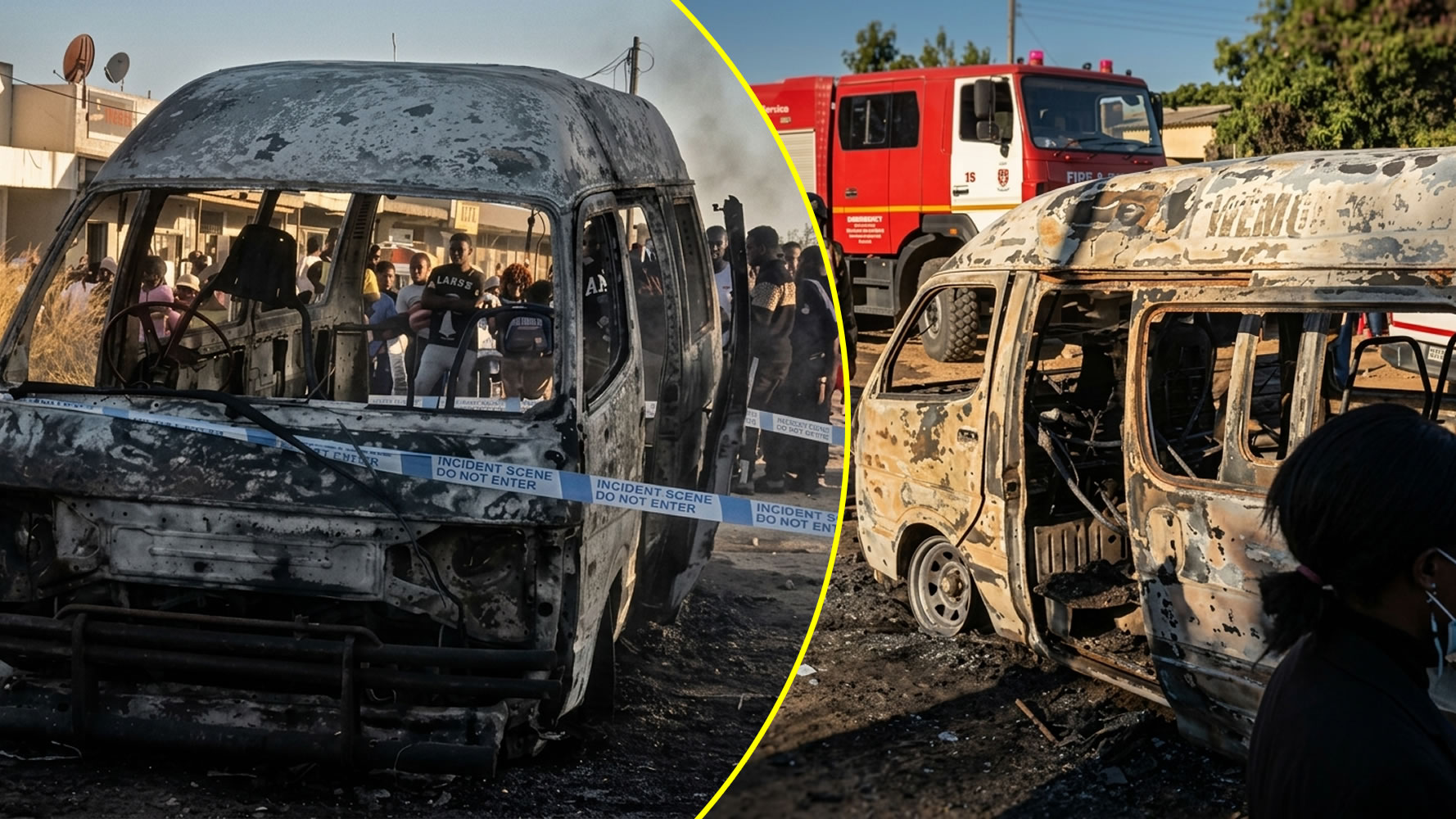
GWERU – A searing tragedy has cast a long shadow over the city of Gweru, in midlands province, following a horrific incident where a school kombi burst into flames, claiming the lives of seven innocent primary school pupils. The devastating inferno, which occurred near Senga Shopping Centre, has ignited a national conversation about the perilous state of school transport and the systemic failures that continue to endanger young lives across the country. While initial police reports point to a jerry can of petrol as a potential catalyst, a deeper investigation reveals a disturbing pattern of negligence, lax enforcement, and a desperate need for urgent accountability.
The incident, which unfolded at approximately 1 PM on a recent Wednesday, saw a commuter omnibus ferrying 23 pupils from Matongo and Stanley Primary Schools engulfed in a raging fire. Seven children, tragically seated at the rear of the vehicle, perished on the spot, burnt beyond recognition. The kombi, reduced to a charred shell, stands as a grim monument to a preventable disaster. Ironically, most kombis are certified to carry around 16 passengers, and if this kombi has 16 passengers, probably the 7 pupils who died would have survived since 16 pupils were successfully rescued to safety when the vehicle caught fire.
Eyewitnesses at Senga Shopping Centre recounted scenes of unimaginable horror and heroic, yet ultimately futile, rescue attempts. Aaron Moyo, a Gweru resident present during the tragedy, described the terrifying speed with which the fire consumed the vehicle.
“We quickly sprang to action when we saw the vehicle on fire. We broke the windows to rescue others while others came through the sliding doors,” he stated. However, the intensity of the blaze proved overwhelming.
“The fire was just too much as we failed to save those who were at the back. Their screams will haunt me for life. It was just too much,” Moyo added, his words echoing the profound trauma experienced by those who witnessed the event.
Another resident, who assisted in pulling many pupils to safety, similarly expressed the indelible impact of the children’s cries, stating that their screams would haunt him for the rest of his life. These harrowing accounts underscore the immediate and devastating impact of the tragedy on the Gweru community, which is now grappling with immense grief and shock.
Public Service Commission Midlands Provincial Coordinator, Andrew Chimanyiwa, confirmed the preliminary findings, stating, “What happened here is total negligence, the driver and the conductor had a 10-litre jerry can with petrol, which they placed close to the battery after loading the children and the vehicle exploded.”
This statement unveils a truly shocking revelation: the deliberate placement of a highly flammable substance in such close proximity to a power source, within a vehicle packed with young, vulnerable lives. This blatant disregard for fundamental safety protocols transformed a routine school run into an unimaginable death trap, exposing a level of recklessness that is difficult to comprehend. The very idea of transporting children with such a hazardous setup is a shocking testament to the severe lapses in judgment and oversight that contributed to this catastrophe.
Commissioner Patson Nyabadza, the Officer Commanding ZRP in the Midlands Province, later addressed parents and guardians at Matongo Primary School, confirming the recovery of seven bodies: two girls and five boys. He also clarified that, contrary to earlier reports, no child who survived was taken to hospital, as all were uninjured.
“Right now we are consolidating names and surnames of pupils who were in the commuter omnibus. We will have full facts by tomorrow morning,” he assured the distraught families.
Gweru Mayor, Martin Chivhoko, expressed the collective sorrow of the city, stating, “I can confirm that seven bodies of infant learners were retrieved from a commuter omnibus that caught fire in Senga today. It’s a sad day for the people of Gweru.” Ward 5 Councillor, Aaron Mumvana, further elaborated that the pupils were being transported home around lunchtime when the vehicle caught fire, and while revellers and shoppers managed to open the sliding door to rescue some, those at the back could not be saved.
This tragedy is not an isolated incident but rather a stark symptom of deeper, pervasive issues within Zimbabwe’s public transport sector, particularly concerning the safety of vehicles used for school runs. Private minibuses, often referred to as kombis, and unregulated sedan taxis are commonly employed to transport schoolchildren, a practice fraught with risks. Concerns about overcrowding are rampant. In a telling example from February, a cabinet minister reportedly stopped a minibus carrying 42 schoolchildren, despite its legal capacity being only 15 passengers. This highlights the widespread flouting of regulations and the desperate measures taken by operators to maximise profits, often at the expense of safety.
Zimbabwe grapples with one of Africa’s highest road traffic fatality rates, with the World Health Organisation (WHO) estimating nearly 30 road deaths per 100,000 people annually. Authorities attribute over 90% of these crashes to human error. However, research indicates that the problem extends beyond individual mistakes to systemic failures.
A 2026 study by PJ Muzondo on the role of government policy in reducing road carnage in Zimbabwe notes that the enforcement of road safety regulations remains inconsistent and often compromised by corruption and institutional fragmentation. This observation resonates deeply with the Gweru incident, where the shocking presence of a jerry can of petrol inside a passenger vehicle, especially one carrying children, points to a severe breakdown in regulatory oversight and enforcement. The fact that such a dangerous practice could occur undetected, or worse, be tolerated, highlights a profound failure in the system designed to protect the public, particularly the most vulnerable members of society.
The issue of unregulated transport extends beyond school runs. The systemic decline of formal public transport services, particularly the Zimbabwe United Passenger Company (ZUPCO), has led to a proliferation of informal operators, many of whom operate outside established safety frameworks. These informal operators, while filling a critical transport gap, often prioritise profit over passenger safety, leading to practices such as overloading, poor vehicle maintenance, and the use of unsuitable vehicles for specific purposes, such as school transport.
Further research into road safety in Zimbabwe reveals a grim picture. Quantitative data covering 191,170 reported road traffic accidents, 37,703 injuries, and 7,754 fatalities between January 2020 and January 2024 underscores the severity of the crisis. The annual road traffic fatality rate is approximately 27.5 per 100,000 people. These statistics are not mere numbers; they represent countless lives lost and families shattered, often due to preventable causes. The Gweru kombi fire, with its tragic loss of young lives, serves as a poignant reminder of the human cost of these systemic failures.
The tragic incident in Gweru also brings to light the broader challenges faced by children in accessing safe and reliable transport to and from school. Many parents, faced with limited options and economic constraints, are often forced to rely on these informal and often unsafe transport providers. The lack of adequate, affordable, and regulated school transport services places children at immense risk daily. This situation is exacerbated by the high cost of childcare and transport, pushing families towards cheaper, albeit riskier, alternatives.
While the Gweru tragedy is recent, similar incidents have plagued Zimbabwe’s roads. Two months ago, another kombi caught fire and burnt all the passengers to death in Esigodini near Bulawayo. Although not directly involving schoolchildren, such incidents underscore the urgent need for stringent vehicle safety checks, particularly for vehicles carrying large numbers of people. The recurring nature of these tragedies points to a persistent problem that demands more than just reactive measures.
Authorities have, at times, attempted to address these issues. There have been reports of school buses being impounded for overcapacity , indicating an awareness of the problem. However, the effectiveness of such measures is often undermined by inconsistent enforcement and the sheer scale of unregulated operations. The question remains: are these interventions sufficient to stem the tide of preventable accidents and fatalities?
The Gweru kombi fire is a clarion call for immediate and comprehensive action. It necessitates a multi-faceted approach that includes stricter enforcement of existing regulations, regular and thorough vehicle inspections, and the development of a safe, affordable, and regulated school transport system. Furthermore, there is a critical need to address the underlying economic factors that compel both operators to cut corners and parents to opt for unsafe transport options.