


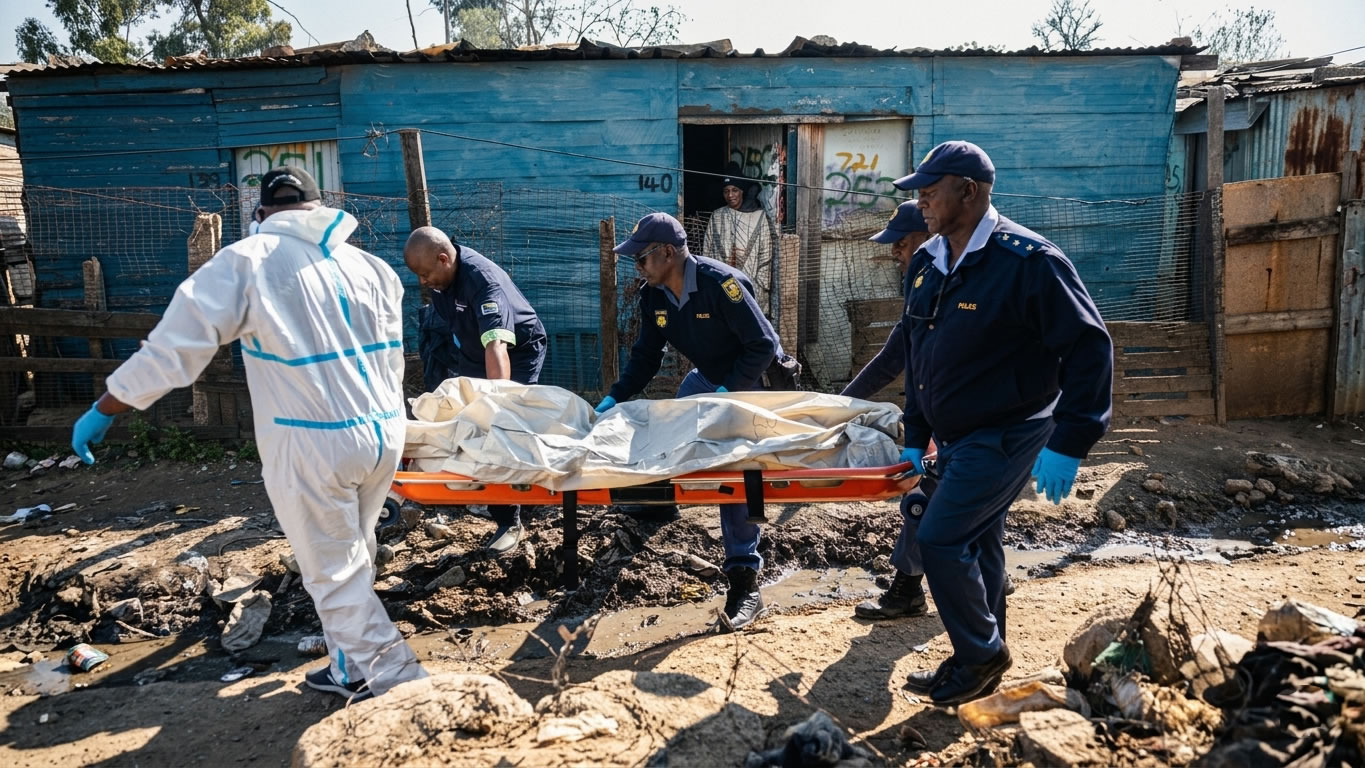
JOHANNESBURG — The night sky over the Jumpers informal settlement in Cleveland, Johannesburg, was shattered by the deafening roar of automatic gunfire late Tuesday evening. In a coordinated and ruthless assault, a heavily armed syndicate descended upon the community, leaving a trail of devastation that claimed the lives of 12 individuals and left at least nine others fighting for their survival.
The massacre, which unfolded with chilling precision, has once again thrust South Africa’s escalating crisis of violent crime and illicit mining into the international spotlight. As forensic teams combed through the bloodstained dirt and corrugated iron structures, the nation was left grappling with the grim reality of a security apparatus seemingly overwhelmed by heavily armed criminal networks.
A Night of Terror
The tranquility of the evening was abruptly broken at approximately 23:10 local time. According to the South African Police Service (SAPS), a white Toyota Quantum—a popular minibus taxi known locally as a kombi—pulled up near a petrol station adjacent to the Cleveland settlement. From this vehicle emerged a heavily armed death squad.
“It is alleged that more than 10 suspects were dropped off by a white Toyota Quantum near a petrol station in Cleveland,” the police detailed in their official statement . “The suspects allegedly entered the informal settlement through both entrances and moved through the area, opening fire on residents and community members at multiple locations before fleeing the scene in the same vehicle.”
The attackers, wielding high-calibre rifles, moved methodically through the settlement. They did not discriminate, firing indiscriminately into the densely packed dwellings. The sheer volume of gunfire suggested a well-resourced and highly organised operation, rather than a random act of violence.
Richard Francis, the chairperson of the Cleveland Community Policing Forum, recounted the harrowing moments as the attack commenced. “Father God, can someone hear us? Jumpers is on fire. Please send the cops,” was the desperate voice note he received from a terrified resident .
Francis elaborated on the chaos, noting that he received numerous calls from community members as the mass shooting was occurring. Residents reported that the shooting spree lasted for more than an hour, a terrifying eternity for those trapped within the settlement’s confines . “I received a voice note from this one lady who said Jumpers is on fire, and I knew she wasn’t talking about a literal fire, which does happen from time to time. She was talking about gunshots,” he said .
When the gunfire finally ceased and the assailants retreated into the night, the true scale of the carnage became apparent. Eight men and three women were pronounced dead at the scene. Another man succumbed to his catastrophic injuries shortly after arriving at a local hospital . At least nine other individuals were rushed to various medical facilities across the city, suffering from severe gunshot wounds .
The Shadow of the Zama Zamas
While the SAPS has officially stated that the motive for the attack remains under investigation, the spectre of illegal mining—and the violent syndicates that control it—looms large over the Jumpers settlement.
During a visit to the crime scene on Wednesday, Gauteng Provincial Police Commissioner Lieutenant General Tommy Mthombeni addressed the media. He described the attack as “heartless” and “barbaric,” but acknowledged the elephant in the room. “As you know, this area is adjacent to the illegal mining area. We are having those suspicions,” he told reporters, confirming that investigators could not rule out a connection to the illicit gold trade .
Cleveland is a site of legacy mining, where major corporations have long since suspended their operations. These abandoned shafts have become a magnet for illegal miners, colloquially known as zama zamas (a Zulu expression loosely translating to “those who try their luck”).
“Basically, when those mines closed, they were left empty, and now people have helped themselves to start mining again,” explained Francis . He noted that illegal mines are dotted around the area, along the north and south of Main Reef Road, and that much of the illicit activity in Jumpers is related to the refining of gold .
The illicit mining sector is fiercely competitive and notoriously violent. Rival syndicates frequently clash over access to lucrative shafts and processing sites. A man wearing a ski mask and a Basotho blanket, who claimed to be part of the community, told a local broadcaster that the shooting was carried out by a faction of zama zamas who had previously been exiled from the settlement . He alleged that this exiled group had tried repeatedly to re-enter the area and had finally succeeded on Tuesday night, exacting a bloody revenge .
A Systemic Failure
The massacre at Jumpers is not an isolated incident but rather a symptom of a broader systemic failure to curb the proliferation of illegal firearms and dismantle organised crime networks in South Africa.
The country boasts one of the highest murder rates globally, and mass shootings have become alarmingly frequent. According to statistics cited by Gideon Joubert from the South African Gunowners’ Association, there are approximately three million legally held firearms in South Africa, and at least an equal number of unlicensed weapons circulating in the criminal underworld .
This vast arsenal fuels the violence that plagues informal settlements, where policing is often inadequate and communities are left to fend for themselves. In the aftermath of the Jumpers shooting, residents expressed profound despair over the deteriorating security situation. Many female residents reported that they no longer leave their dwellings at night due to the pervasive fear of violence .
Adding to the community’s outrage was the conspicuous absence of security personnel during the attack. The gated informal settlement usually has security guards stationed at the entrance, hired via contractors to protect electrification infrastructure for a municipal upgrade project. However, residents reported that these guards, who had been stationed there since February, were missing when the gunmen struck .
Political Fallout and the Road Ahead
The sheer brutality of the Cleveland massacre has ignited a fierce political debate regarding the government’s handling of the illegal mining crisis and the broader issue of violent crime.
The Democratic Alliance (DA) was quick to condemn the attack and demand decisive action. “We must not permit Gauteng residents to live in constant fear of criminals descending on their homes under the cover of darkness and carrying out brutal attacks. Such barbarity has no place in our province and must not be allowed to take root,” stated the DA’s Crezane Bosch .
The Economic Freedom Fighters (EFF) echoed these sentiments, pointing directly to the zama zama syndicates. “While investigations must establish the full facts, it is undeniable that illegal mining has become a major source of organised crime, violence and instability in parts of Gauteng,” the party said in a statement . “Communities have repeatedly raised concerns about criminal networks operating openly in the area, yet intervention by law enforcement agencies has been inadequate and ineffective.”
In response to the mounting pressure, the acting national police commissioner, Lieutenant-General Puleng Dimpane, announced the deployment of a specialised multidisciplinary task team to investigate the massacre. This team includes members from forensic services, tactical response units, and other specialised investigative resources .
“We have reinforced provincial efforts with additional national specialised resources to ensure that the investigation is expedited and that those responsible are swiftly brought to justice,” Dimpane assured the public .
The Gauteng provincial government also issued a strong condemnation, describing the attack as a “direct assault on the safety and dignity of our communities.” They pledged to work closely with law enforcement to apprehend the perpetrators and restore a sense of safety .
However, for the residents of Jumpers and countless other informal settlements across South Africa, these promises offer little comfort. The reality on the ground is one of entrenched poverty, rampant criminality, and a pervasive sense of vulnerability.
As forensic pathologists transported the bodies from the blood-soaked dirt of Cleveland, the nation was left to ponder a grim question: How many more lives must be lost before the tide of violence is finally stemmed? The 12 souls who perished in the Jumpers massacre are a tragic testament to the urgent need for comprehensive reform and decisive action against the syndicates that operate with impunity in the shadows of South Africa’s forgotten communities.
The investigation continues, with police actively tracing the white Toyota Quantum and pursuing all intelligence leads. Yet, until the root causes of this violence—the illicit economy, the proliferation of illegal firearms, and the systemic neglect of informal settlements—are addressed, the spectre of another bloodbath remains a terrifying possibility.