


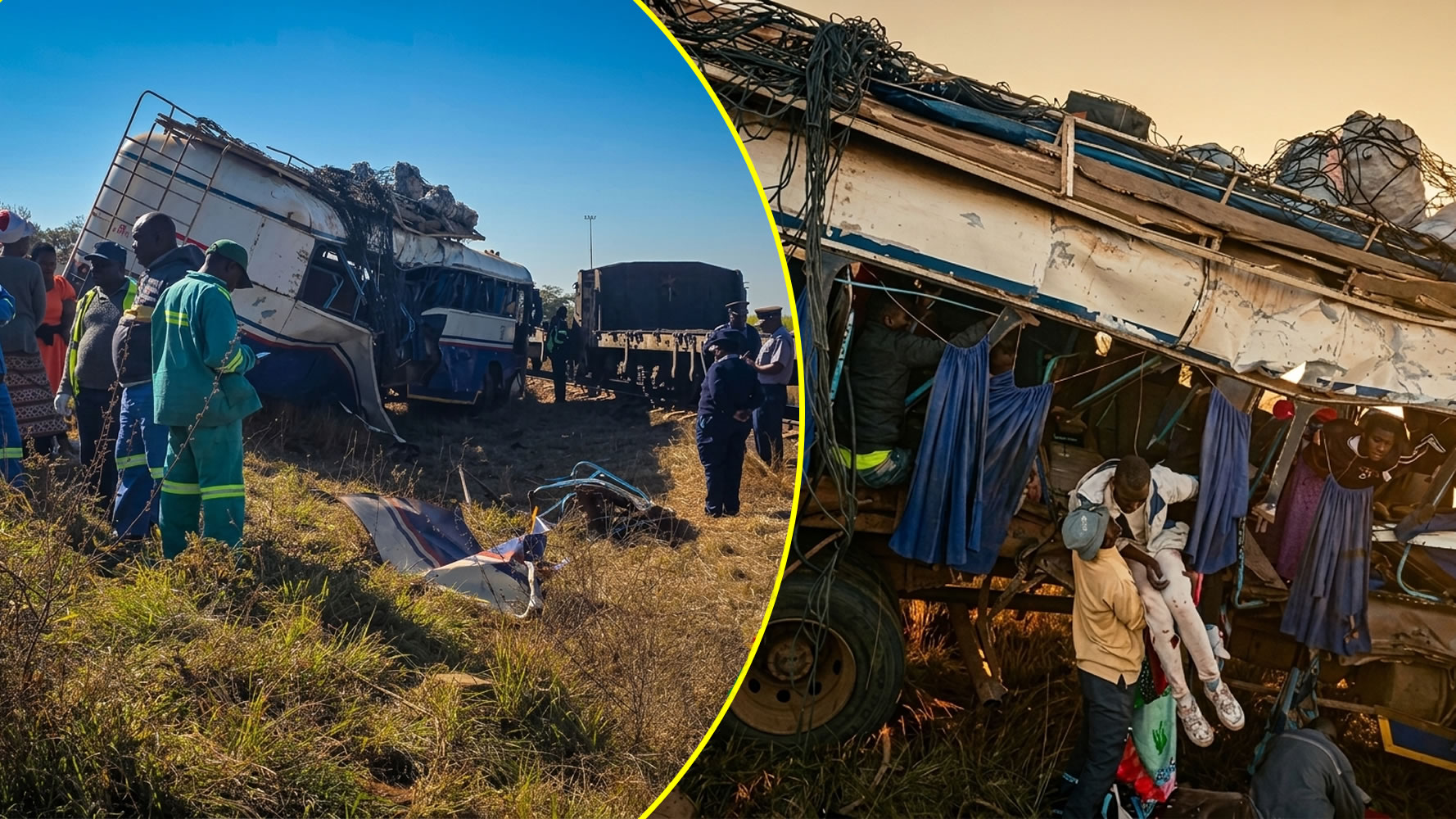
TRAGEDY IN THE LOWVELD: NINE DEAD AS BUS CRUSHED AT CHIREDZI LEVEL CROSSING
MASVINGO – The winter sun had only just begun to cast long, pale shadows across the sugar cane fields of Triangle when the silence of the Lowveld was shattered by the screech of grinding metal and the desperate roar of a locomotive’s whistle. At approximately 7:00 AM on Tuesday, a routine journey from Chikombedzi to Masvingo ended in a scene of absolute devastation at a railway level crossing on Mbizi Road. A Makuku Bus, carrying dozens of passengers, drove directly into the path of an oncoming National Railways of Zimbabwe (NRZ) goods train.
The impact was catastrophic. The heavy locomotive, which was travelling from Triangle to the NRZ Lundi siding, struck the passenger bus with such force that the vehicle was reduced to a twisted heap of steel and shattered glass. By the time the dust settled and the train came to a shuddering halt, nine lives had been extinguished. Amongst the dead were seven adults and two minors, their lives cut short on a stretch of road that has now become a site of mourning for the Chiredzi district.
As emergency services arrived, the scale of the tragedy became clear. Local police, ambulances, and the fire brigade were quickly on-site, managing an active and grim rescue operation. While nine bodies were recovered from the wreckage, at least 25 other passengers were pulled from the remains of the bus, many with life-altering injuries. They were rushed to nearby hospitals, where medical staff worked frantically to stabilise them.
National police spokesman Commissioner Paul Nyathi provided a brief but sobering update as the investigation began. He stated:
“More details will be availed soon as police officers are still attending to the accident.”
His words, though concise, reflected the gravity of an incident that has once again turned the spotlight on the perilous state of Zimbabwe’s road and rail intersections. In a separate statement, the NRZ confirmed the fatalities and noted that 26 people had been injured, a slight variation from the initial police count that highlights the chaotic nature of the immediate aftermath.
THE FAILURE AT THE CROSSING
The primary cause of the collision, according to the NRZ, was a blatant disregard for basic safety protocols. The parastatal was blunt in its assessment of the driver’s actions, noting that the Makuku Bus driver “failed to observe level crossing rules, which require drivers to stop and check for oncoming trains before proceeding.”
In the Lowveld, where the railway lines often cut through vast estates and rural bypasses, these crossings are a common feature of the landscape. However, they are also sites of frequent near-misses and tragedies. The NRZ extended its condolences to the families of the deceased and wished the injured a speedy recovery, but their statement also carried a weary tone of frustration.
The parastatal appealed to road users, saying: “We would also like to urge all motorists to strictly observe level crossing regulations to avoid loss of lives and injuries.”
This appeal is not new. It is a refrain that has been heard across Zimbabwe for decades, yet the message seems to be falling on deaf ears as the death toll continues to climb. Investigative enquiries into the Mbizi Road crossing suggest that while the rules are clear, the environment is often unforgiving. Local residents have previously raised concerns about tall grass and vegetation obscuring the view of oncoming trains, particularly during the early morning hours when visibility can be compromised by the Lowveld haze.
A LEGACY OF SERVICE AND RISK
The bus involved in the crash belonged to the Makuku Bus Service, a name that is deeply woven into the fabric of Zimbabwean transport history. For many in the rural south-east, Makuku is more than just a transport company; it is a lifeline that connects remote villages like Chikombedzi to the urban centres of Masvingo and beyond.
Founded by pioneers of the “chicken bus” era, the company has survived decades of economic upheaval and changing regulations. However, this latest incident adds a dark chapter to its long history. While the company has provided essential services to the Lowveld for generations, the safety records of long-distance bus operators in Zimbabwe have come under intense scrutiny in recent years.
The route from Chikombedzi to Masvingo is a long and demanding one, often requiring drivers to navigate poorly maintained roads for hours on end. In an industry where time is money and schedules are tight, the temptation to “beat the train” at a level crossing can sometimes outweigh the instinct for caution. For the passengers on Tuesday morning, that split-second decision proved fatal.
A SYSTEMIC CRISIS ON THE RAILS
The Chiredzi disaster is far from an isolated event. It is merely the latest in a string of rail-road collisions that have plagued the National Railways of Zimbabwe. Historical data paints a grim picture of the risks associated with level crossings in the country. Between January 2007 and December 2013 alone, 167 people died and 581 were injured at such crossings.
Despite various safety campaigns and the installation of warning signs, the trend has persisted into 2026. In March 2025, the NRZ issued a “Level Crossing Safety Alert” after recording multiple accidents in just two days. In one instance, a couple was severely injured when their car was struck by a train. The NRZ’s alarm at the rise of these incidents has been a constant theme in their public communications.
One of the most significant challenges facing the NRZ is the theft and vandalism of safety infrastructure. Warning bells and automated gates, which were once common at major crossings, have frequently been stripped of their copper wiring or solar panels, leaving drivers to rely solely on their own eyes and ears. In rural areas like Triangle, many crossings are “unprotected,” marked only by a stationary sign that is easily ignored by a distracted or hurried driver.
THE BROADER TOLL OF ZIMBABWE’S ROADS
To understand the Chiredzi crash, one must look at the broader context of road safety in Zimbabwe in 2026. The country is currently grappling with what many experts describe as a national emergency on its highways. Statistics from the Traffic Safety Council of Zimbabwe (TSCZ) indicate that, on average, five people die in road traffic accidents every 24 hours.
The year 2026 has been particularly brutal. Just weeks before the Chiredzi tragedy, a collision between a bus and a haulage truck in central Zimbabwe claimed ten lives. Earlier in the year, during the Easter period, the police reported a higher death toll despite a lower number of total accidents, suggesting that the crashes occurring are becoming increasingly lethal.
Several factors have contributed to this escalating crisis. The deregulation of certain transport sectors, introduced through Statutory Instruments 6 and 10 of 2026, has raised concerns among safety advocates. These regulations, which aimed to simplify requirements for operators, have been criticised for potentially lowering the bar for driver retesting and vehicle inspections. In an environment where corruption in the licensing system is already a known issue, any perceived softening of the rules is seen as a recipe for disaster.
Furthermore, the state of the national fleet is a cause for concern. Many buses currently in operation are ageing vehicles that have been rebodied or repaired multiple times. While the Makuku Bus involved in Tuesday’s crash appeared to be a standard passenger vehicle, the general lack of stringent, enforced maintenance standards across the industry means that mechanical failures—such as brake issues—cannot be ruled out in the early stages of any investigation.
THE HUMAN COST
Beyond the statistics and the official statements lie the shattered lives of the families in Chikombedzi and Chiredzi. The loss of two minors in this accident is a particularly bitter pill for the community to swallow. These children were likely travelling with parents or guardians, perhaps heading to the city for school, medical appointments, or to visit relatives. Instead, their journey ended in a field of sugar cane, surrounded by the wreckage of their hopes.
For the 25 survivors currently in hospital, the road to recovery will be long and arduous. Many will face permanent disabilities, and all will carry the psychological scars of having survived a high-speed collision with a freight train. The trauma of such an event ripples outward, affecting not just the victims but the first responders who had to pull bodies from the twisted metal and the train crew who were powerless to stop their massive machine in time.
A CALL FOR ACCOUNTABILITY
As the police continue their work at the scene on Mbizi Road, the questions for the authorities are mounting. Why are these level crossings still so dangerous? Is the NRZ doing enough to clear vegetation and maintain visibility? Are bus companies like Makuku ensuring their drivers are adequately trained and not overworked?
The NRZ’s recurring appeal for motorists to “stop, look, and listen” is a necessary one, but it may no longer be sufficient. In many other countries, the solution to level crossing accidents has been the construction of bridges or underpasses, or the installation of sophisticated, tamper-proof warning systems. In Zimbabwe, however, the economic reality often means that such infrastructure projects remain a distant dream.
For now, the people of Chiredzi are left to mourn their dead. The sugar cane continues to grow in the Lowveld sun, and the trains will continue to rumble through the estates of Triangle. But for nine families, the world stopped at 7:00 AM on a Tuesday morning, at a crossing where a bus failed to stop, and a train could not.
The investigation into the crash remains active. Until significant changes are made to how road and rail interact in Zimbabwe, the Mbizi Road tragedy will likely not be the last. The “seasoned investigative journalist” would conclude that while the driver’s error may have been the immediate trigger, the underlying causes are a complex mix of systemic neglect, economic pressure, and a culture of risk that continues to haunt the nation’s transport networks.
Timeline of Recent Rail/Road Incidents in Zimbabwe:
|
Date
|
Location
|
Incident Details
|
|
June 2026
|
Chiredzi
|
Makuku Bus hit by goods train; 9 dead, 25 injured.
|
|
May 2026
|
Central Zimbabwe
|
Bus and haulage truck collision; 10 fatalities.
|
|
March 2025
|
Various
|
NRZ flags multiple level crossing accidents in 48 hours.
|
|
April 2024
|
Harare
|
Commuter omnibus (kombi) struck by train; multiple injuries.
|
|
2007-2013
|
National
|
167 deaths recorded at rail-road level crossings.
|
The silence in the wards of the local hospitals is a stark contrast to the violence of the impact. As the injured wait for news of their loved ones, the nation waits for more than just another statement of condolence. It waits for action.