


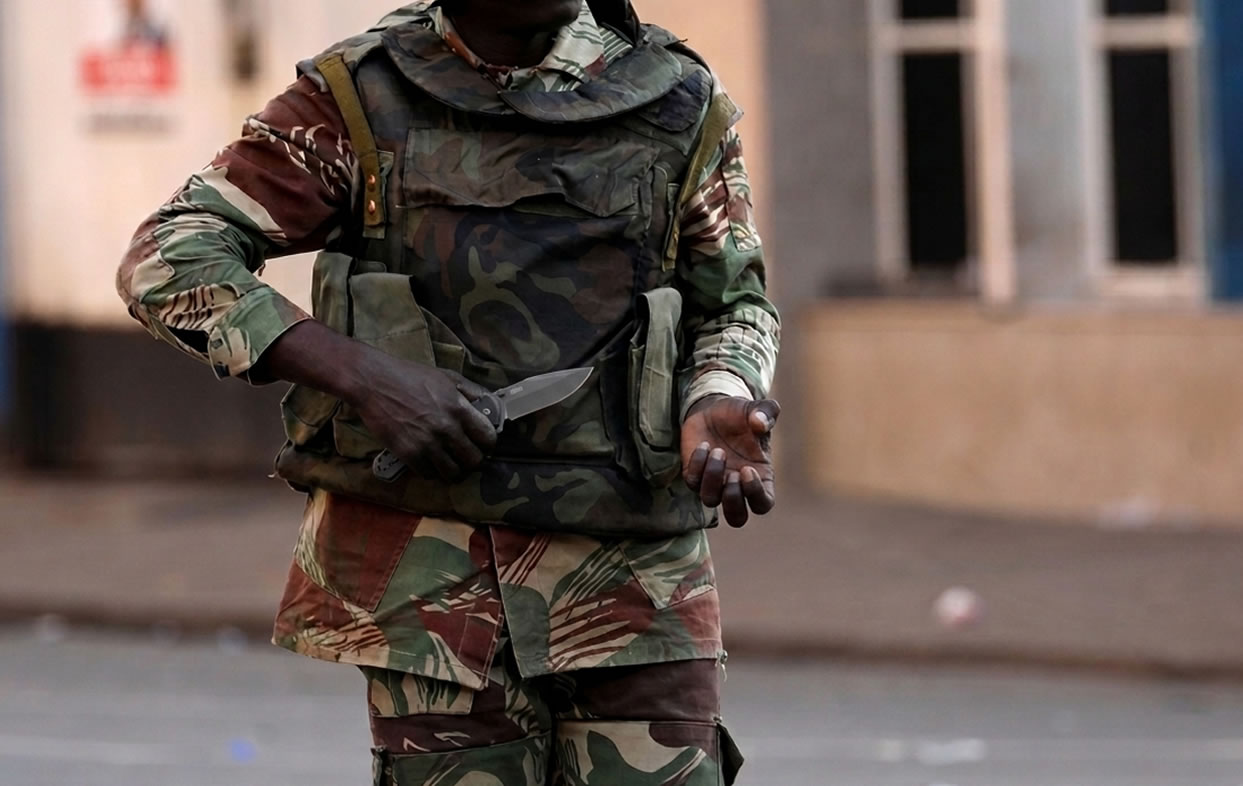
The wooden benches of the Rusape Magistrate’s Court are often filled with the desperate and the destitute, but on a recent Monday, the figure standing in the dock carried a different kind of weight. Learnmore Gwenyaya, a 31-year-old soldier from the elite One Commando Regiment, stood before Provincial Magistrate Tendai Mahwe to answer for a crime that has left many questioning the state of discipline within Zimbabwe’s most prestigious military units.
Gwenyaya, who resides at Block 5 of the One Commando Regiment barracks in Harare, was sentenced to an effective four years in prison. His crime was the knifepoint robbery of Father Kanisious Mashati, a Roman Catholic priest, in the quiet farming community of Headlands. While the sentence marks the end of a legal chapter, it opens a much larger investigation into a disturbing trend: the transformation of the nation’s protectors into its predators.
A Midnight Incursion
The events that led Gwenyaya from the elite barracks of the capital to a prison cell began on the evening of 7 December 2025. At Mt Carmel Primary School in Headlands, Father Mashati had retired to bed around 9pm. His residence had been secured by a domestic worker, Margret Mafeni, who had checked every window and locked the doors. It was a routine night in a place of peace, until the early hours of the following morning.
At approximately 1:30am, the silence was shattered. Gwenyaya and two accomplices, who managed to evade capture and remain at large, arrived at the priest’s home. They were not merely opportunistic thieves; they were prepared. Armed with an iron bar, a shovel, and a sharp okapi knife, the trio wore balaclavas to hide their faces. Most chillingly, they did not break a window to gain entry. Instead, they used duplicate keys to open the main door, suggesting a level of premeditation that has become a hallmark of recent military-linked crimes.
Once inside, they forced their way into Father Mashati’s bedroom. The priest did not go down without a fight. As the intruders assaulted him with the iron bar and the shovel, Father Mashati resisted with remarkable bravery. During the struggle, he managed to grab a bottle of wine and hurl it at his attackers, striking and injuring Gwenyaya. However, the defiance of the clergyman was eventually met with the cold steel of an okapi knife. Threatened with being stabbed, Father Mashati was forced to surrender.
The robbers ransacked the room, but their haul was surprisingly meagre for such a violent and risky operation. They made off with an Itel A70 mobile phone. The trio then fled into the night, leaving a bruised and shaken priest behind.
The Capture and the Courtroom
The escape was short-lived. Zimbabwe Republic Police officers on night patrol intercepted the three men at Halfway House along the Harare-Mutare Road at around 3:30am, just two hours after the robbery. When the police approached, two of the suspects bolted into the darkness and disappeared. Gwenyaya, perhaps slowed by the injury sustained during the struggle with the priest, was apprehended.
A search of his belongings revealed more than just a stolen phone. Inside his satchel, police discovered a live cartridge. Ballistics tests later confirmed the ammunition was live, and investigations revealed that Gwenyaya held no firearm certificate.
In court, Gwenyaya pleaded guilty to the robbery charges. Prosecutor Faith Mutukwa detailed the harrowing ordeal, painting a picture of a man who had traded his military honour for a cheap mobile phone. Magistrate Mahwe was firm in his delivery. For the robbery, he sentenced Gwenyaya to five years in prison, suspending one year on the condition of good behaviour. For the unlawful possession of ammunition, the soldier was fined US$300, with a four-month prison term as an alternative if he failed to pay.
A Pattern of Desperation
The case of Learnmore Gwenyaya is not an isolated incident. To understand why an elite commando would risk his career and freedom for a smartphone, one must look at the broader landscape of the Zimbabwe National Army (ZNA). Over the past two years, the frequency of military personnel being implicated in violent crimes has reached a level that can no longer be ignored.
In April 2024, a massive police operation led to the arrest of nine suspected armed robbers. Among them were four serving soldiers: Owen Mbayi, Promise Mussa, Farai Chauke, and Simbarashe Vhazhure. These men were not just petty thieves; they were linked to a series of high-profile heists across Harare, Murehwa, and Shamva. Most notably, they were connected to a 2022 robbery at J&P Security offices in Eastlea, where over US$142,000 was stolen.
Assistant Commissioner Paul Nyathi, the national police spokesperson, has been consistent in his rhetoric, stating:
“The position of the security services has been that anyone involved in criminal acts will be dealt with professionally.”
Yet, despite these assurances, the “rogue elements” continue to surface. In December 2024, three soldiers—Iphithule Mlotshwa, Hamlet Mlotshwa, and Haulezwe Mlotshwa—were arrested for a robbery spree in the Fort Rixon mining area. Armed with axes, knives, and even handcuffs, they attacked miners and stole thousands of dollars. The sight of men in ZNA uniforms committing such acts has become a recurring nightmare for rural communities.
The Poverty in the Barracks
The common thread in these stories is often whispered in the corridors of power but rarely addressed in public: the dire economic state of the rank-and-file soldier. While the top brass of the military often enjoy significant privileges, the ordinary soldier is facing the same crushing inflation and currency instability as the rest of the population.
Reports from within the military community suggest that hunger in the barracks is a very real issue. Sub-standard wages that are frequently eroded by the rising cost of living have left many soldiers unable to support their families. In June 2026, just days before Gwenyaya’s sentencing, reports emerged that approximately 65 soldiers were arrested for distributing leaflets that allegedly highlighted these grievances.
This internal unrest suggests that the discipline for which the ZNA was once famous is being corroded by the basic need for survival. When a soldier’s monthly pay cannot cover the cost of a bag of maize meal, the temptation to use their training and equipment for criminal gain becomes a dangerous reality.
The Erosion of Trust
The impact of these crimes goes beyond the immediate victims like Father Mashati. It strikes at the heart of national security. The One Commando Regiment is supposed to be the pride of the nation—an elite force trained for the most difficult missions. When members of such a unit are caught using duplicate keys to rob priests, the message to the public is one of profound instability.
The use of duplicate keys in the Gwenyaya case is particularly concerning. It suggests a level of insider knowledge or a breakdown in the security of military-issued equipment. It raises the question of how many other soldiers might be using their access and skills to facilitate criminal networks.
Furthermore, the presence of live ammunition in Gwenyaya’s possession, despite not having a firearm certificate, points to a lack of accountability for military hardware. If a soldier can walk out of a barracks with live rounds in his satchel to go on a robbery, the internal controls of the ZNA are clearly failing.
A Nation at a Crossroads
Zimbabwe finds itself at a difficult juncture. The military has historically been the backbone of the state, but that backbone is showing signs of severe strain. The government’s response has largely been to treat these incidents as the work of “bad apples,” but the sheer number of “bad apples” suggests the tree itself may be struggling.
As Learnmore Gwenyaya begins his four-year sentence, the two accomplices who fled into the night remain a reminder that the problem is far from solved. The stolen Itel A70 phone may have been recovered, but the sense of security in communities like Headlands has been significantly damaged.
The Roman Catholic Church, a pillar of support for many in Zimbabwe, has yet to issue a formal statement on the attack on Father Mashati. However, the silence in the pews speaks volumes. For many Zimbabweans, the sight of a soldier is no longer a guarantee of protection; it is increasingly a cause for caution.
Addressing this crisis will require more than just prison sentences. It will require a fundamental look at the socio-economic conditions of those we ask to defend the nation. Until the “poverty in the barracks” is addressed, the line between the commando and the criminal will continue to blur, and more priests may find themselves staring down the blade of an okapi knife held by a man in uniform.
The case of Learnmore Gwenyaya is a tragedy in many parts: a soldier’s fall from grace, a priest’s violated sanctuary, and a nation’s crumbling trust. As the prison gates close on Gwenyaya, the questions left behind remain wide open. If the elite can fall this far, what does the future hold for the rest of the ranks?