


The political atmosphere in Zimbabwe has reached a boiling point as the controversial Constitutional Amendment Bill Number 3 (CAB3) nears its finalisation. In a move that has stripped away any remaining veneer of democratic reform, a high-ranking ally of President Emmerson Mnangagwa has issued a chilling warning to those within the ruling party who have dared to question the legislation. Ezra Chadzamira, the Minister of State for Provincial Affairs and Devolution for Masvingo, has explicitly put Zanu PF members on notice, declaring that there will be a “baptism of fire” and significant “regret” once the amendment process is wrapped up.
Chadzamira’s remarks, delivered during a tense Zanu PF provincial inter-district meeting at Clovelly, have exposed the deep fissures and the “hidden agenda” driving the CAB3 initiative. Far from being a mere technical adjustment to the nation’s governance, the bill is increasingly seen as a strategic instrument for absolute power consolidation. Chadzamira did not mince his words when describing the surveillance mechanisms now in place to monitor internal dissent. He revealed that he, alongside the Minister of State for Security Lovemore Matuke, is actively tracking the political moves of every Member of Parliament and councillor.
“Allow this CAB3 process to be finalised, as Matuke stated, and there will be regret,” Chadzamira told the gathered party members. His rhetoric took a particularly sharp turn when he likened dissenting members to “bats” who operate in the shadows. “Some of you are like bats. You stand with us in daylight but at night you whisper in code. You hold endless meetings in homes and hotels. Nothing escapes me. I lead the Provincial Joint Operations Command while Matuke heads the National Operations Command. Our job is to get briefings on everything each of you is doing.”
This level of overt surveillance highlights the high stakes involved in the passage of CAB3. The bill proposes a radical restructuring of Zimbabwe’s electoral and executive framework. Most notably, it seeks to extend the presidential and parliamentary terms from five to seven years, a move that would keep President Mnangagwa in power until at least 2030 without the need for a general election in 2028. Furthermore, it aims to replace the direct popular election of the president with a parliamentary-based system, effectively allowing the ruling party elite to select the head of state behind closed doors.
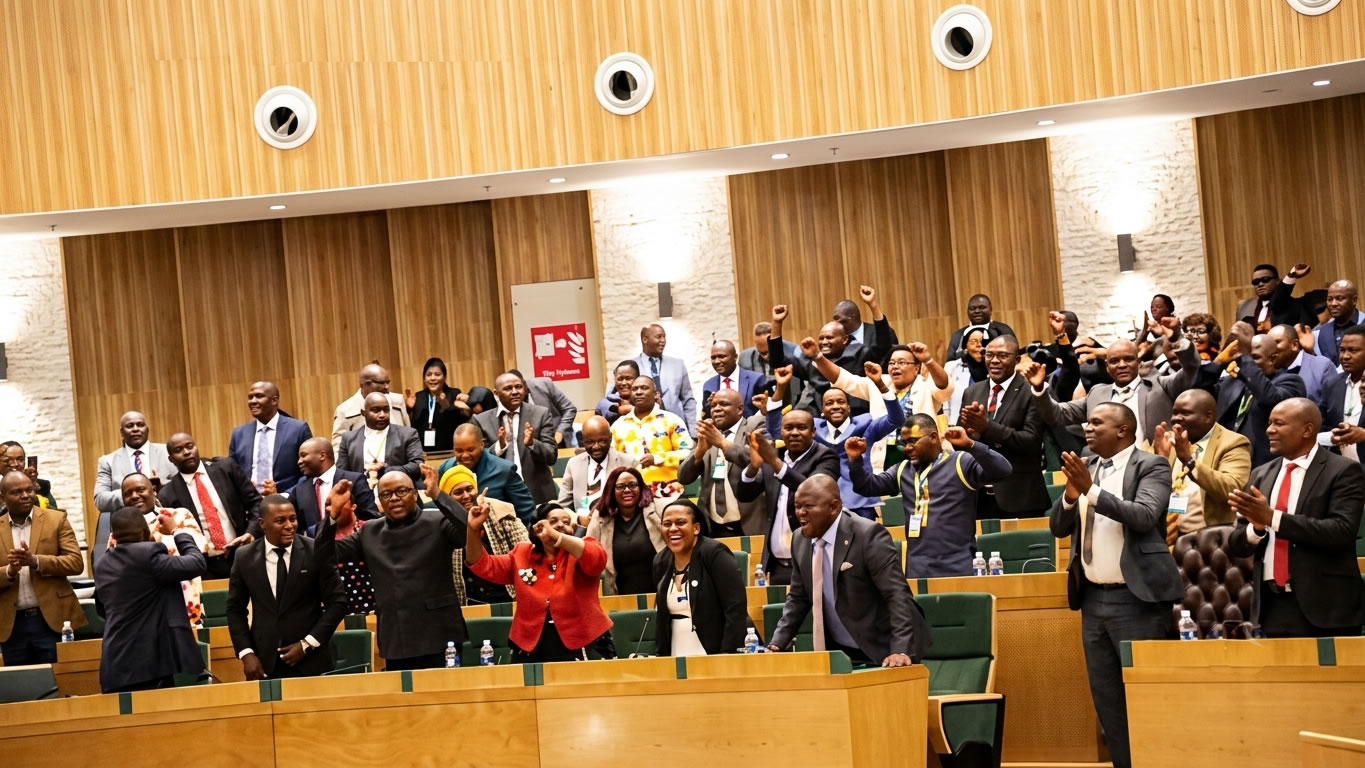
The “baptism of fire” promised by Chadzamira is not an idle threat. It follows a series of incidents that have rattled the Zanu PF leadership, including a recent National Assembly vote where 14 MPs and several ministers were conspicuously absent. This absenteeism has been interpreted by the Mnangagwa loyalists as a form of “internal sabotage.” The “witch hunt” to identify these individuals is already underway, with Chadzamira cautioning members against attending any meetings not sanctioned by the official provincial leadership. “Don’t trade your loyalty for a few drinks, because after CAB3 there will be regret,” he warned.
Historically, constitutional amendments in Zimbabwe have served as the primary tool for executive entrenchment. From the 1987 changes that created the executive presidency to the more recent Amendment No. 2, the pattern is one of systematic erosion of democratic checks and balances. However, CAB3 represents a more fundamental shift. By lengthening the president’s term without a referendum, legal experts argue the bill is in direct violation of the Constitution. Yet, the government justifies these moves by claiming that developing countries need longer leadership terms to implement long-term projects—a rationale Chadzamira echoed during his address.
The internal resistance to CAB3 is not limited to backbenchers. High-level figures, including Vice President Constantino Chiwenga and several senior retired army commanders, have reportedly voiced their opposition to the amendments. This has created a volatile situation where the “hidden agenda” of term extension is clashing with the ambitions of other powerful factions within the party. The use of the Provincial and National Joint Operations Commands to monitor elected officials suggests that the leadership is prepared to use the state’s security apparatus to enforce party loyalty.
For the average Zimbabwean citizen, the implications are profound. The move towards a parliamentary-elected presidency risks creating a leadership that is entirely insulated from the public will. This “constitutional coup” would effectively disenfranchise millions of voters, making the presidency a prize to be traded among the party’s inner circle. The focus on “technical expertise” and “long-term projects” is seen by many as a thin veil for a desperate attempt to maintain control in the face of mounting economic and social challenges.
The pressure on party members to conform is immense. Chadzamira’s warning to “shun the rest” and only attend meetings called by provincial chairman Rabson Mavhenyengwa is a clear directive to stifle any independent thought or assembly. The atmosphere of fear is intended to ensure that when CAB3 finally reaches the Senate, there will be no remaining voices of dissent. However, this strategy of forced loyalty may ultimately backfire. By alienating key factions and relying on overt threats, the Mnangagwa administration risks creating a brittle political structure that could crumble under the weight of its own internal contradictions.
As investigative journalists, we must question whether the “baptism of fire” will indeed secure Mnangagwa’s legacy or if it will instead ignite a broader conflict within the nation’s fabric. The parallels to the final years of the Mugabe era are striking—a leadership obsessed with succession and survival, using constitutional manipulation to stay relevant. The difference now is the openness with which the threats are being issued. There is no longer a pretence of consensus; there is only the demand for absolute submission.
The potential long-term consequences for Zimbabwe’s democratic institutions are catastrophic. If the presidency becomes a product of parliamentary arithmetic, the role of the citizen in shaping the nation’s future is effectively nullified. The fabric of society, already strained by years of economic hardship, may not be able to withstand a further entrenchment of authoritarian rule. The “hidden agenda” exposed by Chadzamira is a blueprint for a future where power is held by the few, at the expense of the many.
Citizens are urged to look beyond the official rhetoric and understand the true implications of CAB3. It is a bill that seeks to rewrite the social contract between the governors and the governed. The “regret” that Chadzamira promises to his colleagues may well be a regret shared by the entire nation if these amendments are allowed to stand. The struggle for the soul of Zimbabwe has entered a critical phase, and the outcome will determine whether the country moves towards a genuine democracy or sinks further into the abyss of one-man rule.
In conclusion, the “baptism of fire” is a stark reminder of the lengths to which those in power will go to preserve their positions. The exposure of the “hidden agenda” by a close ally of the President has provided a rare glimpse into the ruthless machinery of the Second Republic. As the amendment process nears its end, the question is no longer what the bill contains, but who will survive the fire that follows. The resilience of the Zimbabwean people, who have faced many such “baptisms” in their history, remains the only hope for a future that is not dictated by threats and surveillance.
The story of CAB3 is far from over. As the “witch hunt” continues and the surveillance intensifies, the true cost of this power play will become increasingly clear. Whether the “bats” can survive the daylight or if the “fire” will consume all dissent remains to be seen. What is certain is that the path Zimbabwe is currently on is one of deep uncertainty, where the law of the land is being sacrificed on the altar of political survival. The “regret” promised by Chadzamira may indeed be the defining characteristic of this era.