


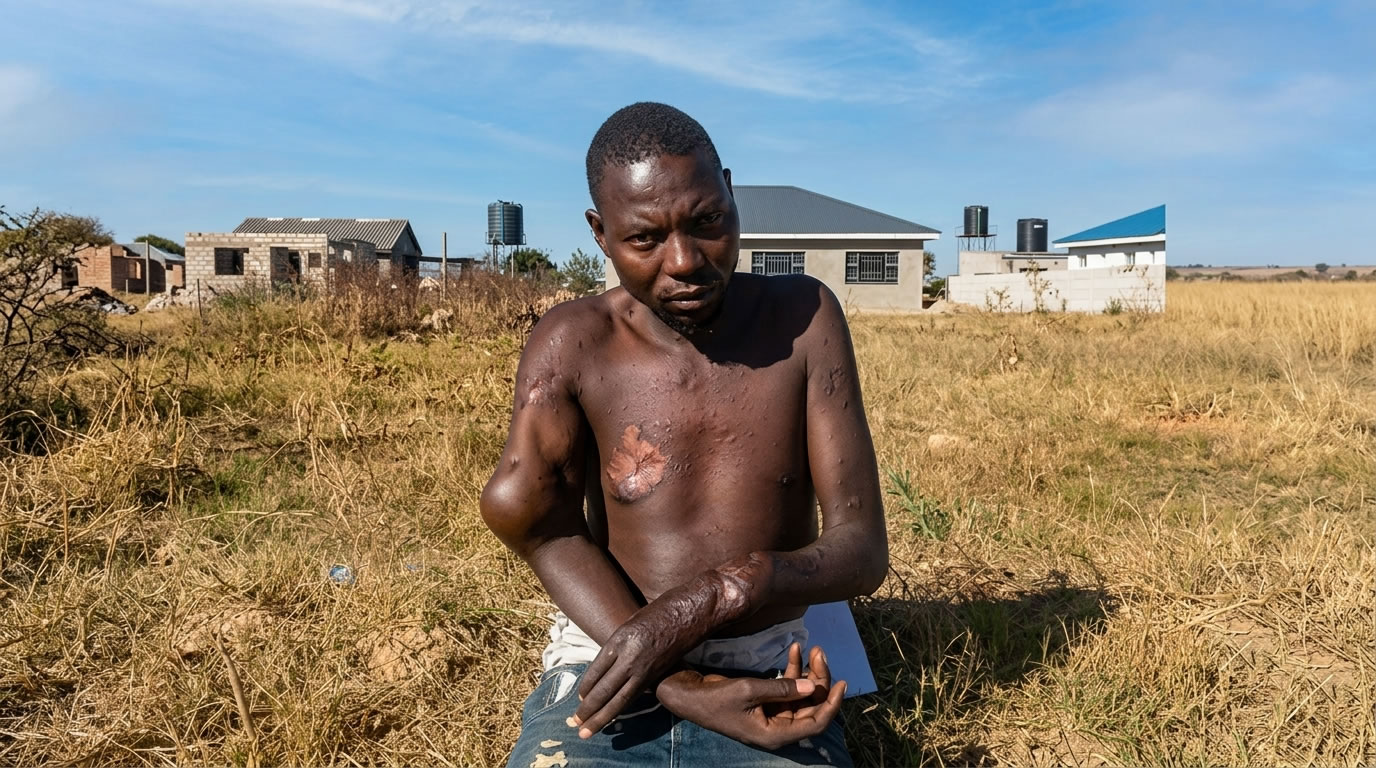
The Cost of a Catch: A Thirty-Minute Battle for Survival in the Jaws of a Chivero Predator
NORTON — For Garikayi Chiweshe, the silence of the pre-dawn mist over Lake Chivero is no longer a source of peace. Instead, it is the backdrop to a nightmare that plays on a loop every time he closes his eyes. On the 6th of April, 2025, the 31-year-old fisherman entered the water with a net and a hope for a decent catch. He left it with his life, but only after a harrowing thirty-minute struggle against a Nile crocodile that has left him physically shattered and financially destitute.
The incident, which took place around 3 AM as the first hints of dawn were breaking over the horizon, highlights a growing and deadly crisis in Zimbabwe. As the economy falters, more men like Chiweshe are forced into “poaching” or informal fishing in crocodile-infested waters to put food on the table. But the price of a few kilograms of bream can be unimaginably high.
“I had a problem of being bitten by a crocodile on April 6 last year. It broke both my arms, which need to have metal plates inserted, but I don’t have the money doctors require,” says Chiweshe, speaking from his in-laws’ home in Kingsdale, Norton. His voice is steady, but his arms, now useless and deformed, tell the true story of that morning.
The Midnight Cast
Chiweshe’s journey to the jaws of a predator began far from the shores of Lake Chivero. Originally from his rural home in Headman Muchinjiko’s area, under Chief Chiendambuya in Rusape, he moved to Norton in search of better prospects. Like many others, he found that the surrounding dams and rivers offered a way to survive. He would catch fish and sell them to the local community, a modest living that kept him afloat until that fateful Sunday.
On the night of the attack, Chiweshe was not alone. “There were eight of us who went to Lake Chivero, and we started casting our nets around 3 AM as dawn was breaking. To prevent ourselves from drowning, we all tied water containers to our bodies. I tied containers with about 30 litres of water,” he recalls. This makeshift safety measure, common among informal fishermen, would later become both a hindrance and a potential lifesaver as he struggled to stay afloat during the attack.
Chiweshe and one of his colleagues were the first to venture into the dark, murky depths. They began spreading their nets over a length of about one hundred metres. The water was cool, and the world was quiet, until Chiweshe felt something solid beneath his left foot.
“When I stepped on the crocodile, I told my colleague that I had stepped on a big crocodile. Then it lifted its head, opened its mouth, and bit my whole waist, and started chewing me,” Chiweshe says.
A Half-Hour of Horror
What followed was a scene of primal violence. The crocodile, an opportunistic ambush predator, did what it has done for millions of years: it tried to drag its prey into the deep to drown it. Chiweshe, however, refused to go quietly.
“I don’t know where my strength came from. I fought the crocodile as it tried to drown me, we kept surfacing and going under, tumbling until it showed signs of fatigue. I was also getting tired. I then started dragging it ashore while it was still biting my hand until we reached water that was knee-deep,” he explains.
During the struggle, Chiweshe managed to keep his wits about him. As the beast dragged him under, he searched for its head. He grabbed its nose and used the fingers of his left hand to poke at its eyes, a desperate attempt to force the reptile to release its grip.
“Then it dragged me underwater, while I was shouting to my colleague to pass me a knife. He handed me the knife, and I took it with my right hand. It then let go of my left hand and bit my right hand, which was holding the knife. This caused the knife to break instantly,” Chiweshe says.
The battle continued for what felt like an eternity. Chiweshe estimates the fight lasted thirty minutes. The crocodile continued to bite his right hand, dragging him deeper, while he fought to stay above the surface. Eventually, through sheer willpower, he managed to move towards the shore.
“Seeing that it was being pulled out, it let go of my hand, slapped the water with its tail, and fled back into the water. It was moving very fast,” he says. As he reached the shallow water, his companions grabbed him and pulled him onto the sand. The exhaustion was immediate and overwhelming. “I collapsed from exhaustion,” he admits.
A Growing National Crisis
Chiweshe’s story is not an isolated incident. Across Zimbabwe, human-wildlife conflict is reaching a breaking point. According to recent data from the Zimbabwe Parks and Wildlife Management Authority (ZimParks), crocodiles and elephants are responsible for over 80% of human fatalities involving wildlife in the country.
Just last month, on the 23rd of May 2026, a grim discovery was made at Mpopoma Dam. ZimParks officials shot and dissected a crocodile suspected of killing a man on the 1st of May. Inside the reptile’s stomach, they found human remains. “The crocodile suspected to have been involved in the incident was shot and subsequently recovered and dissected on May 23. During the dissection process, human remains believed to be those of the deceased client were discovered in the crocodile’s stomach,” confirmed ZimParks spokesperson Mr Luckmore Safuli.
In another heartbreaking case in February 2026, a three-year-old boy was snatched and dragged into the Matetsi River in Jambezi while his mother was fishing nearby. Commissioner Paul Nyathi, the police national spokesperson, noted at the time: “The child had accompanied his mother and sibling to the river for fishing when the incident occurred.”
Statistics show a worrying trend. Between 2016 and 2022, 322 people died in wildlife encounters in Zimbabwe, with annual fatalities increasing fourfold in just seven years. The northern and western districts, including Kariba, Binga, and Hwange, are hotspots for these fatal encounters, largely due to the proximity of communities to large water bodies and protected areas.
The Aftermath of Survival
For Chiweshe, surviving the attack was only the beginning of a different kind of struggle. He was carried away from the water on a sack by four of his companions and rushed to Parirenyatwa Group of Hospitals in Harare.
“My companions then carried me to the car and took me to Parirenyatwa, where I began receiving treatment. I spent three months receiving treatment at this hospital. The problem now is that both my arms are broken and need metal plates to function again. More than US$1,000 is needed,” Chiweshe says.
The physical toll is immense. While his hip bones were spared, his waist is covered in deep scars from the crocodile’s teeth. “I was also bitten on the chest, and I cleaned the wound, which later healed. It’s the arms that need to be straightened with metal plates,” he adds. Without the surgery, he is unable to work or support himself, leaving him dependent on the charity of his in-laws.
His mother, 54-year-old Ogila Chiweshe, has been by his side throughout the ordeal. She travelled from her rural home after hearing of the accident and stayed in Harare for three months during his initial hospitalisation.
“I came from my rural home after hearing about my son’s accident, and I stayed here in Harare for three months. I have no one helping me with my son’s illness since I separated from his father, who lives in Headman Gombiro’s area, in Makumbe, Buhera,” she says.
The family’s plight is compounded by a string of tragedies. “Misfortunes continue to follow them, as another one of her daughters was struck by lightning in clear weather and died last year in Rusape,” Mai Chiweshe adds, her voice heavy with the weight of her family’s suffering.
A Systemic Failure
The case of Garikayi Chiweshe is a stark reminder of the intersection between economic hardship and environmental danger. In many parts of Zimbabwe, the “poaching” of fish is not a choice made out of greed, but a desperate act of survival. When formal employment is scarce and the cost of living continues to rise, the risks of the river seem like a gamble worth taking—until the gamble fails.
ZimParks frequently issues warnings to the public. “Members of the public are strongly advised to avoid swimming, fishing, and collecting water in unsafe areas, particularly in the early morning and evening, when crocodile activity is heightened,” says Mr Safuli. However, for those with empty stomachs, these warnings often go unheeded.
The lack of mental health support and financial safety nets for victims of wildlife attacks further exacerbates the crisis. Families are left to bear the astronomical costs of specialised medical care, such as the metal plates Chiweshe requires, in a healthcare system that is already under immense strain.
A Call for Compassion
Today, Garikayi Chiweshe sits in Norton, a man caught between a traumatic past and an uncertain future. He is seeking financial assistance exceeding US$1,000 to undergo the surgery that could give him back the use of his arms. For a man who once wrestled a crocodile for half an hour, the prospect of never being able to work again is a daunting one.
“I don’t have the money doctors require,” he repeats, a simple statement that sums up the barrier between him and recovery.
As the sun sets over Lake Chivero, the crocodiles remain, silent and waiting. And as long as the economic tides do not turn, more men will continue to venture into those waters, dicing with death for the sake of a catch. For Garikayi Chiweshe, the battle is not over; it has merely moved from the water to the halls of medicine and the hearts of those who might hear his plea.
For those who wish to assist Garikayi Chiweshe, he can be reached on his mobile number: 0783 647 686.
Key Statistics on Human-Wildlife Conflict (2016–2022):
- Total Fatalities: 322 people.
- Primary Species: Crocodiles (over 50%) and Elephants (approx. 30%).
- Trend: Annual deaths increased from 17 to 67 in seven years.
- Hotspots: Kariba, Binga, and Hwange districts.
- Main Activities at Risk: Fishing, crossing rivers, and collecting water.