


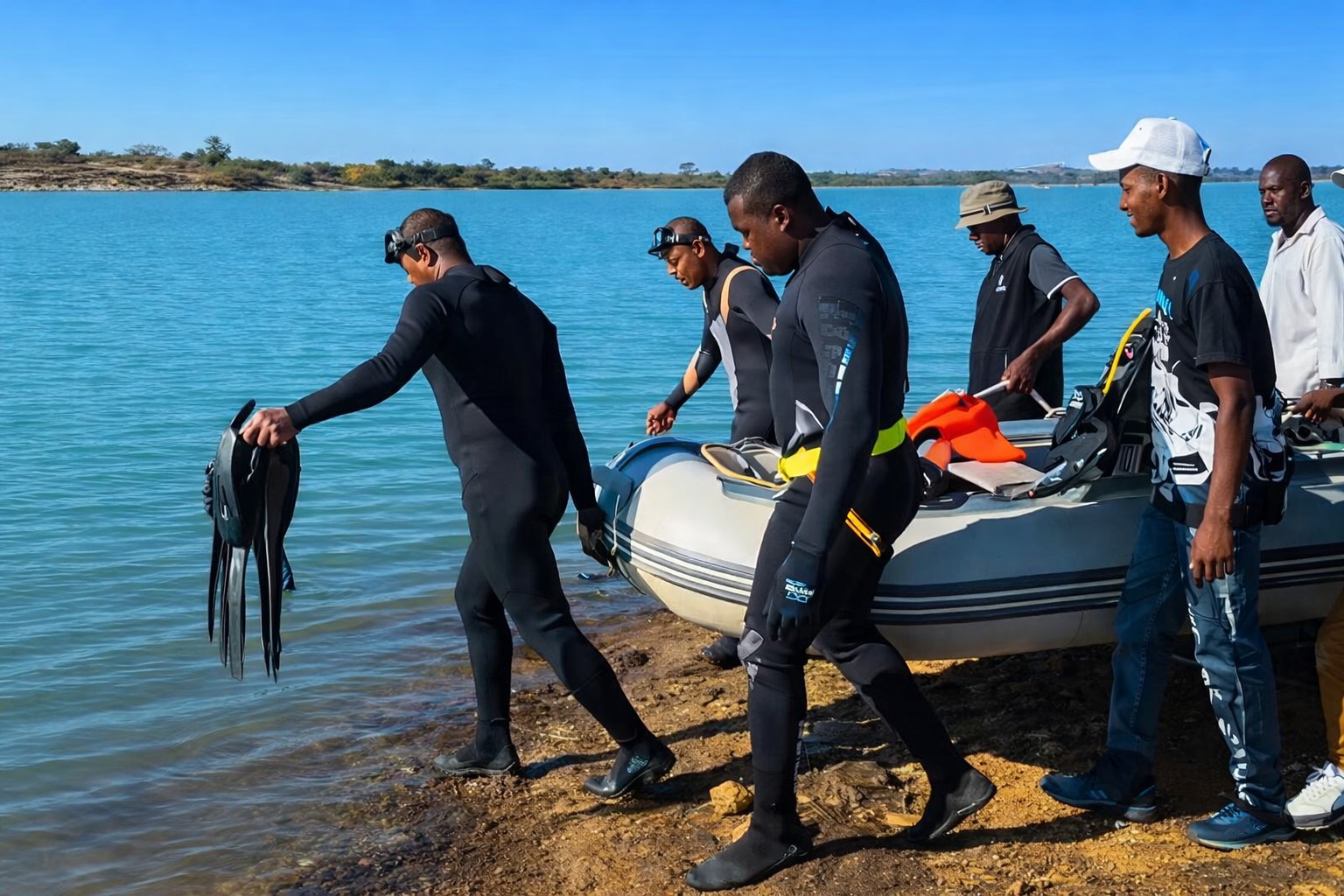
The water of Ruti Dam is a deceptive mirror. By day, it reflects the vast, open skies of the Buhera and Gutu districts, a shimmering expanse that masks the treacherous depths below. But by night, it turns into a cold, dark void — a graveyard for those whose desperation forces them to navigate its currents in the small hours of the morning. Last Saturday, at approximately 2 am, that void claimed four more lives. As the sun rose over the silent ripples, a family was left in a state of suspended agony, waiting for a state apparatus that seemed either unable or unwilling to help.
For six gruelling days, the nation watched a familiar, tragic script unfold. The Police Sub-Aqua Unit, the official guardians of Zimbabwe’s waterways, arrived at the scene. They searched. They dived. They scanned. And yet, they yielded nothing. It was only when a private citizen, Victor Kazembe — a man now known across the country by the cinematic moniker ‘Coach Rambo’—stepped into the fray that the bodies were finally brought home. His success has not only brought closure to a grieving family but has also pulled back the curtain on a national crisis: the systemic collapse of our emergency services.
The Ruti Dam incident is a heartbreaking tale of a family trying to cross a dam at 2 am just to catch a bus. The victims were not thrill-seekers or reckless adventurers. They were ordinary Zimbabweans trying to navigate a landscape where basic infrastructure is often a luxury. Modreck Rufu was operating a fibreglass canoe, ferrying his sister, Tecla Rufu, and her two young children, Moreblessing and Peacemaker Zvoushe. Their goal was simple: to reach Ndyarima Business Centre in Buhera to catch a bus to Harare.
The journey ended in disaster when the canoe capsised in the pitch-black water. The first sign of the tragedy came at 4 am, when a local fisherman, Thomas Gojo, discovered the tiny body of four-year-old Moreblessing Zvoushe floating near the shore. While the discovery was a devastating blow, it was only the beginning of a week-long nightmare for the Rufu and Zvoushe families.
“It is difficult to accept the loss of four family members at a go, but that is God’s case, however difficult it may be to accept,” said Prince Chikonzo, the family spokesperson, his voice heavy with the weight of the week’s events. “It cannot be reversed, but the scars are permanent, and may not heal. Death is God’s case, and there is nothing we can do.”
As the official search stalled, the family’s desperation grew. The Police Sub-Aqua Unit from Changadzi, Birchenough, had been on-site since Sunday, but their efforts were described by onlookers as hampered by a lack of advanced equipment and perhaps a lack of the dogged determination required for such hazardous work. By Monday, the search had yielded nothing. By Tuesday, the family had seen enough. They reached out to the one man who has become a symbol of hope in these dark times: Coach Rambo.
Victor Kazembe did not choose the name ‘Coach Rambo,’ but he has certainly earned it. He recently rose to fame for his heroics in Budiriro, Harare, where he retrieved three bodies from a hazardous sewer pit—a task so dangerous that official teams were hesitant to even attempt it. Wading through thick, toxic sludge with only an emergency oxygen tank, Kazembe did what the state could not. His equipment is often better than that of the police, and his willingness to dive into hazardous conditions exceeds that of the official teams.
Why is a private citizen better equipped than the national police force? This is the question that must be asked. Investigative efforts into the state of the Police Sub-Aqua Unit reveal a “conspiracy of neglect.” Funding for these vital units has dwindled over the years, leaving divers with outdated gear, limited fuel for their boats, and a lack of the specialised technology needed to locate bodies in deep, silt-heavy waters like those of Ruti Dam. In many rural communities, the police are seen not as a first line of defence, but as a secondary force that arrives late and leaves empty-handed.
When Coach Rambo arrived at Ruti Dam, the atmosphere changed. There was a renewed sense of purpose. He did not just bring his diving gear; he brought a 16-year career of experience and a personal mandate to provide closure. On Wednesday morning, at around 6 am, he retrieved the body of Tecla Rufu. Not content with just the recovery, he assisted the family in driving the body to the police station to ensure the necessary certifications were handled quickly. Because the body was swollen and could not be taken to a mortuary, she was buried the same day at the family homestead in Rineshanga.
The search continued into Thursday. By the end of the day, the remaining bodies—those of Modreck Rufu and Peacemaker Zvoushe—had been recovered. The grim tally was complete. Four lives lost, four bodies returned.
“We would like to acknowledge the sacrifice made by Coach Rambo, it left us speechless,” Mr Chikonzo stated, reflecting the sentiments of a community that had felt abandoned by the state. “We may not be able to thank and reward him for his heroics. We will leave it to God. If he had not accepted our plea to intervene and assist, these bodies would be still under the water, and maybe would have end up being devoured by aquatic creatures.”
The Ruti Dam tragedy is not an isolated incident. It follows a string of similar failures across the country. Only weeks ago, a drowning at Henry Hallam Dam saw a similar delay in recovery, and the Budiriro sewer incident remains fresh in the public’s mind. In each case, the pattern is the same: a tragedy occurs, the official response is inadequate, and a “hero for hire” or a brave volunteer is required to finish the job.
This reliance on private citizens like Victor Kazembe is a damning indictment of our national services. While Kazembe’s bravery is unquestionable—he was recently rewarded by businessman Wicknell Chivayo with two vehicles and cash for his Budiriro heroics—the fact that he has to exist at all is a sign of a broken system. A nation’s safety should not depend on the charity or the courage of a single individual. It should be guaranteed by the institutions funded by the taxpayers.
The dangers of water bodies like Ruti Dam cannot be overstated. These are not mere ponds; they are gigantic water bodies with complex currents and hidden hazards. Crossing them in a small canoe at 2 am is a risk no one should have to take. Yet, for many in the Buhera and Gutu districts, there are no other options. The lack of bridges, reliable roads, and safe transport means that the shortest path to a bus stop often leads through the water.
As we honour the victims of the Ruti Dam tragedy—Moreblessing, Peacemaker, Tecla, and Modreck — we must also demand better for the living. We must ask why our rural communities are left so vulnerable. Why does it take a celebrity diver to bring closure to a tragedy? Why is the “conspiracy of neglect” allowed to continue?
Victor Kazembe’s latest mission has once again highlighted the gap between the state’s promises and the reality on the ground. He has become a symbol of both hope and a broken system. While the Rufu family can finally begin the long process of grieving, the rest of the nation must grapple with the uncomfortable truth that next time, Coach Rambo might not be there.
The bodies will have their post-mortems waived, as the family does not suspect foul play. They know exactly what killed their loved ones: it was the water, the darkness, and a system that failed to protect them long before they ever stepped into that canoe. This article serves as a record of their loss and a demand for the accountability that is so sorely lacking. We must ensure that the next time a family cries out for help from the depths of a dam, it is the national service that answers the call, not just a man with a nickname and a diving suit.