


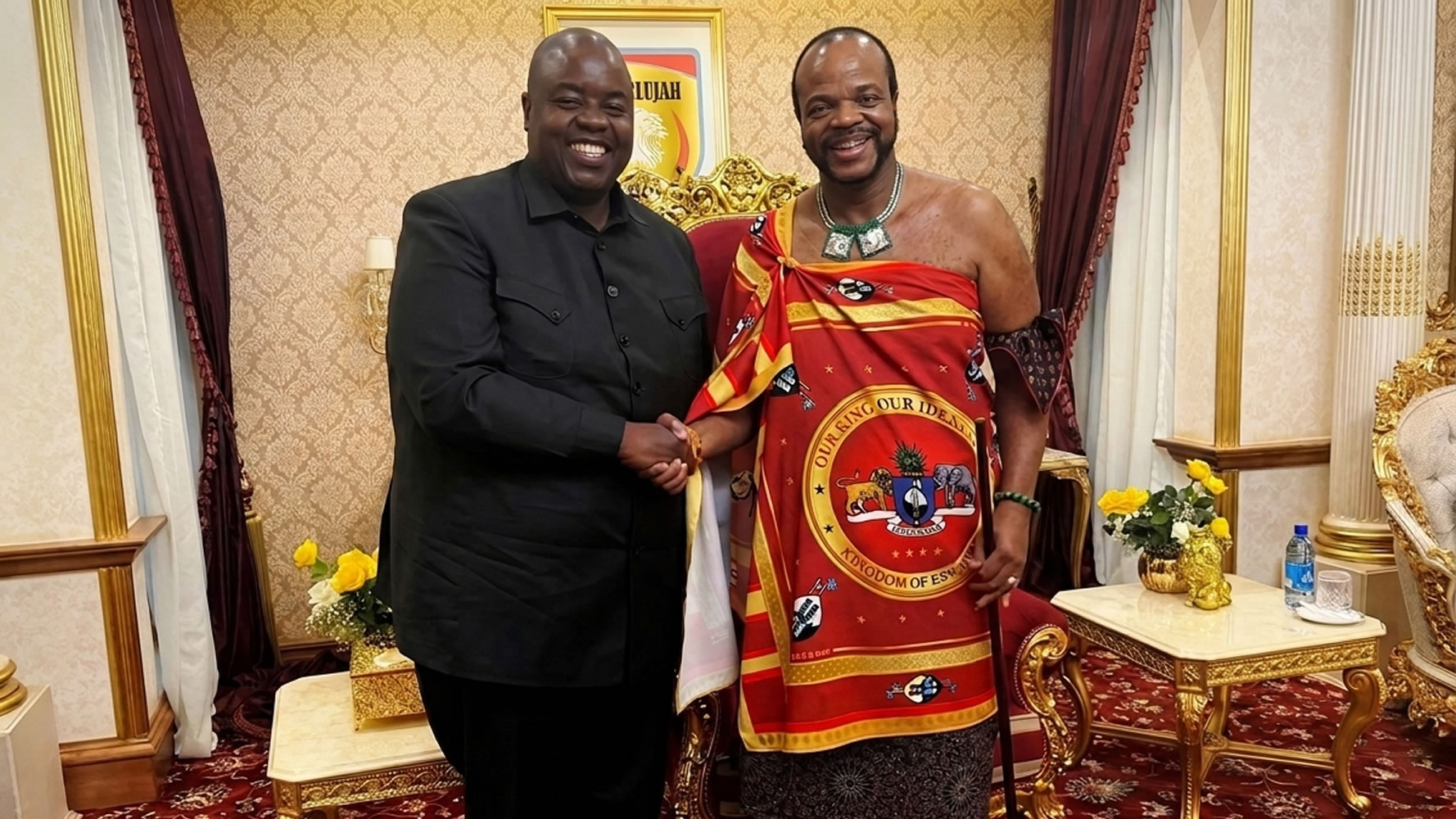
In the gilded halls of the Lozitha Palace, amidst the heavy scent of tradition and the quiet rustle of royal protocol, a scene unfolded that has left regional observers and legal experts questioning the very definition of diplomacy. King Mswati III, the last absolute monarch of Africa, stood beside a man whose reputation precedes him in every corner of Southern Africa: Wicknell Munodaani Chivayo.
The occasion was not merely a courtesy visit. It was a formal bestowing of Eswatini citizenship and, more crucially, the presentation of a diplomatic passport. As the King handed over the document, his words were brief but loaded with significance: “This will take you all over.”
To the casual observer, it might look like a simple reward for a promised R3 billion solar investment. But to those who have followed the “Sir Wicknell” brand through the murky waters of Zimbabwean tenders and international fraud allegations, the Eswatini connection looks less like a business deal and more like the construction of a royal sanctuary.
The R3 Billion Solar Gambit: A Familiar Script?
The official narrative, pushed heavily by Chivayo’s sophisticated public relations machine, is one of industrialisation and energy security. Through his Mauritius-registered holding company, Intratrek Holdings, Chivayo has pledged to build a 300-megawatt solar plant on 120 hectares of land provided by the King.
“The highlight of my courtesy visit was His Majesty’s most humbling instruction to his administration, which bestowed upon me the highest honour of being granted Eswatini citizenship, as the King accepted me as his young, fellow African son,” Chivayo wrote on his social media, framing the event as a paternal embrace. He added that the diplomatic passport was “meant to facilitate ease of travel and business activity in Eswatini and across the continent in connection with infrastructure development pursuits.”
However, history suggests that for Chivayo, a “pledge” and a “power plant” are often two very different things. In 2015, his company Intratrek Zimbabwe was awarded a contract to build a 100-megawatt solar plant in Gwanda, Zimbabwe. The deal was valued at over US$170 million. The Zimbabwe Power Company (ZPC) paid out an advance of US$5 million for “pre-commencement works.”
A decade later, the Gwanda site remains a field of shrubs and unfulfilled promises. Not a single solar panel has been installed, despite the millions of dollars that were paid to his company. While Chivayo was eventually acquitted of fraud charges in 2024 — a victory many attribute to his close ties with Powerful Zimbabwean politicians — the ghost of Gwanda haunts his new Eswatini venture. Is there even a single solar panel being built in Eswatini, or is this R3 billion project merely a sophisticated vehicle for moving capital across borders?
The “Gold-for-Protection” Agreement
In most cases, a diplomatic passport is not just about “ease of travel”; but a “get out of jail free” card in the world of international finance and shadow trade.
A diplomatic passport allows the holder to bypass standard airport security and, crucially, protects their luggage from being searched. In a region where gold smuggling has become a primary method of bypassing international sanctions and laundering wealth, such a document is worth more than its weight in the precious metal.
The timing is telling. Only a week before Chivayo received his documents, another controversial figure, Zimbabwean Prophet Uebert Angel, was also spotted at the Lozitha Palace receiving diplomatic cover, according to Swaziland News. Angel was a central figure in Al Jazeera’s “Gold Mafia” investigation, where he was caught on camera offering to use his diplomatic status to launder over US$1 billion in cash.
Following the Gold Mafia expose, the British Parliament issued the following statement: “We are aware of an Al Jazeera documentary investigating cases of alleged smuggling and fraud involving Uebert Angel, a dual British-Zimbabwean national and Presidential Envoy and Ambassador At Large for the country of Zimbabwe to Europe and the Americas. Whilst Mr Angel holds a diplomatic passport he is not diplomatically accredited to the UK – countries are free to determine for themselves who they grant these passports to, but the passport itself does not confer any diplomatic status on the holder.”
The Royal Sanctuary: A Haven from Sanctions
As international pressure mounts on the Zimbabwean elite and the “Gold Mafia” networks, Eswatini is increasingly being viewed as a “Royal Sanctuary.” For men like Chivayo, who have built their fortunes on government tenders and political proximity, the threat of international sanctions is a constant shadow.
By securing Eswatini citizenship and a diplomatic passport, Chivayo is effectively insulating himself from the reach of Western financial investigators. Eswatini, under King Mswati’s absolute rule, offers a level of sovereign protection that few other countries can match. It is a place where the law is the King’s word, and the King’s friends are untouchable.
Mlungisi Makhanya, the President of the People’s United Democratic Movement (PUDEMO), described the move in scathing terms: “What the King did is treason, the King auctioned the Sovereignty and the autonomy of the Swazi Nation in giving these two individuals… international passports which remain out of reach for many Swazis. Not everyone is granted a diplomatic passport because a diplomatic passport simply implies, that issuing State is taking full and absolute responsibility for the conduct of the holder.”
Makhanya’s point is critical. A diplomatic passport is supposed to be reserved for those representing the state on official business. “Simple put, a Minister in South Africa who is travelling to Swaziland for leisure and non-official travels, is not expected to use a diplomatic passport but the normal passport. When a person uses a diplomatic passport, it implies that he is undertaking an official State responsibility,” he added. By giving Chivayo this status, King Mswati is essentially declaring that Chivayo’s private business is now the business of the Eswatini state.
The Mnangagwa Connection
The bridge between Harare and Mbabane is built on more than just gold. It is built on a long-standing personal relationship between King Mswati III and President Emmerson Mnangagwa. The two leaders have frequently visited each other, often bypassing the traditional diplomatic channels of the SADC region.
Chivayo, who is known to be a “close ally” of the Zimbabwean President, acts as the functional bridge between these two regimes. His role is to facilitate the “business” that neither leader wants on the official books. Whether it is the supply of election materials through opaque US$100 million contracts or the expansion of regional influence, Chivayo is the businessman who makes it happen.
The granting of Eswatini citizenship to Chivayo follows a similar pattern in Kenya, where he reportedly received a passport in early 2026. Reports indicate that his company, IMC Construction Kenya, has even secured a stake in a massive US$2.9 billion contract to expand Nairobi’s Jomo Kenyatta International Airport. It appears the “Sir Wicknell” brand is being exported across the continent, creating a network of “diplomatic” businessmen who operate above the law of any single nation.