


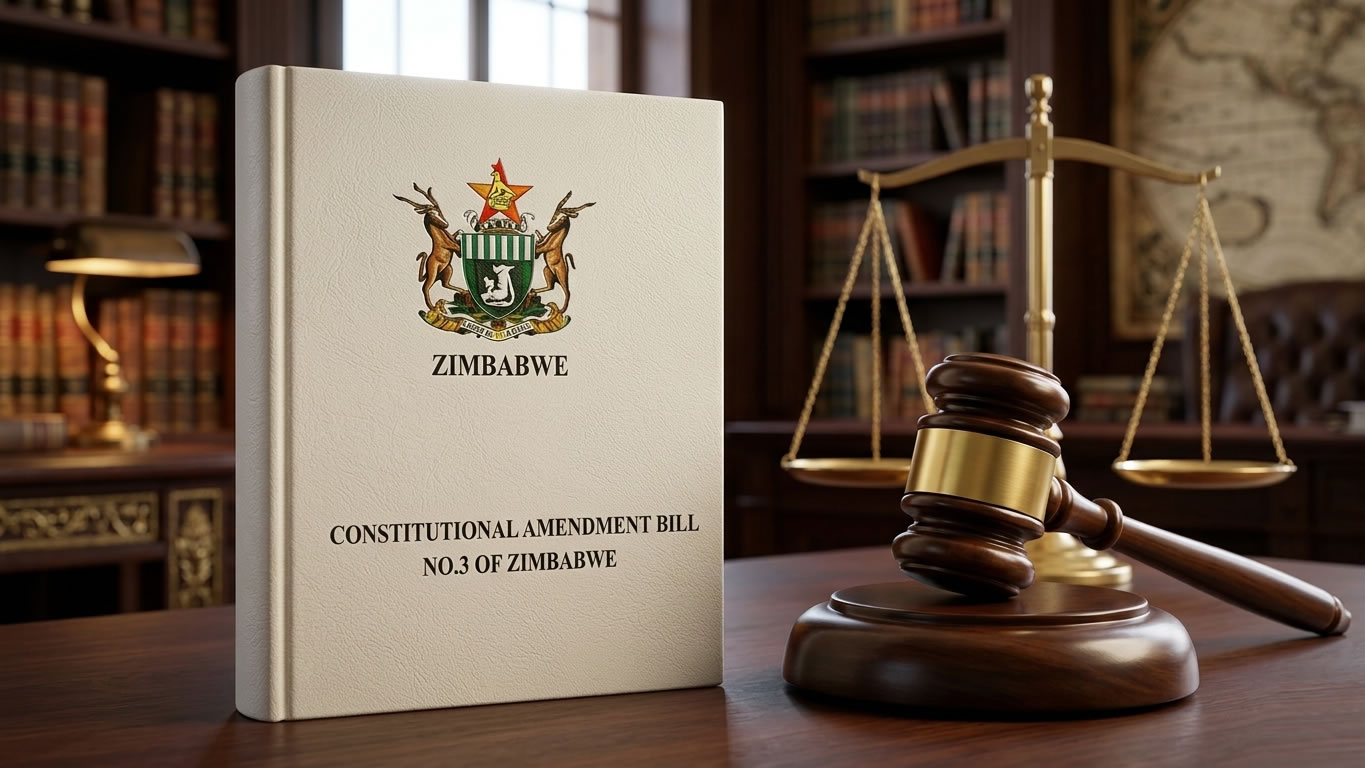
Inside the Legal Labyrinth of Zimbabwe’s Constitutional Amendment Bill No. 3
HARARE — In the dimly lit corridors of Zimbabwe’s Parliament, a legislative storm has reached its zenith, leaving the nation’s democratic foundations trembling. On a Tuesday (30 June 2026) that many legal experts are already calling a “dark day for constitutionalism,” the National Assembly overwhelmingly adopted Senate amendments to Constitutional Amendment Bill No. 3 (CAB3). With a decisive vote of 226 to 41, the ruling Zanu PF party has effectively paved the way for President Emmerson Mnangagwa to remain in power until 2030, fundamentally altering the country’s political landscape.
Yet, as the Bill moves to the President’s desk for assent, a chorus of legal giants and human rights activists is shouting from the rooftops. At the heart of this resistance is Professor Lovemore Madhuku, a veteran constitutional lawyer and leader of the National Constitutional Assembly (NCA). In an exclusive dialogue following the vote, Madhuku did not mince his words, describing the entire parliamentary process as “heavily flawed” and a “nullity.”
The “Nullity” and the Clerk’s New Power
Professor Madhuku’s criticism is not merely political; it is deeply technical. He argues that the Senate introduced amendments that were never put to the people during the mandatory public consultation phase. “They were delaying us from our own processes to challenge them,” Madhuku told reporters. “They were failing to constitutionally follow their own parliamentary processes. The amendments by the Senate were not competent. They approved a nullity in the National Assembly today.”
One of the most contentious changes involves the role of the Clerk of Parliament. Under the new amendments, the Clerk—a non-elected official—now holds the power to determine the date of the first sitting of Parliament after a general election. Madhuku finds this transition of power absurd. “The Clerk of Parliament does not have a recognisable deputy. What if he is intimidated or he runs away?” he questioned. “It is different from the office of the Chief Justice because that office is constitutionally entrenched… But the Clerk of Parliament is simply an official whose office has no constitutional independence. It does not represent any institution. Imagine the stupidity of not realising that the outgoing Speaker would still be there. What if the Clerk is manipulated? No country is run in such a way.”
According to Madhuku, these changes introduce an entirely new constitutional arrangement that could not lawfully originate as Senate amendments. “They are saying they are amendments, but it seems the Senate had its own Bill, which was not put to the people,” he noted. “It required much more intellect than they used in the hurried process.”
The Infinite Loop: A Constitutional Trapdoor
While Madhuku focuses on the procedural “nullity,” another legal mind, Doug Coltart, has identified what he calls an “extremely dangerous loophole.” In a detailed legal opinion shared with members of the National Assembly, Coltart warned that the Bill, as currently drafted, could allow the ruling party to avoid general elections indefinitely.
The loophole lies in how a replacement President is elected if a vacancy occurs due to death, resignation, or removal. Under CAB3, Parliament—not the people—elects the successor. Coltart argues that this successor could then claim a fresh seven-year term, which in turn triggers a fresh seven-year parliamentary cycle.
“As presently drafted, there is a credible legal argument that a President elected by Parliament to fill a vacancy… would begin a fresh seven-year presidential term, and that this could in turn trigger a fresh seven-year parliamentary term, thereby postponing the next general election,” Coltart explained. “This constitutional loophole could be repeatedly exploited indefinitely with the result that Zimbabwe may never have a general election ever again.”
Coltart’s fear is that a President could resign shortly before their term ends, allowing Parliament to elect a successor and “restart the constitutional cycle.” He urged legislators to close this “unintended” gap, but his warnings were largely ignored by the Zanu PF majority. “Whether or not such an argument would ultimately succeed before the courts is beside the point,” Coltart warned. “The Constitution should not admit an interpretation capable of permitting Parliament’s democratic mandate to be extended indefinitely without returning to the electorate.”
A Trail of Blood and Broken Windows
The legislative victory for Zanu PF was not won in a vacuum. It was preceded by months of reported violence, intimidation, and what many describe as “sham” public hearings. In March 2026, as the nation attempted to debate the Bill, the process was marred by chaos.
Professor Madhuku himself became a victim of the very system he seeks to correct. On March 1, 2026, Madhuku and several activists were gathered for a meeting when they were reportedly set upon by individuals who beat them with whips. Images of the Professor with “whip-like injuries across his back, shoulders, torso and lower back” circulated widely, serving as a grim reminder of the stakes involved.
“Professor Lovemore Madhuku, Effort Manono, and other activists from his party had gathered for a meeting when they were violently beaten,” Amnesty International reported, calling for an immediate investigation. Despite the brutality, the police presence at these incidents was often described as passive, with some witnesses claiming officers watched as the assaults took place.
The violence led to a widespread boycott of the public hearings by opposition leaders. “Opposition leaders announced they were boycotting ongoing public hearings… citing violence and intimidation,” one report noted. In Harare, hearings were described as “marred by intimidation and exclusion” by the Zimbabwean Human Rights Commission (ZHRC). There were even reports of arson and abductions targeting those who spoke out against the term extensions.
Dismantling the Guardrails
To some, CAB3 is not just about extending terms; it is about centralising power. The Bill strips the Zimbabwe Electoral Commission (ZEC) of its voter registration duties, transferring them back to the Registrar-General. Critics see this as a massive regression. The independence of the ZEC, though often questioned, was a hard-won constitutional protection in the 2013 Constitution. Moving registration back to a government department is seen by many as a way for the ruling party to tighten its grip on the voters’ roll.
Furthermore, the Bill shifts the election of the President from a direct public vote to a parliamentary model. Supporters of the Bill, largely from Zanu PF, argue this will “reduce political polarisation” and “eliminate the toxicity of constant election cycles.” They claim it provides the “policy continuity necessary for long-term national development goals.”
However, opposition figures like those in the Citizens Coalition for Change (CCC) view it as a “constitutional coup.” By adopting a parliamentary model, the direct mandate of the voters—the “one man, one vote” concept—is diluted. Power is instead concentrated within the ruling legislative majority, allowing the party to choose the leader without the “inconvenience” of a national campaign.
The Ghost of 1987
To understand the gravity of CAB3, one must look back at Zimbabwe’s history. In 1987, the late Robert Mugabe introduced the “imperial presidency” in the aftermath of the Gukurahundi massacres. That amendment moved the country away from a parliamentary system toward an executive presidency with sweeping powers, a move closely associated with authoritarian regimes.
Ironically, while CAB3 claims to dismantle the “imperial presidency” by returning to a parliamentary election for the leader, it simultaneously extends the tenure of the incumbent and lengthens future terms to seven years. Critics argue that instead of decentralising power, it is simply “institutionalising structural centralisation.”
Justice Minister Ziyambi Ziyambi, a staunch defender of the Bill, remains unmoved by the outcry. “The House is now free of the Bill,” he said after the vote. “What the House has done is its constitutional duty. It has made law… The law it has made will enable the progressive building and development of this country.” When asked about the President’s assent, Ziyambi was confident: “Normally when he gets bills he assents to them as and when he gets them.”
The Road to the Courts
The battle is far from over. Professor Madhuku has already signalled that a third court challenge is imminent. “This is another third case that we are going to lodge,” he promised. Many constitutional lawyers argue that because the Bill touches on protected provisions—specifically Section 328(7)—it cannot become law through presidential signature alone. They maintain that such fundamental changes must be put to a national referendum.
“The fight against the controversial Constitution of Zimbabwe Amendment (No. 3) Bill is far from over,” Madhuku stated emphatically. He believes the contradictions created by the hurried process will be its undoing in court. “They made a bigger mistake trying to correct the error they made. Senate had no authority to make amendments of that nature.”
As Zimbabwe stands on the precipice of this new constitutional era, the question remains: will the courts intervene to protect the 2013 Constitution, or will the “legislative mechanism” of the ruling party succeed in cementing its power for the next decade? For now, the people of Zimbabwe watch as their direct vote is traded for parliamentary appointments, and their five-year cycles are stretched into seven, all while the shadows of the 1980s loom larger than ever.
The “way forward,” as Professor Madhuku suggests, is no longer in the hands of the parliamentarians who cheered the Bill’s passage. It is in the hands of the judges, and perhaps, eventually, the people themselves in a referendum that the government is desperate to avoid.