


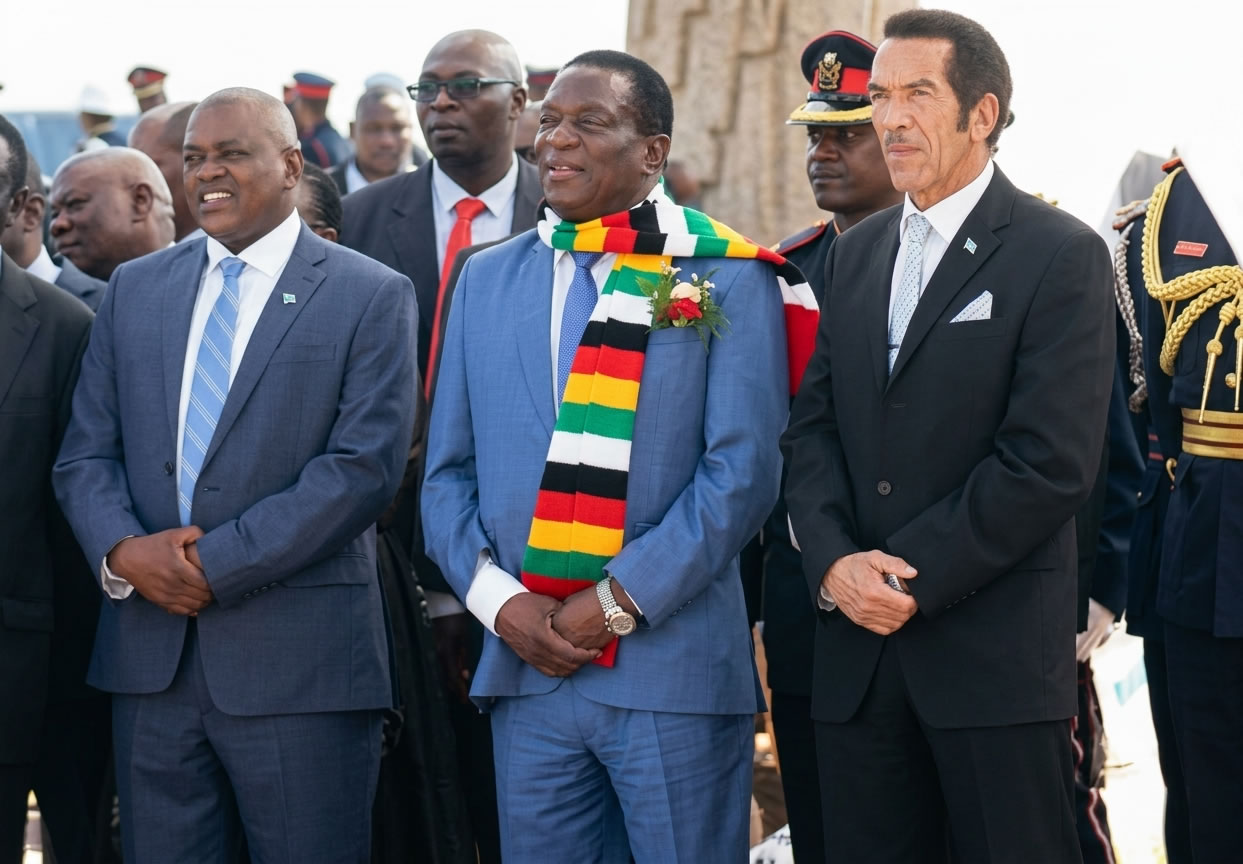
GABORONE – Former Botswana President Seretse Ian Khama has made explosive claims, alleging that the government of Zimbabwe, under President Emmerson Mnangagwa, is actively plotting his assassination. These grave accusations, which have been vehemently denied by Harare, have cast a shadow over regional diplomatic relations and highlighted the deep-seated political tensions in Southern Africa.
Khama, a vocal critic of what he describes as authoritarian tendencies in the region, revealed his fears in an interview with the Masvingo Mirror. He stated that he had received warnings from two independent sources about a sinister plot against his life. These warnings, he claims, were further corroborated by intelligence suggesting a secret visit to Botswana by a high-ranking Zimbabwean Central Intelligence Organisation (CIO) official. This official, whose name was supplied by Khama but not publicly disclosed, allegedly held meetings with counterparts in Botswana, which Khama believes were to orchestrate his demise.
“I was contacted by two sources with information that there is a plot by the Government of Mnangagwa to kill me,” Khama was quoted as saying. “These sources have been trying to get in touch with me for some time and it is not by coincidence that a top CIO was in Botswana this week where he met his counterparts.” The former President emphasised the seriousness of his allegations, adding, “I am making this information public so that people know where to look if anything happens to me.”
Khama attributes the alleged plot to his outspoken criticism of President Mnangagwa’s administration, particularly regarding the controversial Constitutional Amendment Number 3. He views this amendment as a self-serving manoeuvre designed to entrench Mnangagwa’s grip on power, rather than serving the interests of the Zimbabwean populace. “Mnangagwa must be warned that he is not a young man, he is over 84 years. Constitutional Amendment Number 3 is self-seeking. That Constitution was amended for one man. It is not in the interest of the people of Zimbabwe,” Khama asserted, drawing parallels with other African leaders who manipulate electoral systems to prolong their tenure.
Harare’s Vehement Denial
In a swift and categorical response, Zimbabwe’s Information Secretary, Nick Mangwana, dismissed Khama’s allegations as “entirely false, baseless and unsupported by any credible evidence.” Speaking on behalf of the Zimbabwean government, Mangwana stated that Harare had no interest in targeting the former Botswana leader and rejected any suggestion of covert operations within Botswana’s borders. “The Government of Zimbabwe categorically rejects these allegations. They are entirely false, baseless and unsupported by any credible evidence,” Mangwana affirmed.
Mangwana criticised Khama for relying on unnamed sources and speculation, urging him to present any credible evidence to the relevant law enforcement and security authorities instead of airing such serious claims through the media. “Serious allegations of this nature cannot become fact simply because they are repeated publicly. If Mr Khama possesses credible evidence, the appropriate course is to submit it to the relevant law enforcement and security authorities rather than litigating the matter through the media,” he explained.
He further stressed that Zimbabwe’s constitutional and political processes are internal matters, and Khama’s opinions, whether favourable or otherwise, are of no consequence to the Zimbabwean government. “Zimbabwe is a sovereign state with constitutional institutions that do not require responding to political commentary by a retired foreign leader. His opinions on Zimbabwe’s internal affairs, whether favourable or otherwise, are of no consequence to the Government of Zimbabwe,” Mangwana concluded, stating that the government considered the matter closed and would remain focused on governance, economic development, and regional cooperation.
The Controversial Constitutional Amendment No. 3
At the heart of Khama’s criticism lies Zimbabwe’s Constitutional Amendment No. 3, which was signed into law by President Mnangagwa around 7th July 2026. This amendment significantly alters the country’s political landscape by extending the terms of office for the President, Parliament, and local authorities from five to seven years. Critics, including Khama, argue that this change is a blatant attempt by Mnangagwa to prolong his rule, potentially until 2030 or beyond, thereby undermining democratic principles and the will of the people. The amendment process itself has been contentious, with accusations that it makes it impossible for citizens to freely choose their president, as the Members of Parliament who will elect him are expected to come through a rigged process.
A History of Friction and Political Asylum
Ian Khama’s current allegations are not an isolated incident but rather a continuation of his long-standing and often confrontational stance against successive Zimbabwean governments. His history as a staunch advocate for democracy in the region dates back to his presidency. A notable instance occurred in 2008 when he provided refuge to the late MDC-T leader Morgan Tsvangirai, who had fled Zimbabwe amid death threats during the highly disputed national elections against then-President Robert Mugabe. This act underscored Khama’s commitment to democratic ideals and his willingness to challenge powerful neighbours.
Khama’s criticisms of Zimbabwean political practices have been consistent, often highlighting concerns about election rigging and the harassment of opposition figures. His recent remarks about Mnangagwa’s “tricks” being copied from other African countries, where leaders pursue power for personal interests, reflect a pattern of concern over democratic backsliding in the continent.
Khama’s Own Political Turmoil
Adding another layer of complexity to these allegations is Khama’s own recent political history. Following his departure from the presidency in Botswana, he became embroiled in a bitter feud with his handpicked successor, President Mokgweetsi Masisi. This fallout stemmed from policy differences and leadership styles, leading to Khama’s self-imposed exile, primarily in South Africa, for three years between 2019 and 2024. During this period, Khama himself claimed to be the target of assassination plots by Botswana’s intelligence services, alleging that a top Botswana intelligence official, who he now claims met with the Zimbabwean spy, had been involved in attempts on his life since 2019. He eventually returned to Botswana in September 2024 to face a raft of charges, including illegal possession of firearms and money laundering. This personal experience with alleged political targeting and intelligence operations may inform his current suspicions regarding Zimbabwe.
Regional Intelligence Dynamics and Unverified Claims
The allegations also bring into focus the often opaque world of regional intelligence operations. There have been reports of frequent visits by Zimbabwean CIO officers to Botswana since late 2023, and conversely, officers from Botswana’s Directorate of Intelligence and Security (DIS) have also been noted to visit Zimbabwe. Botswana’s DIS itself has faced accusations of being used as an instrument of coercion, raising questions about the accountability and oversight of intelligence agencies in the region.
Despite the gravity of Khama’s claims and the Zimbabwean government’s firm denial, it is crucial to note that no independent evidence has been publicly presented to substantiate the alleged assassination plot. Both sides have offered strong statements, but the lack of verifiable proof leaves the matter in a state of diplomatic uncertainty.