


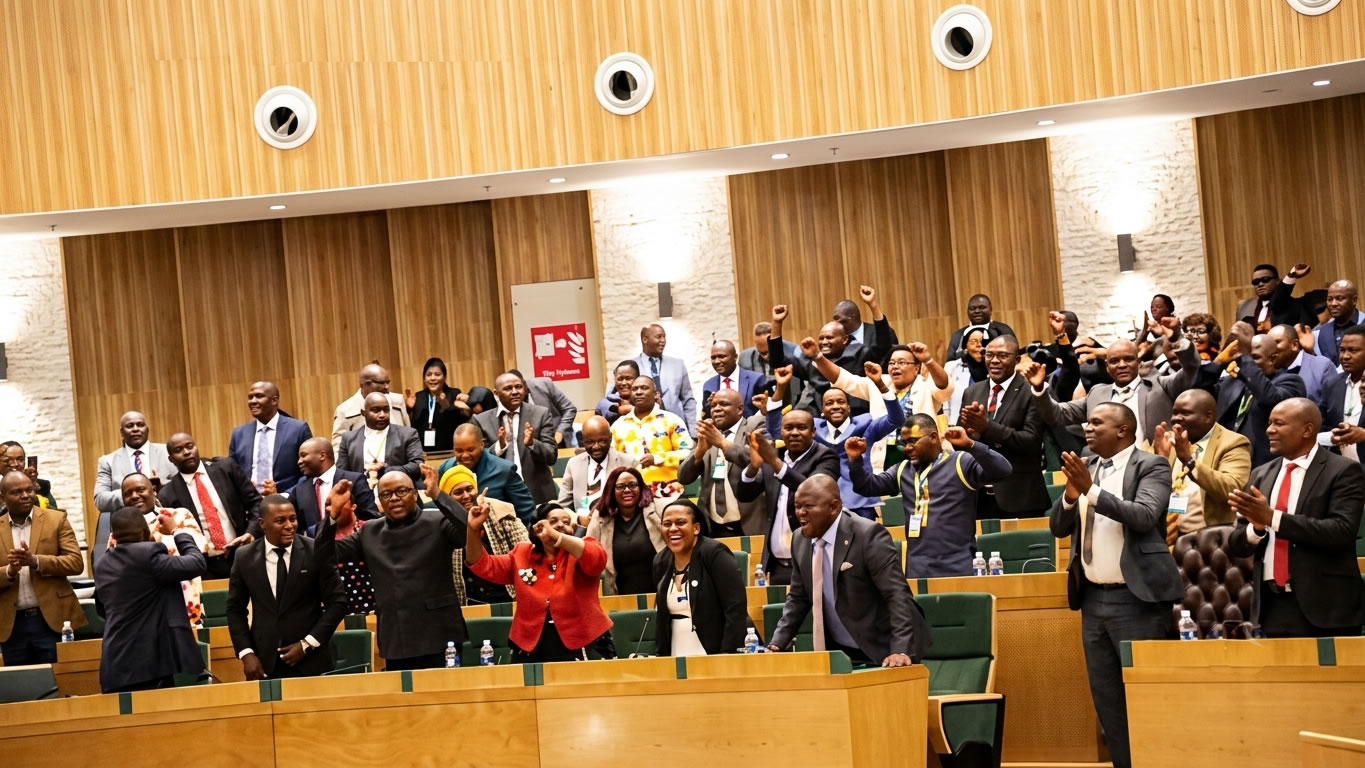
HARARE – The political landscape of Zimbabwe has been irrevocably altered by the recent signing into law of the Constitutional Amendment Bill No. 3 (CAB3) by President Emmerson Mnangagwa. While state-controlled media outlets have lauded this development as a significant “milestone” for governance, an investigative deep dive into the corridors of the Senate reveals a far more troubling narrative. The bill, which significantly expands executive powers and circumvents public referendums for crucial constitutional alterations, passed with an astonishing majority. The most alarming revelation is that several opposition senators, who had previously pledged allegiance to the 2013 Constitution, reportedly cast their votes in favour of the bill behind closed doors.
This legislative manoeuvre has ignited a firestorm of controversy, raising profound questions about the integrity of Zimbabwe’s democratic processes and the commitment of its elected representatives. The passage of CAB3 is not merely a technical adjustment to legal frameworks; it represents a calculated dismantling of the people’s will, orchestrated with the complicity of those entrusted to safeguard it.
The Anatomy of a Constitutional Overhaul
Constitutional Amendment Bill No. 3, now an Act, introduces sweeping changes that fundamentally reshape the balance of power in Zimbabwe. Among its most contentious provisions is the extension of presidential and parliamentary terms from five to seven years. This particular amendment has drawn sharp criticism from legal experts and civil society organisations, who argue that it undermines democratic governance and fosters an environment ripe for complacency and corruption within government. Veritas, a prominent legal think-tank, highlighted that such extended terms are rarely seen globally and are often associated with authoritarian regimes. They further noted that applying this extension to the incumbent President, Emmerson Mnangagwa, directly contravenes section 328(7) of the Constitution, which explicitly prohibits constitutional amendments extending term limits from applying to current office holders without a national referendum.
Beyond term extensions, CAB3 also seeks to centralise power by altering the process of appointing senior judicial officers, giving the President more direct control over these crucial positions. Furthermore, it proposes the creation of the Zimbabwe Electoral Delimitation Commission and shifts critical electoral functions, such as voter registration and the maintenance of the voters’ roll, from the Zimbabwe Electoral Commission (ZEC) to the Registrar-General’s Office. While proponents argue this makes administrative sense, critics fear a return to the pre-2013 era when voter rolls were poorly maintained under the Registrar-General’s purview, potentially compromising the integrity of future elections.
The Senate’s Staggering Affirmation
The passage of CAB3 through the Senate was a moment of profound disappointment for many who had hoped for a robust defence of the Constitution. Despite the opposition Citizens Coalition for Change (CCC) holding 27 seats in the 80-member Upper House, the bill sailed through with 75 votes in favour, only four against, and one senator absent. This overwhelming majority, far exceeding the two-thirds required for constitutional amendments, underscored a disturbing alignment between the ruling Zanu PF and a significant faction within the opposition.
Of the 27 CCC senators, a staggering 23 reportedly voted in favour of the bill’s promulgation. This act of apparent defection has been widely condemned as a betrayal of the electorate who voted these individuals into office on a platform of constitutional defence. The four courageous CCC senators who stood against the tide were Sesel Zvidzai (Midlands), Solani Moyo (Matabeleland South), Meliwe Phthi (Matabeleland South), and Nonhlanhla Mlotshwa (Matabeleland South). Their principled stand, however, was insufficient to halt the legislative juggernaut.
The ‘Carrot and Stick’ Allegations
The sudden shift in allegiance among opposition senators has fuelled widespread speculation and serious allegations of inducement. Reports have surfaced suggesting that a “carrot and stick” approach was employed by the ruling party to secure these crucial votes. Whispers and more overt accusations point to the use of “sitting allowances” and “vehicle schemes” as potential incentives that swayed the hearts and minds of those meant to be the final bulwark against constitutional erosion.
Indeed, some Members of Parliament reportedly received vehicles and cash, including sums of US$10,000 each, in exchange for their support of the Bill. While these allegations remain largely unconfirmed by official sources, they paint a grim picture of political expediency overriding public duty. Such tactics, if proven, represent a profound subversion of democratic principles, transforming legislative processes into transactional exchanges.
The Sting of Betrayal: Advocate Thabani Mpofu’s Anguish
The profound sense of betrayal extends beyond the abstract realm of constitutional principles, touching individuals who have dedicated their lives to upholding justice and democracy. Advocate Thabani Mpofu, a distinguished legal mind in Zimbabwe, has publicly expressed his anguish following the CAB3 vote. His heartbreak stems from the fact that a majority of Citizens Coalition for Change (CCC) Members of Parliament from Bulawayo, whom he had selflessly represented pro bono, voted in favour of the contentious bill.
Advocate Mpofu, alongside Professor Welshman Ncube and a team of dedicated lawyers, had provided crucial legal assistance to these MPs. Their intervention was instrumental in overturning a High Court decision that had disqualified 12 Bulawayo CCC candidates from contesting the 2023 general elections. Without this free legal aid, these individuals would have seen their political aspirations extinguished before they even began.
Mpofu’s commitment to justice is evident in his recounting of the tumultuous period leading up to the 2023 elections. He vividly described how, in 2023, then-opposition leader Nelson Chamisa approached him for urgent legal assistance, explicitly stating the party’s inability to pay for his services. Mpofu, driven by a desire to serve the people of Zimbabwe, accepted the challenge without hesitation.
His initial public duty involved accompanying Chamisa to the High Court to ensure the presidential nomination process was proceeding correctly. However, the real challenge emerged when the Nomination Court sitting at Rotten Row rejected the Proportional Representation CCC parliamentary nominations, creating a chaotic and dangerous situation. Despite not being responsible for the initial error, Mpofu found himself tasked with resolving this critical issue.
Leveraging his intimate knowledge of the Electoral Act, Mpofu swiftly addressed the Harare problem. His presence and oratory skills managed to shift the atmosphere, lifting the spirits of the despondent candidates. Just as he believed his work was done, a call came in: twelve Bulawayo MPs were facing problems with their nomination papers, well after the cut-off time. The prospect of the opposition stronghold of Bulawayo being handed over to Zanu PF was unacceptable to him.
After a flurry of calls, Mpofu managed to grasp the facts of the Bulawayo situation. With no legal team immediately available, he reached out to colleagues. David Coltart, exhausted from his own day, was unable to assist. After some difficulty, he finally connected with Tinashe Runganga, a lawyer from Tanaka Law Chambers. Although Runganga admitted the Electoral Act was not his area of expertise, Mpofu needed his dedication and heart. Mpofu guided Runganga through the legal arguments and strategy over the phone, and Runganga, a clever lawyer, effectively presented the case at the Nomination Court.
Despite initial resistance, Runganga persisted, eventually securing a hearing. He remained at the Nomination Court until 2 AM, successfully resolving the issue for the twelve candidates. Mpofu, awake throughout, described it as cleaning up someone else’s mess and fighting on an uneven field where the lights of justice flickered uncertainly.
Days later, despite the initial relief, twelve applications were filed against the candidates. By then, Mpofu had assembled a formidable legal team of twenty minds. The candidates, remembering Runganga’s efforts, agreed to channel their papers through him. Mpofu, meanwhile, drafted twelve defences overnight, prepared heads of argument, and shared them with his team. His subsequent trip to Bulawayo for the High Court hearing was self-funded, an expense that still leaves him bitter.
To Mpofu’s dismay, the twelve candidates, whose political futures hung in the balance, were not even present at the Bulawayo High Court. He instructed Runganga to convey a stern message: if they were not in attendance, he would not represent them. The indifference and capitulation he encountered in Bulawayo deeply shocked and upset him.
Despite the candidates’ absence, Welshman Ncube and Mpofu argued the matter. Surprisingly, the Zimbabwe Electoral Commission (ZEC) sided with them, fighting in their corner as if their integrity was at stake. However, despite ZEC’s defence, they lost the High Court case.
The news of the loss reached Mpofu while he was in England for a family engagement, disrupting his holiday. Despite his exhaustion and anger, he was determined to reverse the injustice. He immediately began drafting a notice of appeal, understanding the political sensitivities and the need to swiftly neutralise the judgment.
His team, though initially delaying, eventually filed the appeal. Mpofu, consumed by rage and frustration, threatened to dissolve the entire team, acknowledging he might have been unfair in his outburst. The appeal was eventually filed, and he continued to work tirelessly on the application for an urgent hearing and heads of argument, even preparing the Polling Agents Manual during this period.
For the Supreme Court appeal, Mpofu suggested that he and Paida Saurombe represent six candidates, while Welshman Ncube and Runganga represent the other six. He praised Ncube’s heads of argument as a “thing of beauty.” The Supreme Court, accommodating Mpofu’s return to Zimbabwe, scheduled the matter for 2:30 PM, a departure from the usual 9:30 AM.
Once again, Ncube’s brilliance shone through. The appeal was allowed, and the twelve Bulawayo candidates were reinstated to contest the elections. All of them subsequently won their respective seats. It is noteworthy that only about six of the candidates attended the Supreme Court hearing, offering what Mpofu described as “pitiful excuses.”
Mpofu maintains that the MPs owe him nothing, as he was never forced into providing his services. However, his “broken heart and shattered soul” sank when he witnessed some of these very MPs vote in favour of Constitutional Amendment Number 3. He questioned his sacrifices, expressing anger, rage, bitterness, and frustration at what he perceived as an “indecency that even sacrifice cannot cleanse.”
Public Outcry and Silenced Voices
The passage of CAB3 was not without significant public resistance. Throughout the country, public hearings were convened to gather citizens’ input on the proposed amendments. However, these forums were often marred by controversy, with reports of state-sponsored “mobs” being deployed to silence dissenting voices and disrupt proceedings. Citizens who attempted to articulate their concerns were frequently intimidated, harassed, and even subjected to violence, effectively stifling genuine public participation.
This stark contrast between the rowdy public hearings, where citizens were denied their right to free expression, and the quiet betrayal within the Senate, paints a disturbing picture of a government determined to push through its agenda regardless of public sentiment. The silencing of public discourse, coupled with the alleged inducements offered to opposition legislators, suggests a calculated strategy to bypass democratic accountability.
The Shadow of Sengezo Tshabangu and Internal Strife
The political landscape within the CCC has been further complicated by the actions of Sengezo Tshabangu, who emerged as the interim Secretary-General of the party. Tshabangu initiated a series of recalls of elected CCC MPs and councillors, leading to numerous by-elections across the country. These recalls have significantly weakened the opposition, with critics suggesting that Tshabangu’s actions have inadvertently benefited the ruling Zanu PF party. Some of the MPs who voted for CAB3 are believed to be aligned with Tshabangu, further fuelling the narrative of internal strife and betrayal within the opposition ranks.
A Constitutional Monarchy in the Making?
Critics argue that CAB3, under the guise of technical expertise, effectively paves the way for a “constitutional monarchy” in Zimbabwe. By concentrating more power in the executive and weakening checks and balances, the amendment risks eroding the democratic foundations of the nation. The ability to bypass public referendums for significant constitutional changes, coupled with extended presidential terms, raises serious concerns about the long-term implications for governance and human rights.
The Zimbabwe Human Rights Commission (ZHRC) has undertaken a legal analysis of CAB3, examining its provisions against established human rights principles and standards, both domestic and international. Their role includes providing authoritative opinions, recommendations, and reports to the Government, Parliament, and other relevant institutions. The ZHRC’s assessment will be crucial in determining whether the proposed amendments align with Zimbabwe’s obligations to uphold democratic governance, safeguard civil and political rights, and ensure the continued protection of fundamental freedoms.
Conclusion
The passage of CAB3 marks a dark chapter in Zimbabwe’s constitutional history. The alleged betrayal by opposition senators, coupled with the silencing of public dissent and the centralisation of executive power, raises serious questions about the future of democracy in the country. As the nation grapples with the implications of these far-reaching changes, the call for accountability and the unwavering defence of constitutionalism become more urgent than ever.