


Air Zimbabwe’s ‘London’ Flights: Spanish Charter Deception – Who’s Profiting from the Illusion?
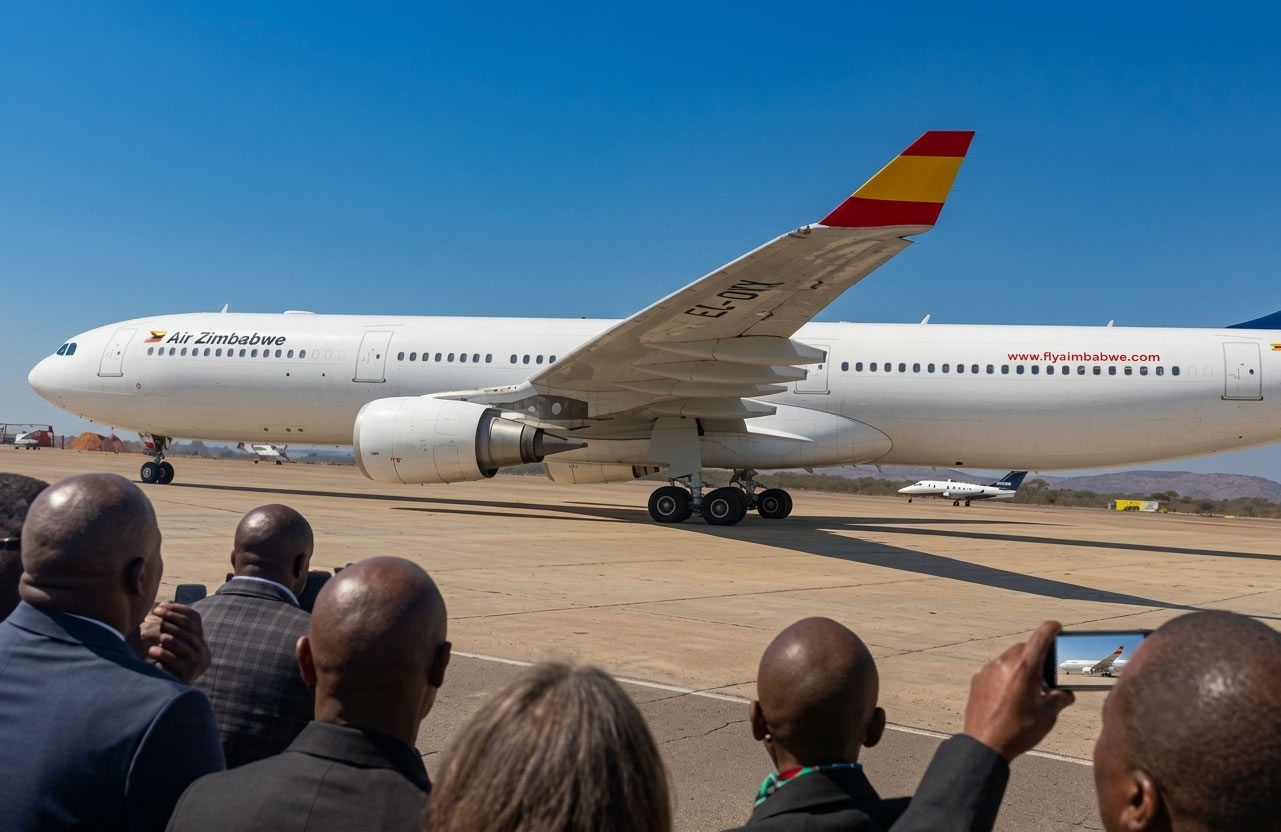
The spectacle at Robert Gabriel Mugabe International Airport last Monday was carefully choreographed to evoke a sense of national rebirth. As a 20-year-old Airbus A330 touched down on the Harare tarmac, it was greeted by the theatrical arch of a water salute and the rhythmic stomp of traditional dancers. Dignitaries, led by Transport Minister Felix Mhona, beamed for the cameras, hailing the return of direct flights to London after a 14-year hiatus as a “milestone” and a “triumph” for the national carrier.
“We are so excited as a ministry, but above all as a nation, that after 14 years without direct flights to London, we are now reconnecting with one of our key international destinations,” Mhona declared to the assembled press. “We have not had direct connectivity with Europe. This service changes that.”
However, beneath the fresh coat of paint and the celebratory rhetoric lies a complex web of commercial sleight of hand. While the aircraft bears the Air Zimbabwe livery, the reality is far from a domestic resurrection. This is not the return of the “Great Spirit of Africa” taking to the skies on its own wings. Instead, it is a meticulously constructed illusion — a Spanish-operated charter service masquerading as a national triumph.
The arrangement, an Aircraft, Crew, Maintenance, and Insurance (ACMI) contract — commonly known as a “wet lease” — is with Plus Ultra Líneas Aéreas, a Madrid-based carrier with a history as turbulent as the skies it navigates. For the next 13 months, every aspect of the flight operation is outsourced. The pilots are Spanish, the cabin crew are Spanish, the engineers are Spanish, and the insurance is held in Europe. Air Zimbabwe’s role has been reduced to that of a glorified travel agency: selling tickets, managing check-in desks, and lending its flight code to a service it neither owns nor operates.
The deception begins with the branding. To the casual observer, the arrival of an Airbus A330 in Air Zimbabwe colours suggests an expansion of the airline’s fleet and a restoration of its technical capacity. Yet, a closer look at the wingtips reveals the red and yellow of the Spanish flag — a silent admission of the aircraft’s true origins. This is a “turnkey” solution where the national carrier has simply hired a foreign entity to do the heavy lifting, bypassing the inconvenient reality that its own long-haul fleet remains grounded and its operational standards fail to meet international benchmarks.
Industry experts warn that this arrangement, while providing a temporary convenience for travellers, does nothing to build long-term institutional capacity. “Renting a turnkey service from a third party does not make you a transport magnate,” noted one aviation analyst. “It simply makes you a ticket broker using someone else’s equipment and manpower. When the lease expires, the aircraft returns to its owner, leaving the broker with no fleet, no trained pilots, and no permanent infrastructure.”
The financial implications of this deal are equally opaque. While the government celebrates the “reconnection,” the cost of such wet leases is notoriously high. Under an ACMI contract, the lion’s share of ticket revenue leaves Zimbabwe to cover foreign salaries, foreign maintenance, and foreign lease payments. In an economy struggling with foreign currency shortages, the logic of funnelling millions of dollars to a Spanish carrier to maintain a “semblance of international presence” is being called into question.
Who truly profits from this illusion? The question becomes more pointed when examining the partner in this deal. Plus Ultra Líneas Aéreas is no stranger to controversy. In Spain, the airline has faced intense scrutiny and criminal investigations over a €53 million state bailout granted in 2021. Allegations have surfaced involving “inadequate use” of public funds and potential links to money-laundering networks. Spanish prosecutors have probed evidence suggesting the bailout may have been politically influenced, with some reports even linking the airline’s interests to Venezuelan political figures.
For Air Zimbabwe to pin its hopes of a revival on such a partner raises serious ethical and reputational concerns. Is this a calculated strategy to circumvent the European Union Aviation Safety Agency (EASA) ban that has barred Air Zimbabwe’s own aircraft from European skies since 2017? By using a Spanish-registered aircraft and crew, the airline effectively “flags out” its operations, sidestepping the safety and regulatory hurdles that have plagued it for years.
The airline’s history is a litany of debt and mismanagement. With a reported debt of over US$380 million, Air Zimbabwe has spent much of the last decade in a state of semi-permanent crisis. Its previous attempt to fly to London ended ignominiously in December 2011, when it abandoned the route after creditors threatened to seise its aircraft. The subsequent years saw the emergence of “Zimbabwe Airways,” a shadowy project involving the purchase of second-hand Boeing 777s that ultimately failed to launch, leaving the taxpayer with a massive bill and a collection of grounded jets.
The current “London” service, operating from London Gatwick, is already drawing mixed reviews from the travelling public. While many welcome the end of grueling layovers in regional hubs, the “new” service offers a stark reminder of the airline’s limitations. Passengers who toured the 20-year-old Airbus A330 quickly noted the absence of modern amenities. The economy class, which will carry the bulk of the passengers on the 10-hour flight, lacks in-flight entertainment screens.
“They ought to do something—can’t sit for 10 hours with no entertainment like I am flying a 2-hour flight with a budget airline,” wrote one observer on social media. Others were more pragmatic, prioritising the convenience of a direct flight over the lack of frills. “My main motivation is once I’m searched and remove my shoes in Harare, that’s it until Gatwick in 10 hours,” remarked another traveller.
But the lack of television screens is the least of the airline’s worries. Deeper systemic issues continue to surface. In May 2026, reports emerged that Air Zimbabwe was in the “hot seat” over missing aircraft records, with auditors discovering that the airline had been operating aircraft not reflected in its financial statements. This lack of transparency regarding asset control and ownership is a recurring theme in the airline’s history, casting doubt on the government’s claims of a successful “turnaround strategy.”
Furthermore, the airline continues to be dogged by legal troubles. In late 2025, it was sued for US$210,000 over grounding costs in the Democratic Republic of Congo (DRC), after one of its Boeing 767s and 14 crew members were stranded in Goma during an outbreak of fighting. These incidents underscore the precarious nature of Air Zimbabwe’s operations and the constant firefighting required to keep its remaining services aloft.
The 13-month contract with Plus Ultra is a stopgap, a temporary mask for a deeper malaise. It allows the government to claim a victory in the international arena while avoiding the difficult work of structural reform. It does not train Zimbabwean pilots to fly modern wide-body jets, nor does it upskill local engineers or increase the airline’s tangible assets. It is a commercial arrangement that prioritises optics over substance.
Transparency remains the most significant casualty in this arrangement. The public, who are being asked to pay promotional fares starting from £490 for a one-way ticket, deserve to know the true nature of the service they are funding. They deserve to know the hidden clauses in the charter agreement and the true cost of maintaining this “Spanish illusion.”
As the Airbus A330 takes off for its first scheduled flight to Gatwick, it carries more than just passengers; it carries the weight of a national airline’s tarnished reputation and the hopes of a government desperate for a success story. But until Air Zimbabwe can clear its regulatory hurdles, settle its staggering debts, and fly its own airworthy fleet with local personnel, the “resumption” of London flights remains a deceptive manoeuvre.
The “Great Spirit of Africa” is currently being channelled through a Spanish medium, and while the convenience of direct travel is undeniable, the true beneficiaries of this arrangement are likely found in the boardrooms of Madrid rather than the streets of Harare. The public deserves a national airline that is more than just a brand name on a rented jet; they deserve a carrier that is transparent, ethical, and truly Zimbabwean.