


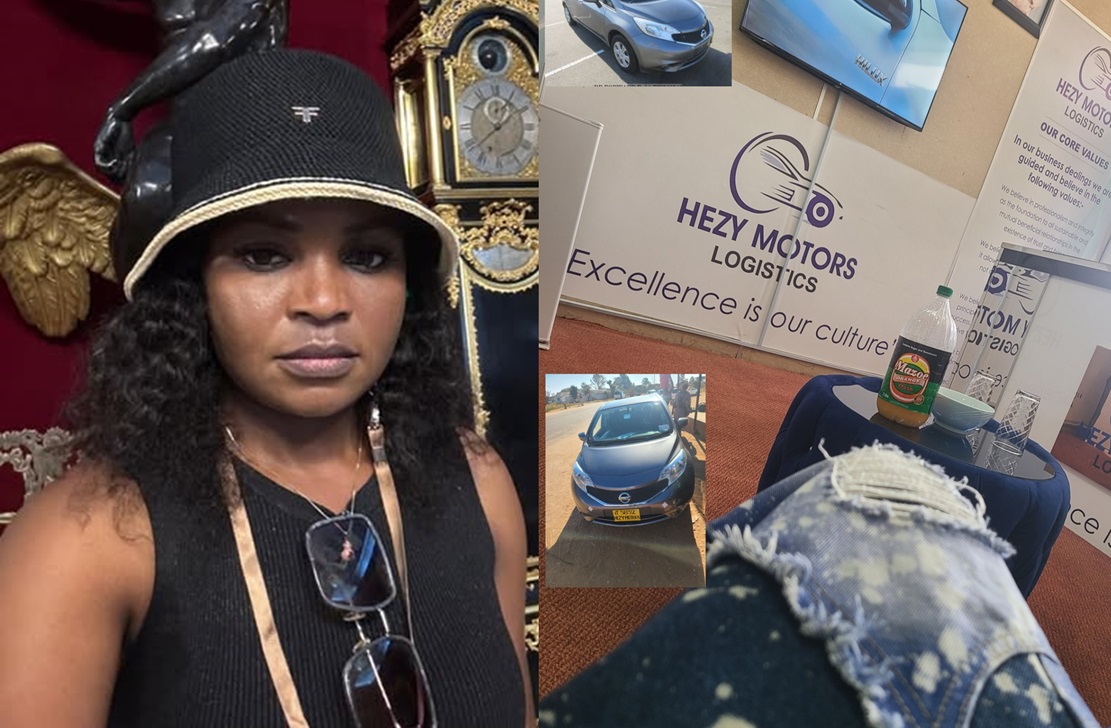
The High Price of Cinematic Success: Inside the US$600,000 ‘Mbinga’ Car Import Scandal
HARARE – The steps of the Harare Magistrates’ Court are a world away from the manicured gardens of the Royal Palace in Madrid or the shimmering lights of the Eiffel Tower. For Hazel Silibaziso Mafu, the 35-year-old director of Hezy Motors Logistics, the transition from international jet-setter to a woman remanded in custody has been as swift as it was public. Once the poster child for Zimbabwean female entrepreneurship, Mafu now stands accused of orchestrating a massive vehicle importation fraud that has left 76 families — and perhaps many more — counting losses exceeding US$624,000 and ZiG1.2 million.
The fall of the woman popularly known as a ‘mbinga’ — a colloquial term for the ultra-wealthy and flamboyant — is more than just a story of a business gone wrong. It is a window into a sophisticated web of perceived success, social media curation, and a systemic vulnerability in Zimbabwe’s car importation sector that has seen millions of dollars vanish into the pockets of unscrupulous dealers.
The Courtroom Reality
On a recent Saturday, the glamour that defined Mafu’s public persona was noticeably absent. Appearing before a Harare regional magistrate, the award-winning businesswoman faced the grim reality of multiple fraud charges. The State, represented by prosecutor Zvikomborero Mupasa, alleges that between 2022 and early 2026, Mafu operated a scheme that was as simple as it was devastating. Through Hezy Motors Logistics, she allegedly marketed vehicle importation services across social media, electronic, and print platforms, claiming an unparalleled capacity to source and deliver vehicles from Japan and other international markets at competitive prices.
The allure was irresistible. In a country where owning a reliable vehicle is often a prerequisite for economic survival, Mafu’s promises of seamless imports within agreed timeframes drew in scores of hopeful buyers. They paid deposits, and in many cases, the full purchase price, believing they were dealing with a titan of industry. Instead, prosecutors say, they were met with evasion, excuses, and eventually, total silence.
“The total prejudice amounts to US$624,958.96 and ZiG1,275,878.35,” the prosecution stated during the hearing. Crucially, the court heard that “nothing was recovered.” For the 76 complainants listed in the current docket, the money—often representing years of savings or hard-earned business capital—has simply evaporated.
A Cinematic Lifestyle Built on Promises
To understand how so many were led into this financial quagmire, one must look at the image Mafu meticulously crafted. In Zimbabwe’s digital age, trust is often bought with the currency of “likes” and “followers.” Mafu was a master of this trade. Her social media accounts were a masterclass in aspirational living, blending business achievements with high-octane luxury.
In another post from Rome, she reflected on the necessity of leisure: “Even the strongest engine needs a fuel stop. Let’s normalise rest as part of success. Comment with your favourite way to recharge, and tag a fellow friend who deserves a pause. It’s the guide for me.”
These statements, intended to inspire, now read like a cruel irony to those who funded the “fuel stops.” While Mafu was “normalising rest” in five-star European hotels, her clients back in Harare were frantically checking their bank balances and calling unanswered phone lines.
The contrast between her public pronouncements and the allegations is stark. In April, while purportedly closing deals in Osaka, Japan, she wrote: “On the other side of the world closing deals and building an empire. This journey has not been easy, but every sacrifice, every sleepless night, every door that was slammed in my face built the woman standing here today.”
To the victims, the “sacrifices” appear to have been entirely theirs.
The Award-Winning Facade
Mafu’s credibility wasn’t just built on holiday snaps. She was a regular fixture on the corporate speaking circuit, invited to radio shows and women’s empowerment forums to share her “rags-to-riches” story. Her book, Dust Before Diamonds, was marketed as a raw account of resilience in a male-dominated industry.
In 2025 alone, she claimed to have won 11 awards, including the Outstanding Young CEO silver award. At the time, she posted a lengthy message of gratitude: “I am grateful to every organisation that recognised me, as well as the partners who joined us along the way. Your trust and collaboration have been invaluable. I look forward to continuing our successful collaborations in 2025 and beyond.”
This institutional validation acted as a powerful endorsement. When a “Young CEO of the Year” tells you they can import your car, you believe them. It is this breach of trust that has caused such profound anger among the victims.
A Trail of Evasion
The path to the courtroom was not a straight one. As the walls began to close in, Mafu reportedly went into hiding. In May 2026, the Zimbabwe Republic Police (ZRP) launched a nationwide manhunt for her. This followed the arrest of five of her employees—Kelly Moyo, Melody Karakupa, Bridget Tanyanyiwa, Paidamoyo Sunhwa, and Pamela T. Zambe—who were charged with fraud and obstructing the course of justice.
The employees allegedly continued to take money from unsuspecting clients even as they knew their director was a wanted woman. Prosecutors claim they acted in connivance with Mafu, maintaining the facade of a functioning business while the ship was already sinking. The scale of the fraud grew exponentially during this period of evasion, jumping from an initial estimate of US$155,000 to the current figure of over US$600,000.
The Broader Crisis: A Fertile Ground for Scams
While the Hazel Mafu case is singular in its scale and the profile of the accused, it is part of a much larger, more troubling trend in Zimbabwe. The country’s vehicle importation sector has become a “Wild West” of sorts, driven by a high demand for Japanese used cars and a complex regulatory environment that many find impossible to navigate alone.
Investigations into related incidents reveal a systemic rot. Only recently, the Zimbabwe Revenue Authority (ZIMRA) uncovered a massive scam involving the abuse of tax rebates intended for civil servants. One woman alone was found to have helped illegally import over 400 cars in a single year using fake rebate letters, costing the state US$621,000 in lost revenue.
Furthermore, the “shadow cash economy” in Zimbabwe—where large transactions are often conducted in US dollars outside formal banking channels—provides the perfect cover for fraudsters. In an environment where passenger motor car imports have risen to approximately US$6 million per month, the opportunities for “middlemen” to disappear with deposits are manifold.
Other names have recently surfaced in similar dockets. Caution Madiro Chikonamombe, a 31-year-old Harare man, was recently arrested for the umpteenth time over a vehicle importation scam. Clayton Mafara, another dealer, appeared in court for allegedly swindling a woman of thousands. These incidents suggest that for every high-profile “mbinga” that falls, several others are waiting in the wings, exploiting the same vulnerabilities.
The Human Cost
Beyond the staggering numbers and the tales of European holidays, there is the human cost. For the 76 people duped by Hezy Motors, these were not just numbers on a spreadsheet. They were retirement packages, school fees, and the capital for small businesses.
One unnamed source, who lost over US$8,000 to the scheme, described the experience as soul-destroying. “You see someone winning awards, you see them on TV, you see them in Paris. You think, ‘This is a person I can trust with my hard-earned money.’ Then you find out it was all a show. The car never existed, the office is closed, and your money is gone.”
The prosecution’s contention that Mafu “had neither the intention nor the capacity to fulfil the orders” suggests a premeditated exploitation of this trust. It wasn’t just a business failure; it was, according to the state, a calculated deception designed to “unlawfully deprive” citizens of their livelihoods.
The Long Road to Justice
As Hazel Mafu awaits the determination of her bail application, the legal battle is only just beginning. The complexity of the case, involving dozens of complainants and transactions spanning four years, means the trial will likely be a protracted affair.
The “mbinga” lifestyle, once a source of pride and a tool for marketing, has now become a central piece of the narrative against her. Every “cinematic” moment shared on Instagram is now a potential exhibit in a fraud trial, a reminder of the luxury that was allegedly bought with the money of people who just wanted a car to get to work.
For the victims, the hope for recovery remains slim. With “nothing recovered” so far, the focus has shifted from getting their money back to ensuring that justice is served. In the court of public opinion, the verdict is already coming in: the “empire” built by the Outstanding Young CEO was, it seems, a house of cards.
As the sun sets over Harare, the city’s car enthusiasts continue to browse online catalogues from Japan, looking for their next vehicle. But the shadow of Hezy Motors Logistics looms large. The lesson is a bitter one for a nation that prides itself on its entrepreneurial spirit: in the world of high-stakes imports, not everything that glitters is gold, and sometimes, the most “cinematic” success stories are the ones that end in the darkest of courtrooms.
Fact Box: The Hezy Motors Scandal in Numbers
- Total US Dollar Prejudice: US$624,958.96
- Total ZiG Prejudice: ZiG1,275,878.35
- Number of Complainants: 76 (and rising)
- Period of Alleged Fraud: 2022 – April 2026
- Status of Funds: Zero recovered to date
- Key Accused: Hazel Silibaziso Mafu (35), Director of Hezy Motors Logistics