


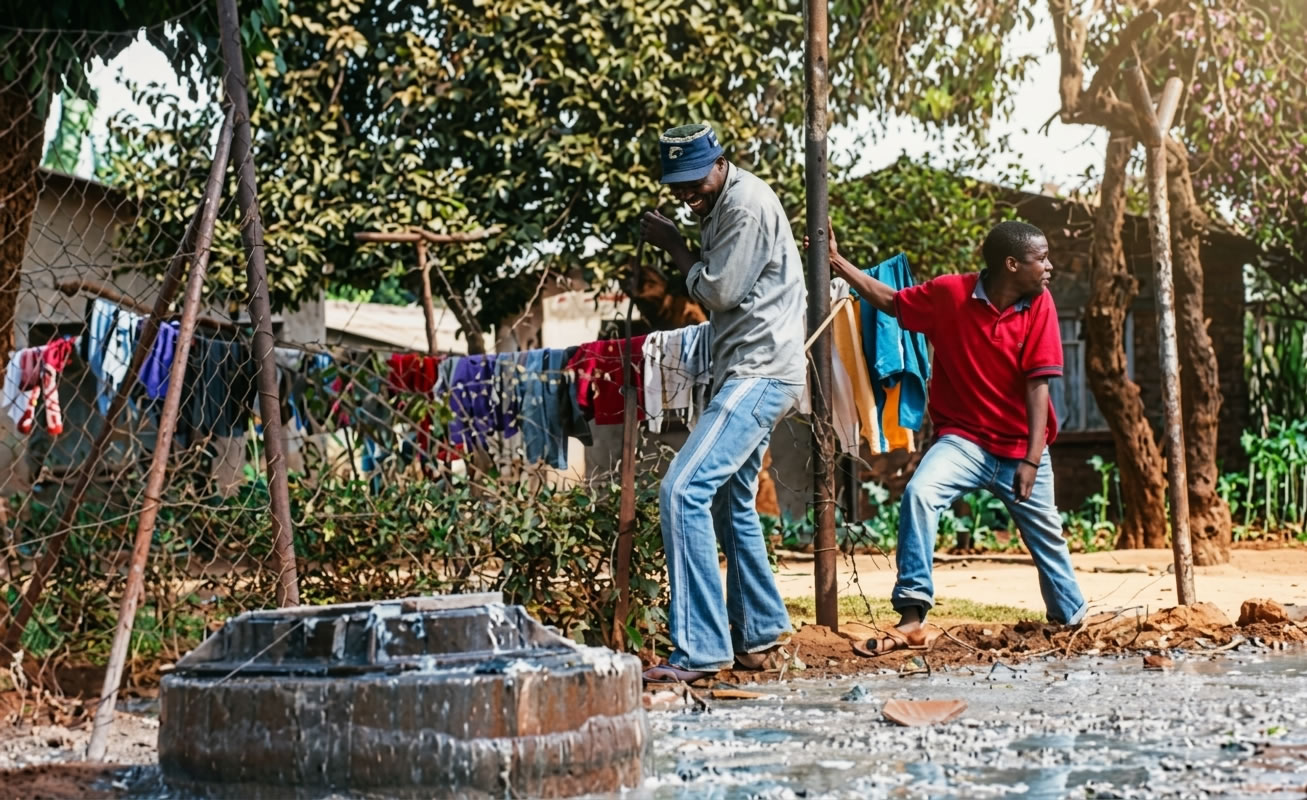
The Chitungwiza Sewage War: Residents Sue Council as Corrupt Workers Demand Bribes to Fix Bursts!
In the dormitory town of Chitungwiza, just south of Harare, the air does not merely carry a scent; it carries a sentence. It is a sentence of indignity, of disease, and of a systemic betrayal that has left thousands of families living in conditions that defy the basic tenets of human rights. For the residents of Ward 6 and Ward 12, the “putrid stench” described in recent legal filings is not a metaphor—it is a daily, suffocating reality that flows through their kitchens, beneath their beds, and along the very paths their children tread to reach school.
This week, the simmering frustration of the community boiled over into the halls of the High Court. The Chitungwiza Residents Trust (CHITREST), alongside eight courageous local citizens, has filed a landmark application seeking an interdict to compel the Chitungwiza Municipality to overhaul its collapsing sewer infrastructure. But as our investigation reveals, the crisis is not merely a failure of old pipes and lack of funding. It is being fuelled by a sinister “bribe-for-repair” ring operating within the council’s plumbing department—a secret economy where the health of the public is held to ransom for a handful of US dollars.
The Bribe-for-Repair Economy
The court papers, filed on 23 July 2026, bring to light a practice that residents have whispered about for years but are now stating as a matter of legal record. Despite being on the municipal payroll, some council workers are allegedly refusing to attend to burst pipes unless the community “contributes” money to pay them privately.
In his founding affidavit, Jacob Rukweza, the board secretary of the Chitungwiza Residents Trust, did not mince words about this internal rot.
“Residents often have to incentivise 1st Respondent’s employees to come and repair sewer bursts by collecting money from affected residents and giving it to them. Such corrupt practices… undermine service delivery.”
The mechanics of this extortion are simple and cruel. When a pipe bursts—which happens with alarming frequency in the town’s ageing network—residents report the fault to the council. Days pass. The sewage rises. The smell becomes unbearable. Then, a “fixer” or a municipal worker arrives, not with tools ready for work, but with a price list.
Local sources suggest that residents are often asked to pay between US$5 and US$10 per household just to get a plumber to look at a blockage. In a country where every dollar is a struggle, this “incentive” is a form of state-sponsored extortion. The workers, already drawing a salary from the public purse, are effectively charging a second, illegal tax for a service that the council is constitutionally mandated to provide.
A Town Under Siege by Filth
The physical evidence of this neglect is visible everywhere. In Ward 6, the situation has reached a point of absolute absurdity. Raw sewage flows freely along the roads used daily by pupils attending Tadzikamidzi Primary School and Zengeza 2 High School. Children, some as young as six, are forced to hop over streams of human waste to get to their classrooms.
“The spectre of raw sewage flowing into one’s home or along roads that they use evidently offends human dignity,” Rukweza stated in his affidavit. “The putrid stench from the same raw sewage attacks the very essence of human dignity.”
In Ward 12, the crisis has moved indoors. Residents have reported sewage back-flowing into their homes, ruining furniture and turning living rooms into cesspools. Alice Kuvheya, the Director of CHITREST and a long-time advocate for the town’s residents, has been at the forefront of documenting these horrors. She has previously shared accounts of sewage overflowing into kitchens and even beneath the beds of sleeping residents.
“Residents we are saying we cannot continue to live in sewage while fuel and resources are disappearing,” Kuvheya said during a recent community dialogue. Her words reflect a broader suspicion among the populace: that the council’s failure is not just about incompetence, but about the deliberate diversion of resources.
The Legal Battle for a Clean Environment
The lawsuit, handled by Kevin Kabaya of the Zimbabwe Lawyers for Human Rights (ZLHR), names the Chitungwiza Municipality as the first respondent. Also cited are the Minister of Local Government and Public Works and the Environmental Management Agency (EMA).
The residents are asking for more than just a few patches on broken pipes. They are demanding a total infrastructure overhaul. Specifically, the application seeks an order directing the municipality to:
- Upgrade and repair the town’s sewer infrastructure within three months.
- Publish an emergency short, medium, and long-term rehabilitation plan within one month.
- Ensure that the Environmental Management Agency (EMA) monitors compliance with this plan.
The legal argument is grounded in the Constitution of Zimbabwe, which guarantees every citizen the right to life, dignity, and an environment that is not harmful to their health. By allowing raw sewage to flow through the streets, the residents argue, the council is in direct breach of the Environmental Management Act, the Public Health Act, and the Urban Councils Act.
The Manyame River Conspiracy
Perhaps the most alarming aspect of the Chitungwiza sewage war is its environmental footprint. The town’s failing system is not a self-contained problem. Untreated effluent from the burst pipes and the non-functional treatment plants eventually finds its way into the Manyame River.
The Manyame River is a critical water source for several downstream towns and eventually feeds into the lakes that provide water for Harare. By failing to manage its waste, Chitungwiza is effectively poisoning the water supply for millions of Zimbabweans.
There is a growing conspiracy theory among residents that the council is intentionally neglecting the pipes to force people into the “bribe-for-repair” system. While the council often cites a lack of foreign currency and old equipment as the primary reasons for the delays, the residents point to the “ghost workers” and financial irregularities uncovered in previous audits as evidence of a deeper malaise.
A 2024 audit of the municipality uncovered 57 ghost workers on the payroll—individuals who did not exist but were still “receiving” salaries. For the residents of Chitungwiza, seeing money vanish into the pockets of non-existent employees while their streets run with filth is the ultimate insult.
A History of Broken Promises
This is not the first time Chitungwiza has been in this position. In December 2020, the High Court ordered the municipality to upgrade its water treatment plants and sewer systems following a similar application by the Zimbabwe Environmental Law Association (ZELA). That order specifically interdicted the municipality from releasing raw sewage into water bodies and the environment.
Six years later, the situation has only worsened. The perennial water challenges and sewage bursts have led to repeated cholera outbreaks, claiming lives in a town that was once a model for urban development. The African Development Bank’s ZimFund previously allocated over US$1 million towards addressing these problems, yet the “sewage dams” near Seke 3 High and other areas remain a persistent feature of the landscape.
The Human Cost
Behind the legal jargon and the technical reports are the people of Chitungwiza. There are the parents who must wash their children’s shoes every day to remove the smell of the streets. There are the elderly who cannot leave their homes because the paths are submerged in waste. And there are the residents who must decide whether to use their last ten dollars for food or to pay a corrupt plumber to stop the sewage from entering their kitchen.
The current lawsuit is a desperate attempt to break this cycle of corruption and neglect. It is a demand for the basic dignity that every human being deserves. As the case moves through the High Court, the eyes of the nation are on Chitungwiza. The question is no longer just about when the pipes will be fixed, but whether the “bribe-for-repair” ring will finally be dismantled.
For now, the residents wait. They wait for the court’s decision, they wait for the “incentivised” plumbers, and they wait for a day when they can open their windows without being greeted by the “putrid stench” of a failing state. This is not just a story about dirty water; it is a story about the fight for the soul of a community that refuses to be buried in its own waste.
The Chitungwiza Municipality has been given a chance to respond to these allegations in court. Whether they will offer solutions or more excuses remains to be seen. But one thing is certain: the residents of Chitungwiza are no longer willing to pay for their own oppression. The “Sewage War” has only just begun.