


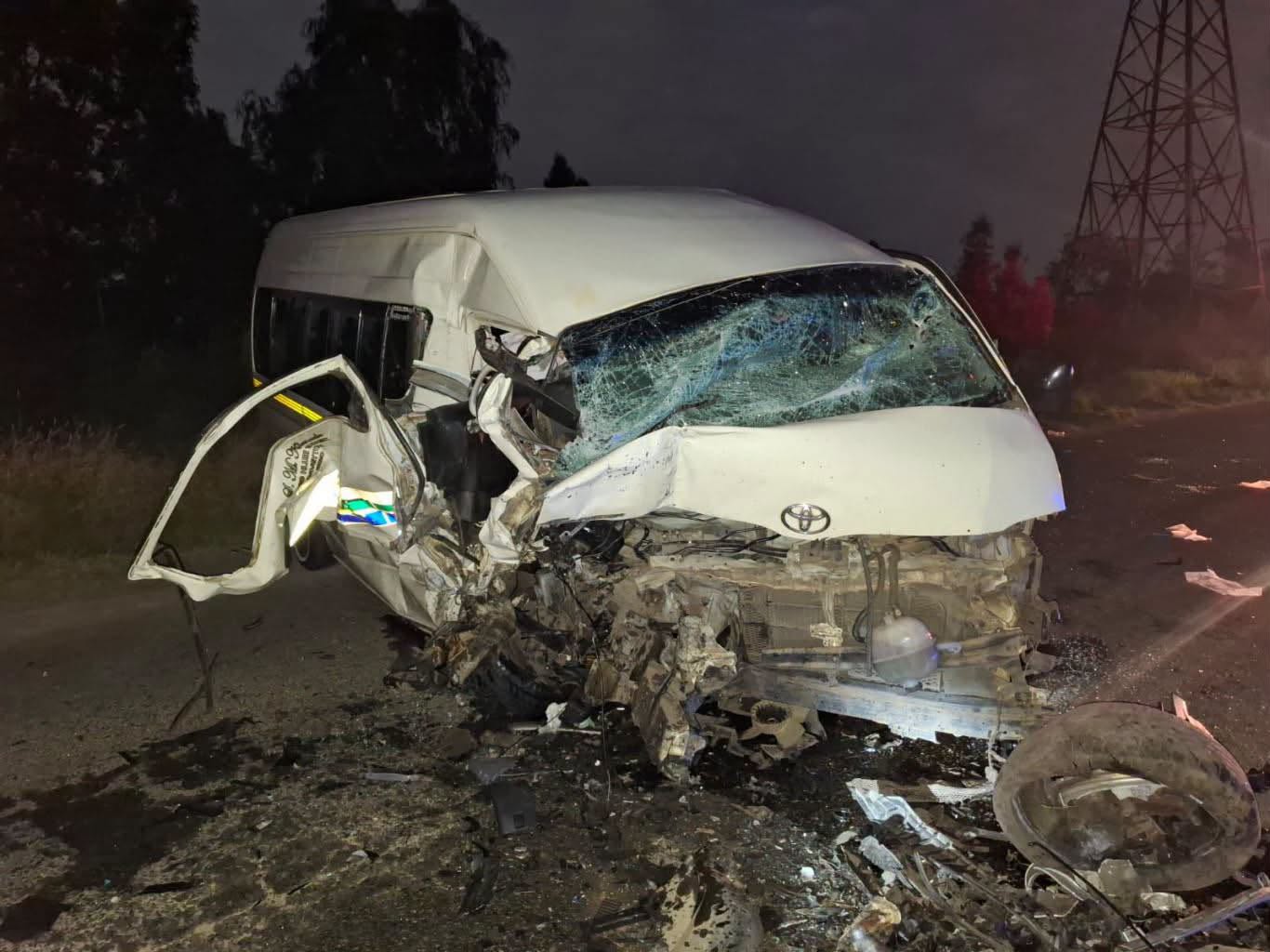
HARARE — The night air at the Tynwald Rail Road Flyover was thick with the smell of damp earth and twisted metal on Wednesday night, as rescue workers waded through a dark, water-filled gully to retrieve the bodies of those lost in Zimbabwe’s latest road tragedy. At approximately 10 pm, a commuter omnibus, known locally as a kombi, veered sharply off the Harare-Bulawayo Road, plunging into a deep, concrete-lined trench that has now become a site of mourning for six families.
The accident, which occurred near the nine-kilometre peg at the intersection of Harare Drive, has once again cast a dark shadow over the nation’s transport system. For the passengers on board, what should have been a routine journey home turned into a nightmare in a matter of seconds. The vehicle, carrying eleven passengers, failed to navigate the flyover, careening off the tarmac and into the depths of the gully below.
National police spokesperson Commissioner Paul Nyathi confirmed the details of the horrific event in a formal statement issued shortly after the scene was cleared. He stated:
“The Zimbabwe Republic Police confirms a fatal road traffic accident which occurred on July 29, 2026 at around 10 pm at the nine-kilometre peg along the Harare-Bulawayo Road at Tynwald Rail Road Flyover near Harare Drive junction. Six people were killed while six others were injured when a kombi with 11 passengers on board veered off the road and plunged into a deep concrete- lined gully which contained water. The bodies of the victims were taken to Parirenyatwa Group of Hospitals mortuary for post-mortem while the injured are admitted at the same hospital. Efforts to locate and notify the next of kin of all the victims are continuing. The Zimbabwe Republic Police extends its deepest condolences to the families of the victims and wishes the injured a speedy recovery. Further details will be released in due course as investigations continue.”
The scene at Parirenyatwa Group of Hospitals in the early hours of Thursday was one of quiet desperation. Relatives of those known to have been travelling on that route gathered in the corridors, their faces etched with anxiety as they waited for news. For six of those families, the news was the worst imaginable. The hospital, which is the primary referral centre for the capital, has been kept busy this month by a relentless stream of road accident victims, highlighting a growing crisis on Zimbabwe’s highways.
This latest disaster is not an isolated incident but part of a grim pattern that has defined the month of July 2026. Only two days prior, on Monday, July 27, the Harare-Nyamapanda Road was the site of another devastating collision. In that instance, two Isuzu D-Max vehicles were involved in a head-on crash at the 101-kilometre peg. Five people died instantly, while nine others sustained serious injuries. The disparity in the number of passengers was stark; one vehicle carried only a single passenger, while the other was dangerously overloaded with fourteen people.
The frequency of these accidents has left the public questioning the effectiveness of road safety enforcement. Just days before the Tynwald tragedy, on Saturday, July 25, the Zimbabwe Republic Police (ZRP) Norton Traffic division held a high-profile event to re-invigorate their Client Service Charter. The theme of the day was “ZERO TOLERANCE TO ROAD ACCIDENTS.” Yet, even as the slogans were being recited, the carnage continued unabated.
Investigating the history of the Tynwald flyover reveals a troubling record. The stretch of the Harare-Bulawayo Road near the Harare Drive junction has long been identified by motorists as a hazardous zone. In April of the previous year, a similar incident occurred at the same flyover when a pedestrian was struck by an unidentified vehicle. The deep, concrete-lined gullies designed for drainage have, in several instances, acted as death traps for vehicles that lose control. Critics argue that the lack of adequate guardrails and poor lighting at the flyover contribute significantly to the danger, especially during the late-night hours when visibility is reduced.
The “kombi culture” in Zimbabwe remains a central factor in these tragedies. These commuter omnibuses are the backbone of urban and peri-urban transport, but they are often operated by drivers under immense pressure to meet daily targets set by vehicle owners. This pressure frequently leads to speeding, overtaking in dangerous areas, and the overloading of vehicles. In the Tynwald accident, the kombi was carrying eleven passengers, which is within the standard capacity, yet the sheer force required to plunge into a concrete gully suggests that speed or mechanical failure played a significant role.
Further back in the month, on July 11, 2026, the Harare-Masvingo Road claimed more lives. At the Sebakwe River Bridge, a Mazda B1800 carrying four people veered off the road and plunged into the river. All four occupants perished. This accident mirrored the Tynwald incident in its terrifying conclusion—a vehicle leaving the safety of the road and entering a body of water or a deep trench from which there is little hope of escape.
The week before the Tynwald crash also saw a high-profile accident on Thursday, July 23, involving a black Ford Raptor. In a multiple-car pile-up, all four occupants of the leading vehicle were killed. These incidents, occurring across different major highways, suggest a systemic failure in road safety that transcends any single location. Whether it is the Harare-Bulawayo, Harare-Masvingo, or Harare-Nyamapanda road, the common denominator is a high death toll and a sense of inevitability.
Statistics for the first quarter of 2026 had already painted a bleak picture, with 593 people dying on Zimbabwe’s roads in just three months. If the current trend in July continues, the year-end figures could be among the worst in the country’s history. The Ministry of Transport and Infrastructural Development has been vocal about the rehabilitation of major roads, such as the Bulawayo-Victoria Falls Road, where progress was reported earlier this month. However, for many commuters in Harare, these improvements feel far away as they navigate the treacherous flyovers and poorly maintained bypasses of the capital.
The human cost of these accidents is immeasurable. Beyond the statistics are individuals—breadwinners, students, and parents—whose lives are cut short in a flash of metal and glass. The ZRP’s efforts to notify the next of kin are a somber reminder of the ripples of grief that follow every “fatal road traffic accident” confirmed by the police.
As investigations into the Tynwald flyover accident continue, the call for more than just “zero tolerance” slogans grows louder. Motorists are demanding better lighting, more robust barriers at flyovers, and a genuine crackdown on the reckless driving habits that have made Zimbabwean roads some of the most dangerous in the region. Until then, the gully at the nine-kilometre peg stands as a silent, concrete witness to the lives lost in the pursuit of a simple journey home.
The Passenger Association of Zimbabwe (PAZ) has frequently voiced concerns over the state of the nation’s public transport. Following this latest tragedy, the conversation has shifted toward the accountability of vehicle owners. Often, the focus is placed solely on the driver, but investigators are now looking into the maintenance records of the kombi involved. A vehicle plunging off a flyover raises questions about brake failure or steering malfunctions, issues that are often overlooked in the rush to clear the road and resume operations.
Furthermore, the role of the Traffic Safety Council of Zimbabwe (TSCZ) has come under scrutiny. While the council continues to run awareness campaigns, the tangible results on the ground remain elusive. The July 2026 death toll serves as a grim indictment of current safety protocols. On the Harare-Bulawayo road, where the speed limit is often ignored by late-night commuters, the absence of speed cameras and regular patrols creates a vacuum where recklessness thrives.
In the coming days, the ZRP is expected to conduct a mechanical inspection of the wreckage. For the survivors currently fighting for their lives at Parirenyatwa, the physical injuries are only part of the trauma. The psychological impact of such a violent plunge into a water-filled gully is profound. As one medical official noted, the “near-death experience” of being trapped in a sinking vehicle in the dark is something that will haunt the survivors for years to come.
The authorities have promised that further details will be released in due course as the investigation broadens to include the mechanical state of the vehicle and the environmental factors at the Tynwald flyover. For now, the city of Harare waits in a state of somber reflection, hoping that the next news bulletin will not bring word of another deadly kombi accident. But if the history of this July is any indication, the road to safety remains a long and difficult one, paved with the memories of those who never made it home.