


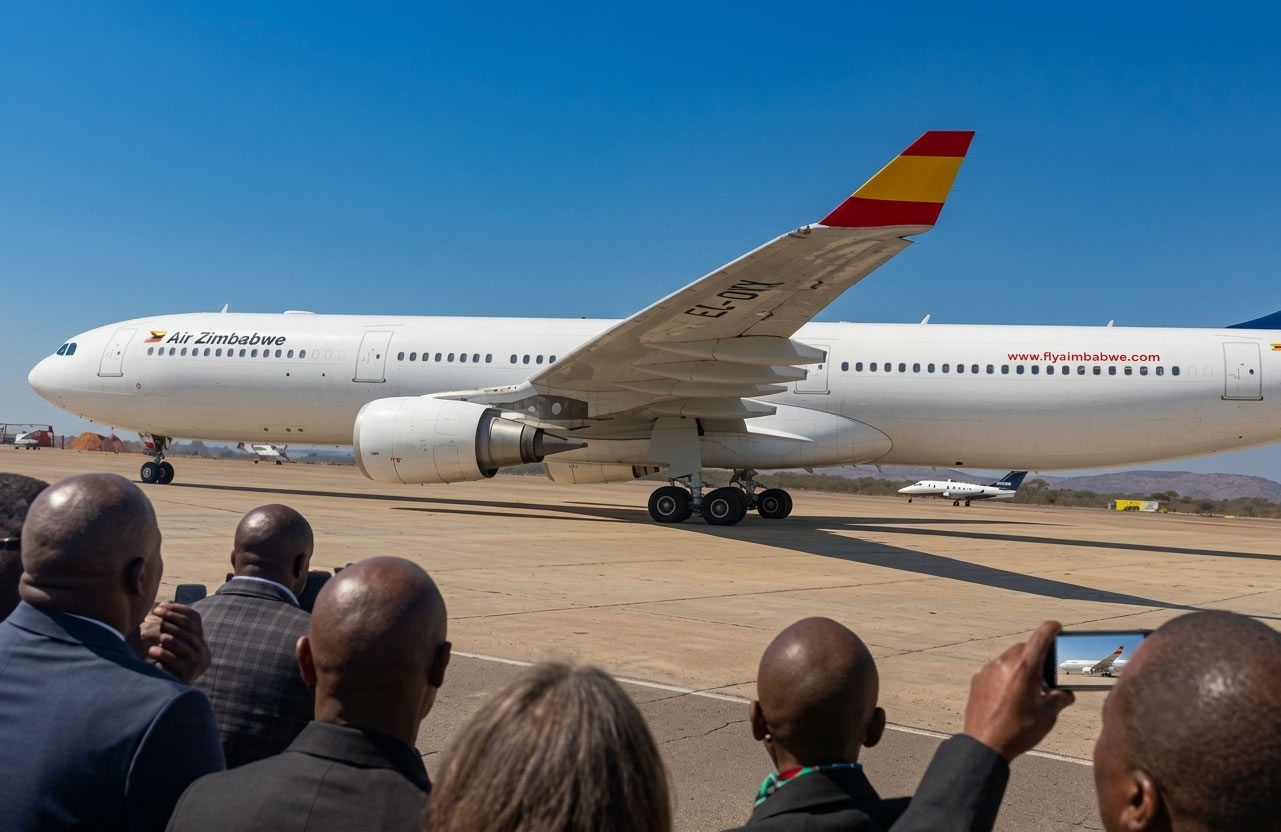
HARARE – The celebratory echoes of traditional drums and the theatrical arch of water salutes at Robert Gabriel Mugabe International Airport have barely faded, but the “triumph” of Air Zimbabwe’s return to London has already hit a turbulent patch of reality. Just ten days after its much-vaunted relaunch, the national carrier was forced to abruptly cancel its Friday night service to the United Kingdom, leaving hundreds of passengers stranded and raising fresh questions about the sustainability of a route that has been absent for fourteen years.
On Friday night, as the 10:40 PM departure time approached, the atmosphere at the terminal shifted from anticipation to frustration. Staff reportedly informed the gathered travellers that the flight had been cancelled due to what was vaguely described as “an issue with one of our crew members.” It later emerged that one of the pilots assigned to the service had reported sick. In a statement issued on Saturday, the airline confirmed the “postponement” of the flight due to “operational reasons,” rescheduling the departure for 9:00 PM on Saturday.
However, for a long-haul service that was supposed to signal a national rebirth, the cancellation of its third-ever Friday flight is more than a mere scheduling hiccup. It exposes the fragile, outsourced foundation upon which this “new” service is built.
The Spanish Illusion
The pilot’s illness proved fatal for the Friday schedule because of a detail the government has been hesitant to highlight: Air Zimbabwe is not actually flying its own planes to London. The service is operated under an Aircraft, Crew, Maintenance, and Insurance (ACMI) contract — a “wet lease” — with Plus Ultra Líneas Aéreas, a Madrid-based carrier.
Under this thirteen-month arrangement, every critical component of the flight is Spanish. The pilots are Spanish, the cabin crew are Spanish, and the technical engineers are Spanish. When the assigned pilot fell ill in Harare, there was no standby crew available. Because Air Zimbabwe lacks its own qualified pilots for the Airbus A330-300 and depends entirely on the Spanish staff provided by Plus Ultra, the sickness of a single individual was enough to ground the entire operation.
“The airline is currently operating the route using outsourced capacity under an arrangement with Spanish carrier Plus Ultra, which supplies both the aircraft and crew,” a source close to the operations confirmed. “With no standby pilot available in Harare, the flight could not depart.”
This arrangement has been described by aviation analysts as a “commercial sleight of hand.” While the 20-year-old Airbus A330-300 carries the Air Zimbabwe livery, a closer look at the wingtips reveals the red and yellow of the Spanish flag. The national carrier has essentially been reduced to a glorified travel agency, managing check-in desks and selling tickets for a service it neither owns nor operates.
Bypassing the Ban
The decision to use a Spanish-registered aircraft and crew is not merely a matter of convenience; it is a calculated strategy to bypass international regulatory hurdles. Since 2017, the European Union Aviation Safety Agency (EASA) has banned Air Zimbabwe’s own aircraft from European skies due to safety concerns and a lack of proper oversight.
By “flagging out” the operation to Plus Ultra, Air Zimbabwe can fly into London Gatwick under the Spanish carrier’s safety certificates. While this allows the government to claim a “reconnection” with Europe, it does nothing to address the systemic safety and maintenance issues that led to the EASA ban in the first place.
“Renting a turnkey service from a third party does not make you a transport magnate,” noted one industry expert. “It simply makes you a ticket broker using someone else’s equipment and manpower. When the lease expires, the aircraft returns to its owner, leaving the broker with no fleet, no trained pilots, and no permanent infrastructure.”
The Shadow of Plus Ultra
The choice of partner has also raised eyebrows. Plus Ultra Líneas Aéreas is a company with a history as turbulent as the skies it navigates. In 2021, the airline was at the centre of a political firestorm in Spain after receiving a €53 million state bailout. Spanish prosecutors launched criminal investigations into the “inadequate use” of public funds, with allegations surfacing of potential links to money-laundering networks and Venezuelan political figures.
For Air Zimbabwe, an airline already struggling with its own reputation for mismanagement, to pin its hopes on such a controversial partner is a high-stakes gamble. The financial implications are equally concerning. In an economy starved of foreign currency, the lion’s share of ticket revenue from the London route is now flowing out of Zimbabwe to cover foreign salaries, foreign maintenance, and foreign lease payments.
A History of Debt and Disappearance
The current troubles are a haunting echo of the airline’s ignominious exit from the London route in December 2011. At that time, Air Zimbabwe abandoned the service after creditors threatened to seize its aircraft to settle a debt that has since ballooned to over US$380 million.
The years since have been marked by a series of failed “turnaround” projects. Most notable was the “Zimbabwe Airways” saga, a shadowy project involving the purchase of second-hand Boeing 777s from Malaysia. That project ultimately failed to launch, leaving taxpayers with a massive bill and a collection of grounded jets that never saw commercial service.
Even as the government celebrates the new Gatwick service, the airline continues to be dogged by allegations of corruption and a lack of transparency. In May 2026, Air Zimbabwe found itself in the “hot seat” during parliamentary hearings after auditors discovered “missing” aircraft records. Lawmakers were told that the airline had been operating aircraft that were not even reflected in its financial statements, raising serious questions about asset control and ownership.
Furthermore, the airline remains entangled in legal battles. In late 2025, it was sued for US$210,000 by Jetex (Pvt) Ltd over grounding costs in the Democratic Republic of Congo (DRC). The lawsuit followed an incident where one of Air Zimbabwe’s Boeing 767s and fourteen crew members were stranded in Goma during an outbreak of fighting, requiring emergency assistance that the airline allegedly failed to pay for.
The Passenger Experience: A Step Back in Time?
For the passengers who do manage to board, the experience on the 20-year-old Airbus is proving to be a mixed bag. While the convenience of a direct flight is welcomed by many who previously endured gruelling layovers in regional hubs, the lack of modern amenities is a frequent point of contention.
The economy class, which carries the bulk of the travellers on the ten-hour journey, lacks in-flight entertainment screens—a standard feature on almost every other international carrier.
“They ought to do something—can’t sit for 10 hours with no entertainment like I am flying a 2-hour flight with a budget airline,” wrote one disgruntled traveller on social media.
Others are more pragmatic. “My main motivation is once I’m searched and remove my shoes in Harare, that’s it until Gatwick in 10 hours,” remarked another passenger, prioritising time over comfort.
The “Great Spirit” or a Hollow Shell?
Transport Minister Felix Mhona recently declared the relaunch a “milestone” and a “triumph” for the nation. “We are so excited as a ministry, but above all as a nation, that after 14 years without direct flights to London, we are now reconnecting with one of our key international destinations,” he told the press. “We have not had direct connectivity with Europe. This service changes that.”
However, the cancellation on Friday night serves as a stark reminder that connectivity is not the same as capability. The thirteen-month contract with Plus Ultra is a stopgap—a temporary mask for a deeper malaise. It does not train Zimbabwean pilots to fly modern wide-body jets, nor does it upskill local engineers or increase the airline’s tangible assets.
As the rescheduled flight prepares to depart on Saturday night, the question remains: is this the return of the “Great Spirit of Africa,” or merely a costly, Spanish-made illusion? For the stranded passengers at Harare, the answer, for now, is as elusive as a healthy pilot.
Table: Air Zimbabwe Key Incidents and Status (2025-2026)
|
Date
|
Incident/Event
|
Details
|
|
July 2026
|
London Route Relaunch
|
13-month wet lease deal with Plus Ultra (Spain).
|
|
July 2026
|
Flight Cancellation
|
Friday night service grounded due to “sick pilot”; no standby crew.
|
|
May 2026
|
Audit Scandal
|
Parliamentary scrutiny over “missing” aircraft records and unrecorded assets.
|
|
Sept 2025
|
Jetex Lawsuit
|
Sued for US$210,000 over stranded aircraft and crew costs in the DRC.
|
|
Ongoing
|
EASA Ban
|
Air Zimbabwe’s own fleet remains barred from EU airspace since 2017.
|
|
Ongoing
|
Debt Crisis
|
Reported debt exceeding US$380 million.
|