


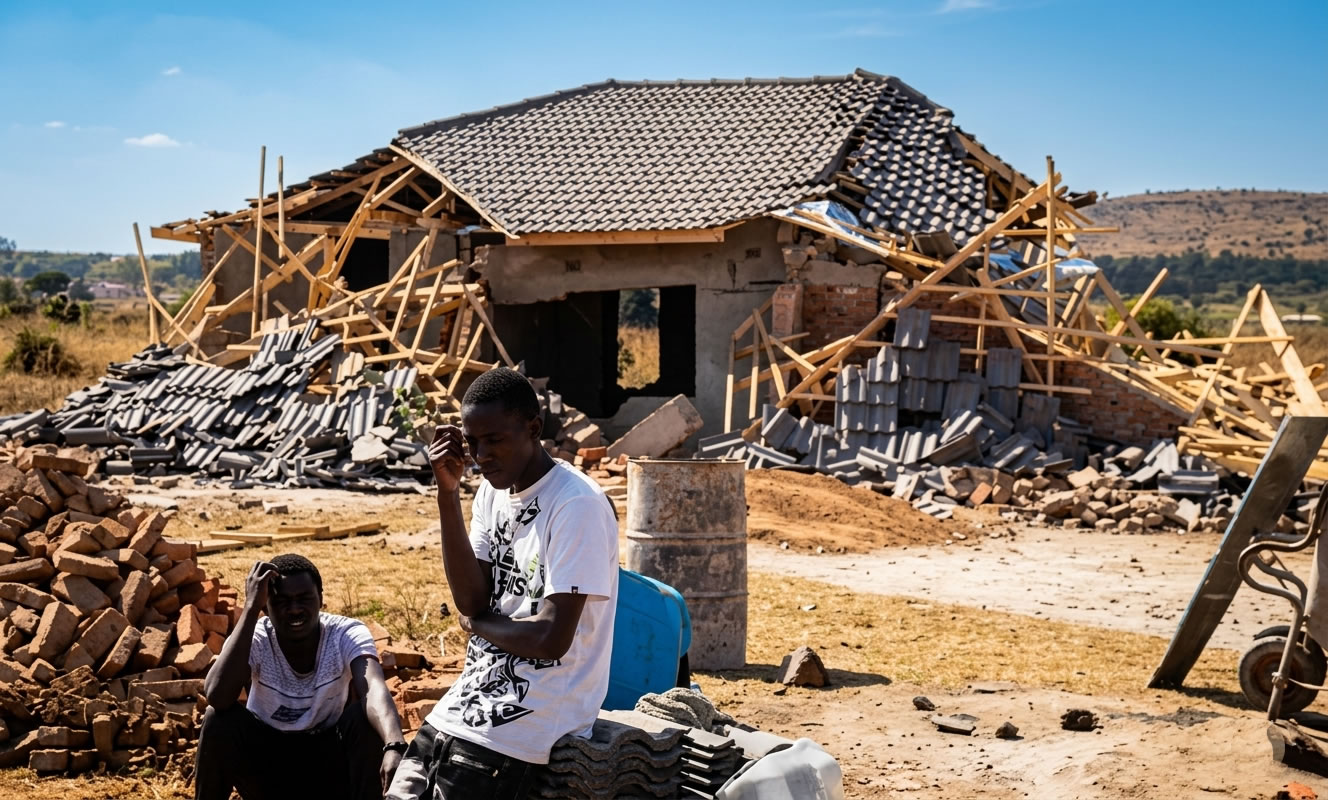
HARARE – The Zimbabwean government has officially declared an all-out war on the notorious ‘Land Barons’ who have for decades held the nation’s housing sector in a vice-like grip. However, as the dust settles on the first wave of arrests in this 2026 crackdown, a far more sinister reality is emerging. Our investigation reveals that the line between the hunters and the hunted is dangerously blurred, with senior government officials and local councillors allegedly serving as the very architects of the illegal land schemes they are now publicly ‘cracking down’ on.
For years, the promise of a piece of land to call home has been the ultimate carrot dangled before desperate Zimbabweans. But in the peri-urban fringes of Harare, Bulawayo, and Mutare, this ‘land hunger’ has been weaponised. The current offensive, ordered directly by President Emmerson Mnangagwa, has seen the deployment of multi-agency enforcement teams, including the police and the Chiefs Council of Zimbabwe. Yet, critics argue that this is merely a reshuffling of the deck—a power struggle between rival political factions where the poor are, as always, the primary casualties.
The ‘Sabhuku’ Deals: A Parallel Administration
At the heart of this chaos are the so-called ‘sabhuku deals’. In Zimbabwe’s traditional hierarchy, the sabhuku (village head) is the custodian of communal land. However, in recent months, this role has been perverted. In areas like Domboshava, Goromonzi, and Seke, rogue traditional leaders have been caught running what can only be described as a parallel land administration system.
These leaders, often acting under the protection of powerful political figures, have been illegally subdividing agricultural and communal land for residential use. They sell these plots to unsuspecting home-seekers for thousands of dollars, despite having no legal authority to do so. Under Zimbabwean law, communal land is vested in the President, and only the Ministry of Lands can issue legitimate offer letters.
Local Government and Public Works Minister, Daniel Garwe, recently issued a chilling final warning to these rogue elements. “With immediate effect, all identified land barons will be arrested, prosecuted and subjected to the full penalties prescribed by law,” he stated during a press briefing. “Any headman or village head found participating in, facilitating or benefiting from illegal land sales will be arrested, prosecuted and, upon conviction, removed from office.”
The scale of the problem is staggering. In Matabeleland North, Minister of State Richard Moyo flagged an influx of unregulated sales in Bubi, uMguza, Tsholotsho, and Lupane. “Some of those giving out land falsely represent that they are doing so on behalf of the Zanu PF party, while others say they would be representing war veterans,” Moyo revealed. This political camouflage makes it nearly impossible for the average citizen to distinguish between a legitimate government initiative and a sophisticated scam.
The Architects of Chaos: Who Is Really Pulling the Strings?
While the government paints a picture of a clean-up operation, our investigation suggests that the ‘barons’ are often just the public face of a much deeper rot. Behind every notorious land baron is often a local councillor or a senior bureaucrat who provides the necessary paperwork—or the promise of it—to bypass town planning laws.
Agricultural land, meant to ensure the nation’s food security, is being parcelled out for residential use without a single pipe for sewage or a single kilometre of tarred road. These ‘unplanned settlements’ are ticking time bombs of environmental degradation and disease. Yet, the developers continue to collect ‘subscriptions’ and ‘administration fees’ from families who have poured their life savings into these dusty plots.
The conspiracy runs deep. By the time the government decides to ‘crack down’ and send in the bulldozers, the architects of the scheme have already moved their profits into offshore accounts or luxury real estate in the leafier suburbs of Harare. The home-seeker, who bought in good faith, is left standing in the rubble of their demolished dream.
The 2026 Hit List: High-Risk Areas
Our sources within the Ministry of Local Government have provided a ‘hit list’ of areas currently under the most intense scrutiny. Residents in these locations are warned that their settlements are considered illegal and could be subject to imminent enforcement action:
|
Region
|
Affected Areas / Settlements
|
|
Harare & Peri-Urban
|
Goromonzi, Seke, Domboshava, Epworth extensions, Harare South (various cooperatives)
|
|
Matabeleland North
|
Bubi, uMguza, Tsholotsho, Lupane
|
|
Manicaland
|
Peri-urban Mutare, Dangamvura extensions
|
|
Midlands
|
Gweru peri-urban, Shurugwi
|
In many of these areas, the ‘red flags’ are waving high. If a developer tells you that the land will be ‘regularised’ later, or if they cannot produce a valid subdivision permit and a certificate of compliance from the local council, you are likely being defrauded.
Recent Casualties: The Net Closes In
The 2026 crackdown has already claimed several high-profile targets. Just last week, on 6 August 2026, Wilson Masokowere was arrested and detained at Mutare Central Police Station. He is accused of stealing trust property valued at a staggering US$2 million in a land-related fraud case. Masokowere’s arrest has sent a clear message: no one is untouchable, or so the government would have us believe.
Other notable names in the crosshairs include Wellington Madzivire, a suspected Harare land baron arrested for allegedly grabbing council and housing consortium land. Then there is the case of Emmanuel Mutambirwa, the former Harare estates manager. The Supreme Court recently confirmed his 10-year sentence for land fraud, a landmark case that exposed how deep the corruption goes within the very institutions meant to protect public land.
“The era of lawlessness is over,” Minister Garwe reiterated. “The abuse of public land, fraudulent land sales and illegal settlements will no longer be tolerated.”
The Human Cost: Stories from the Rubble
For families like the Mwenes in Seke, these high-level statements offer little comfort. They bought a 400-square-metre stand from a local ‘committee’ three years ago. They were shown documents with official-looking stamps and were even visited by a man claiming to be a government surveyor.
“We spent every cent we had building our four-roomed house,” Mrs Mwene told us, her voice trembling. “Now they say it’s a ‘sabhuku deal’ and that the land belongs to the state. We have been told to vacate, or the bulldozers will come. Where are we supposed to go? The people who sold us the land are gone, and the councillor who told us it was safe now says he doesn’t know us.”
The Mwenes are not alone. Thousands are caught in the middle of power struggles between rival political factions. One faction encourages the settlement to gain votes, while the other orders the demolition to ‘restore order’—often just to clear the land for a different set of developers.
Red Flags: How to Protect Yourself
The Ministry of Local Government has urged citizens to be vigilant. The following are critical warning signs that a land deal is illegal:
- The Sabhuku Deal: Any traditional leader offering to ‘sell’ you land for a fee is acting illegally. They can only allocate communal land for use, not for sale.
- Missing Permits: A legitimate developer must have a Permit to Subdivide and a Certificate of Compliance from the local authority.
- Cash-Only Transactions: If the developer insists on cash payments in a private office rather than through established bank accounts or council offices, be wary.
- No Infrastructure: If there are no roads, water pipes, or electricity plans, the settlement is likely unplanned and illegal.
- ‘Regularisation’ Promises: Never buy land on the promise that it will be made legal in the future. In most cases, it never is.
Who Is Next?
As the multi-agency teams continue their work, the question on everyone’s lips is: who is next? The government has signaled that the next phase of the operation will target the ‘big fish’—the senior officials who have used their offices to facilitate these crimes.
Permanent Secretary for Presidential Affairs and Devolution, Engineer Tafadzwa Muguti, has already ordered provincial secretaries to compile detailed reports on all illegal settlements. The deadline for this information was 15 May 2026, and sources suggest that a fresh wave of high-profile arrests is imminent.
However, for the ordinary Zimbabwean, the ‘Land Baron Wars’ are a double-edged sword. While the removal of criminals is welcomed, the lack of a clear plan to provide affordable, legal housing means that the cycle of desperation and exploitation is likely to continue. Until the government addresses the root cause of ‘land hunger’, the barons will always find a way to return, perhaps under a different name, but with the same devastating consequences for the poor.
The battle for Zimbabwe’s soil is far from over. It is a war for the soul of the nation’s cities, and for now, the casualties continue to mount.
Fact Box: The Legal Position
- Communal Land: Vested in the President and administered by Rural District Councils. It cannot be sold.
- State Land: Can only be allocated through the Ministry of Lands, Agriculture, Fisheries, Water and Rural Development.
- Urban Land: Must be developed according to the Regional, Town and Country Planning Act. Any sale must be preceded by a subdivision permit and a certificate of compliance.