


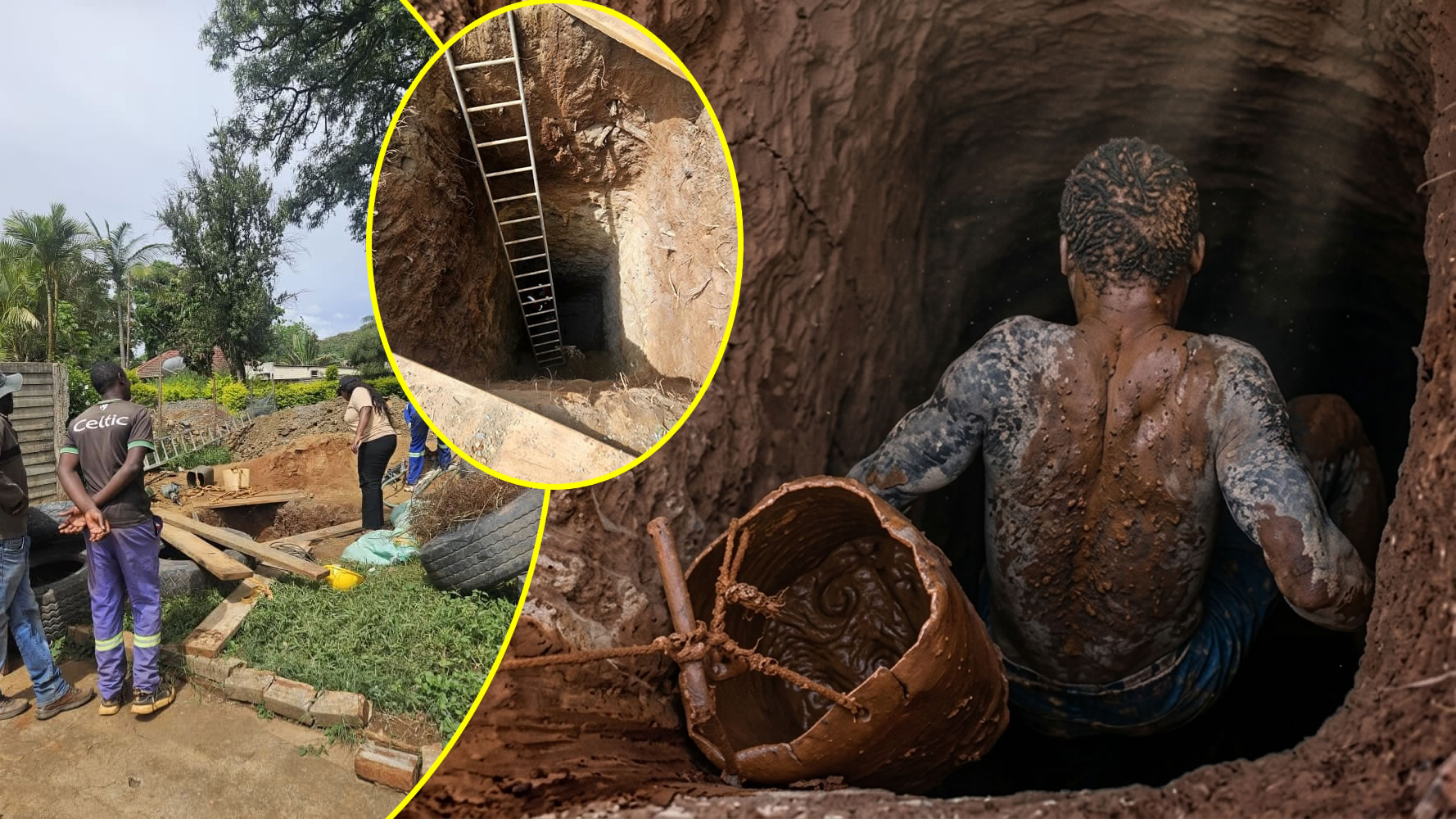
HARARE – In the affluent streets of Borrowdale, Chiripai Chipandire lived the life of a modern Zimbabwean “mbinga”. He was a man of means, a product of the prestigious Vainona High School, and a figure associated with the high-minded ideals of youth leadership through his involvement with groups like WELEAD Africa. But while he moved through the polished circles of Harare’s elite, a much grittier and more dangerous reality was unfolding beneath the manicured lawns of Marlborough, a suburb nearly fifteen kilometres away.
The duality of Chipandire’s life came to a crashing halt recently when the Zimbabwe Republic Police descended upon Number 4 Wallington Close in Marlborough. What they found was not just a residential property, but a full-scale, illegal gold mining operation that had been hollowed out from within over the course of four years. The arrest of Chipandire and seven of his employees has pulled back the curtain on a saga of deception, “Rhodesian” myths, and a ruthless pursuit of wealth that has left a trail of structural destruction in its wake.
The Myth of the Rhodesian Treasure
The audacity of the operation began with a story that sounds like it was lifted from a colonial-era adventure novel. According to authorities and local community leaders, the entire enterprise was built on a captivating lie. Chiripai Chipandire and his associate, Douglas Walsh, allegedly approached the owner of the Marlborough property, Tinashe Rwodzi, with a tale of “buried treasure.”
They claimed to possess a map passed down from a grandfather who had lived during the Rhodesian era. This map, they insisted, marked the location of a significant cache of hidden wealth buried deep beneath the soil of Wallington Close. It was a story designed to exploit the allure of the “Gold Rush” that has long gripped Zimbabwe, but with a sophisticated, urban twist.
Ward 41 Councillor Kudzai Kadzombe, who has been at the forefront of the community’s response, recounted the deception during a recent tour of the site. “They told me they had received a permit from the Ministry of Mines,” she said. “Apparently it was a family that had been given a map by their grandfather during the Rhodesian times to retrieve what they believed was buried treasure. They convinced the property owner to allow them access and begin digging.”
The owner, perhaps blinded by the prospect of a share in the mythical treasure, allowed the men onto his land. What followed was not a careful archaeological search, but a brutal industrial extraction.
An Industrial Operation in a Quiet Suburb
The operation had been running clandestinely since 2022. For four years, the quiet, leafy atmosphere of Marlborough—where the distant hum of traffic and the sound of garden sprinklers usually define the day—was punctuated by the muffled thuds of underground blasting.
The State alleges that Chipandire initially sought some level of legitimacy. He was reportedly given a temporary permit by the Ministry of Mines and Mining Development to “search for treasure,” which included authorization to blast under very strict conditions. However, the conditions were quickly ignored. When residents first complained in January 2025, the ministry ordered a total halt to the operations.
Chipandire allegedly ignored the order. After a brief pause to let the heat die down, the digging resumed in the shadows. The miners worked right under the noses of unsuspecting neighbours, carving out the heart of the suburb while the “mbinga” from Borrowdale managed the enterprise from afar.
The Toll on the Pensioners of Marlborough
While the miners chased their gold, the residents of Marlborough were living through a slow-motion catastrophe. The suburb is a sanctuary for many of Harare’s elderly pensioners—people who spent their entire working lives saving to buy these homes and maintain their gardens. Now, they are watching their greatest assets crumble into the red earth.
The vibrations from the underground blasting and the hollowed-out earth have left a trail of structural damage that experts fear may be irreversible. Councillor Kadzombe began receiving reports of the activity as early as October 2024. “I received calls from residents in October 2024 telling me there was blasting taking place at one of the properties in Marlborough,” she said.
Despite the reports to the City of Harare’s Development Control Unit and the Environmental Management Agency (EMA), the mining continued. By 2026, the cracks in the neighbouring houses became impossible to ignore. Structural engineers called in to assess the area have delivered a chilling verdict.
“The report from the engineers said the cracks are posing a health risk. They could actually collapse at any given moment,” Kadzombe warned. She stood inside one of the affected homes, pointing to walls that looked like a shattered jigsaw puzzle. “Our area is predominantly filled with pensioners who invested years and years to buy these properties and maintain them. Just because of one reckless act by someone pursuing personal enrichment, neighbouring properties have now been affected.”
“Mbinga” in Court
Chiripai Chipandire has appeared before Harare magistrate Artwell Sanyatwe. He faces a litany of charges, including contravening the Mines and Minerals Act, acquiring explosives without a valid permit, conducting blasting operations without a licence, and prospecting for minerals without a licence.
Represented by lawyer Tawanda Takaindisa, Chipandire was granted US$500 bail. The court heard how he allegedly met Douglas Walsh on the streets of Harare in early 2024, where Walsh convinced him of the “hidden treasure” at Number 4 Wallington Close. The prosecution argues that even after being ordered to stop by the Ministry of Mines, Chipandire continued to employ men to dig and blast.
The arrest has sparked a wider conversation about the rise of “backyard mining” in Zimbabwe’s urban centres. As the price of gold remains high, the temptation to dig beneath residential properties has become a growing menace.
A Systemic Crisis: From Christmas Pass to Penhalonga
The Marlborough scandal is not an isolated incident. It is part of a much wider and deadlier pattern of illegal mining that has begun to threaten the very infrastructure of the country. The issue recently reached the floor of the Senate, where Deputy President Lt. Gen. (Rtd) Michael R. Nyambuya issued a stern directive to the Ministry of Mines.
The Senate debate was sparked by Senator Irene Zindi, who raised alarms about similar activities at Christmas Pass in Mutare. She warned that gold mining there had left a massive trench stretching up to ten kilometres, posing a serious flooding risk to nearby communities and schools. “People living in that area are now afraid that if a cyclone occurs, they will be in great danger,” she said. “If that trench is filled with water from the mountain, the water can wash away all the houses, including a school.”
The Senator also specifically pointed to the Marlborough situation, questioning why the mining was allowed to continue despite previous government interventions. “Right now, as we are here in Parliament debating, these people are mining. What then is supposed to be done?” she asked.
In response, Deputy Minister of Mines Caleb Makwiranzou admitted that the government was struggling to keep up with the “clandestine” nature of these operations. “We do not allow urban mining unless it is allowed by the local authority. Right now, we are waiting for the police to interdict those people,” he said.
The human cost of this “Gold Rush” was recently highlighted by Minister Polite Kambamura during a workshop in Kadoma. He cited a horrific incident in Penhalonga, Manicaland, where illegal miners had constructed a network of underground tunnels accessed through a “dummy” tuckshop. The operation was only exposed when a shaft collapsed, burying eight miners alive.
“As the Ministry of Mines and Mining Development, we do not issue licences for mining operations in urban residential areas,” Minister Kambamura stated firmly. “We have noticed that some people are clandestinely mining at their residences, drilling and blasting, thereby causing environmental damage. This is unacceptable.”
The Search for Justice
For the residents of Marlborough, the arrest of Chiripai Chipandire and his crew is only the first step in a long road to recovery. The physical damage to their homes remains, and the psychological toll of living above a blasting site for four years has left the community on edge.
Councillor Kadzombe is now working with human rights lawyers to explore legal remedies for the affected families. The focus is on property damage, safety violations, and the significant decline in property values. There are also tough questions being asked of the authorities. How did a ten-metre shaft and regular blasting go unnoticed for four years?
“We really need to look into how the Ministry of Mines could approve such a development where mining is taking place right in the middle of a residential area surrounded by other properties,” Kadzombe questioned.
As the legal process unfolds, the case of the Borrowdale “mbinga” serves as a stark reminder of the lengths to which some will go in the pursuit of gold. In the heart of a quiet suburb, the search for a mythical Rhodesian treasure has turned into a very real nightmare for ordinary citizens, leaving a community to wonder if their homes will still be standing by the time justice is finally served.
Timeline of the Marlborough Mining Scandal:
- 2022: The illegal mining operation begins under the guise of searching for “buried treasure.”
- Early 2024: Chiripai Chipandire allegedly meets Douglas Walsh and begins the operation in earnest.
- October 2024: Residents first report hearing underground blasting to Councillor Kadzombe.
- January 2025: The Ministry of Mines issues a stop order following resident complaints, which is later ignored.
- Early 2026: Structural engineers confirm significant damage and a high risk of collapse in neighbouring homes.
- 17 July 2026: Employees are caught in the act; police recover explosives and mining tools.
- 2 August 2026: Police raid the property and arrest eight men; the full scale of the 10-metre shaft is revealed.
- August 2026: Chiripai Chipandire appears in court and is granted US$500 bail.