


Wicknell Chivayo’s US$34m Gulfstream faces ownership questions as mansion and car debts emerge
A fresh claim that Wicknell Chivayo’s US$34 million Gulfstream G550 has returned to Switzerland has reopened questions about who owned the aircraft the Zimbabwean businessman publicly presented as his own.
Activist Rutendo Matinyarare said on 9 November that the jet had been rented from a Swiss company and was “back in Switzerland where it was rented from”. He wrote that the company had “retaken the jet back”. His post did not include a lease agreement, a company name or a flight record showing when the aircraft left Zimbabwe. The claim has therefore added a new chapter to a dispute over an asset whose public identity was closely tied to Chivayo, but whose legal ownership has not been set out in accessible documents.
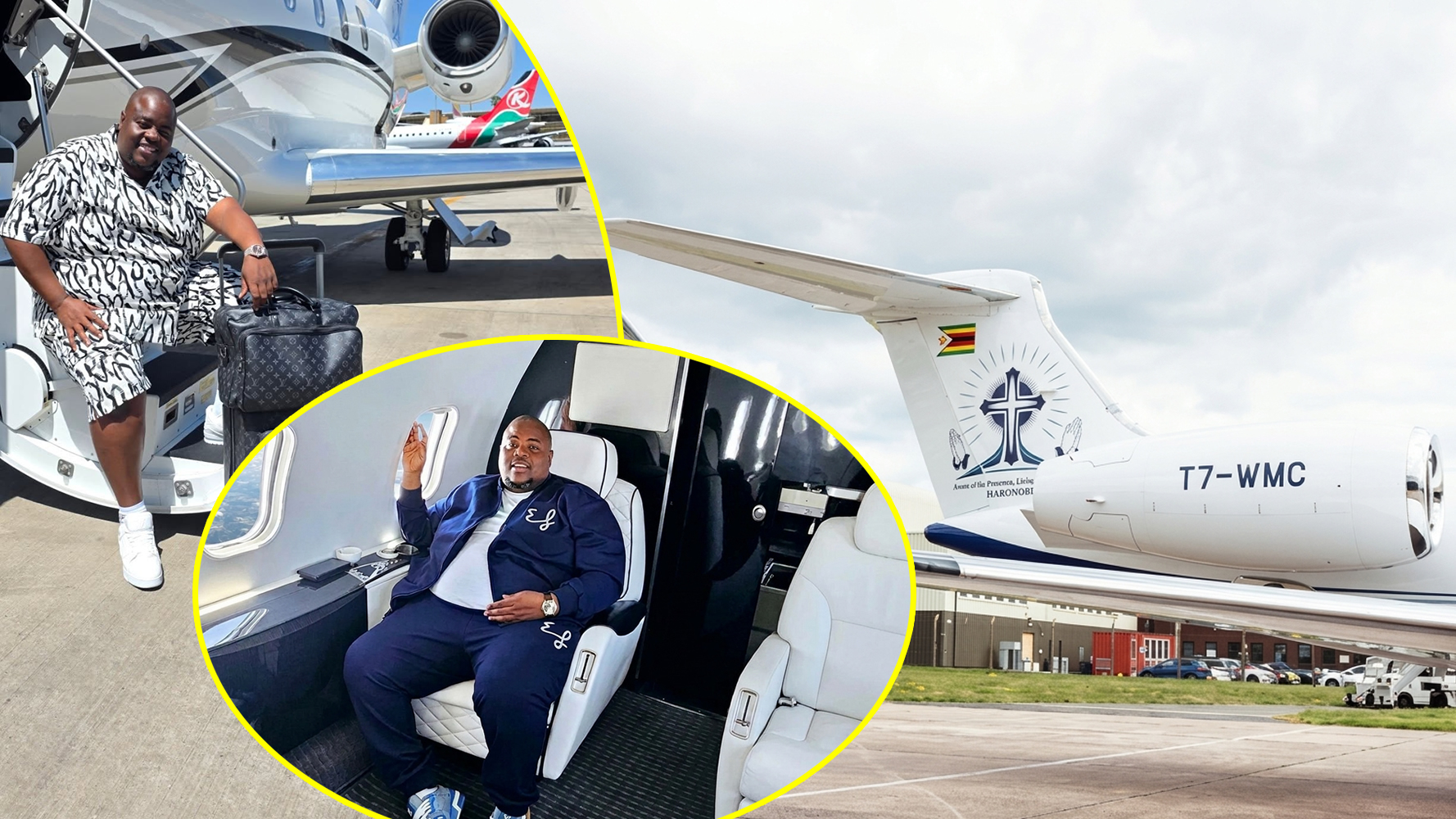
The aircraft, a Gulfstream G550 with registration T7-WMC and manufacturer serial number 5508, became one of the most visible symbols of Chivayo’s wealth. Aviation photographs identify the registration and serial number, and show the aircraft bearing the crest of the Johane Masowe Chishanu Apostoles, the church with which he was associated. A photograph records the jet at Geneva airport on 13 July. That image establishes the aircraft’s presence in Switzerland on that date; it does not, by itself, establish who owned it.
Chivayo publicly described the G550 as a purchase worth about US$34 million. When it arrived in Zimbabwe in June, he announced: “My new Gulfstream G550 is ready for collection and coming home soon to its new owner”. He also wrote: “MY GULFSTREAM G550 FINALLY ARRIVES HOME”. The aircraft’s registration, T7-WMC, incorporated his initials, and its customised exterior carried a large religious crest and Zimbabwean colours. The presentation helped make the jet a highly recognisable feature of his public image.
The timing of the latest claim has drawn attention because public accounts of the aircraft’s whereabouts have shifted. A report published on 14 October described the G550 at Robert Gabriel Mugabe International Airport in Harare, where it had reportedly remained after Chivayo’s death. Matinyarare’s later post says it has since gone back to Switzerland. The two accounts place the aircraft in different countries at different moments; neither, on its own, settles the question of legal title or the terms under which it was being used.
The G550 is a long-range business aircraft, commonly configured for between 14 and 19 passengers. Its range is about 12,500 kilometres, allowing non-stop travel between Harare and destinations in Europe or the Gulf. Chivayo’s June arrival drew a public welcome, and images of the aircraft, its customised livery and its spacious cabin circulated widely. The plane was more than transport: it was a conspicuous emblem of the fortune and lifestyle he chose to display.
Chivayo died on 30 September when a helicopter crashed near Marondera, about 70 kilometres east of Harare. His wife, Lucy Muteke, and 4 other people also died. Police said all 6 people aboard were killed. The Civil Aviation Authority of Zimbabwe said initial findings indicated the helicopter’s tail hit the ground first, spilling fuel and triggering a fire; the cause of the crash was still under investigation in the days after the accident. The deaths were confirmed by Chivayo’s family spokesperson and reported by officials and international coverage of the crash.
His death has brought scrutiny of his assets into sharper focus. The private jet is now part of a wider accounting of what the businessman owned, what his companies controlled and what obligations may remain. His companies named in a condolence statement included Intratrek Zimbabwe, IMC Communications, IMC Construction and WMC 777 Airways. The presence of WMC 777 Airways has prompted questions about whether the aircraft was held personally, through a business, through another company or under a lease arrangement. No public inventory has yet provided a complete picture of the estate’s assets.
The estate is now being administered by Chivayo’s former wife, Sonja Madzikanda, and his sister, Esther Chivayo, who were appointed co-executrices. The role places them in charge of identifying property, dealing with liabilities and managing the eventual distribution of assets. Madzikanda had a US$25 million matrimonial property claim pending before the Supreme Court when Chivayo died. The appointment means the estate now has representatives to take part in proceedings and oversee its administration; it does not resolve the claim. Details of the appointment and the pending dispute are set out in the estate report.
Mansion deal adds another unresolved asset
One of the largest property questions concerns Chivayo’s mansion in Gletwyn, an affluent suburb of Harare. The estate is described as four adjoining stands covering about 11.5 hectares. The property was associated with former police commissioner-general Augustine Chihuri, from whom Chivayo was reported to have bought it. The transaction has become a second high-value asset dispute alongside the Gulfstream, with accounts differing over when the deal was made, how much had been paid and what remained to complete the transfer.
One account describes an agreement signed in 2017 for US$2.555 million. Under the terms reported, US$1 million was due at signing and US$1.555 million within a year. The agreement was said to provide that failure to pay the balance on time would make the contract “null and void and of no effect”. The same account said the tax authority later valued the property at US$7 million, creating a potential US$1.4 million capital-gains tax bill at the reported 20 per cent rate. The transaction did not proceed to a completed transfer, with tax and transfer costs among the issues still to be resolved. The reported agreement terms and property details set out one version of the deal.
A separate account says Chivayo paid US$1.4 million in May 2024 towards an agreed US$2.5 million purchase price, leaving a reported US$1.1 million balance. A source familiar with that transaction said the remainder was not expected to be paid entirely in cash, but was linked to services described as political. The source asked: “How do you put a monetary value to political services when one of the parties to the deal is no longer alive?” Those reported payment terms and the alleged services arrangement differ from the 2017 instalment schedule described in the other account; both cannot be treated as one settled set of terms.
The reported US$7 million valuation was substantially higher than the sale price stated in the second account. The property’s title was not registered in Chivayo’s name, and the reported sale had not been fully completed. One account said Chihuri retained the keys. Chivayo’s lawyers had previously described his interest differently, saying he was a beneficiary of the trust that owned the property and that the owner’s title was being processed. Their statement was: “Mr Chivayo is a beneficiary of the owner of the property, having purchased the same. The owner, whose title is being processed, is a trust that, for now, cannot be named.” The lawyers’ description of the trust arrangement adds a further account to the unresolved transfer.
The property also has a history beyond the sale to Chivayo. The state seized it in 2020 during proceedings over Chihuri’s assets, then he regained it in 2022 after a court challenge. The mansion’s earlier history helps explain why the title and transfer conditions matter to the current estate review: Chivayo’s occupation or public association with the home does not answer who holds the registered title or whether the purchase obligations were completed.
Separate claims over vehicles have also surfaced. Car dealers in Harare have been reported as seeking a combined US$5.1 million for vehicles supplied to Chivayo, with several of the cars later gifted to musicians and other public figures. Musician Sugar Sugar has reportedly been asked to return a vehicle he received from the businessman. These claims have created uncertainty for recipients who had understood the cars to be gifts, while dealers say the underlying transactions had not been fully paid. The balance of those disputes, and whether the estate will settle them, remains part of the administration process.
The questions surrounding the jet are especially pointed because Chivayo publicly spoke of buying it, while Matinyarare now says it belonged to a Swiss company and was leased. Public aircraft data and aviation photographs confirm the G550’s registration, type and appearance, but those details do not show the financial arrangement behind it. A registration is an identifier; it is not, by itself, proof of beneficial ownership. The distinction matters as the estate’s representatives begin to establish which assets belong to it and which may be subject to claims by third parties.
For Chivayo, luxury purchases and public generosity were central to a carefully cultivated public persona. He was known for gifting cars and cash, sharing photographs with political leaders and promoting his business interests online. He also became a controversial figure through government-linked contracts, including Intratrek’s long-delayed Gwanda solar project, valued at about US$172 million. The project and Chivayo’s business dealings attracted years of public attention, while he denied wrongdoing in relation to allegations connected to those dealings. The background to his business career and public profile now forms part of the wider context in which questions about his estate are being asked.
The Swiss-return claim has not yet been accompanied by a published lease, a statement from the company said to own the plane, or a documented flight itinerary. Matinyarare’s post, the aircraft’s earlier appearance in Switzerland and the account placing it at Harare airport in October leave a clear sequence of locations, but not a public chain of title. Until the estate’s inventory or the aircraft’s ownership records are made available, the central question remains whether Chivayo bought the Gulfstream outright or used it through an arrangement that ended after his death.