


‘DDF does not drown’: Survivors say warnings were ignored before Lake Kariba ferry disaster
The Lake Kariba ferry disaster has left Zimbabwe facing a painful question: how did a vessel carrying far more people than its stated capacity continue into rough water after passengers say they repeatedly warned the captain that the journey had become unsafe?
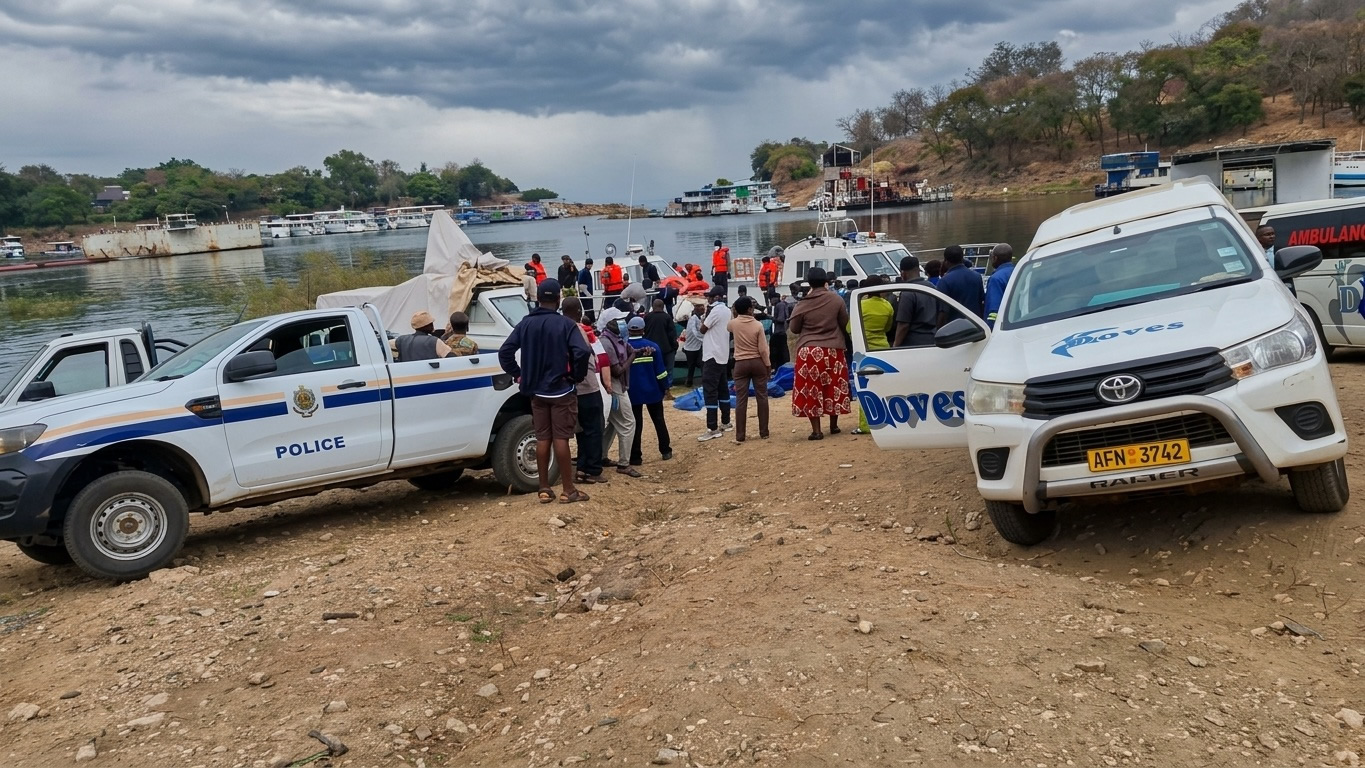
At least 44 people died after the Mbuya Nehanda, a passenger ferry operated by the Rural Infrastructure Development Agency (RIDA), capsized on Tuesday in heavy winds and strong waves. Police and rescue officials said 67 people survived, while the number of missing passengers remained uncertain. The death toll and passenger figures were still being revised as divers, soldiers and police searched the wreck and the surrounding water.
President Emmerson Mnangagwa declared the disaster a national tragedy and said it had exposed “serious deficiencies” in Zimbabwe’s maritime safety capabilities. He directed agencies responsible for water safety, including specialised security units, to begin remedial action so that places of recreation would not become “death traps to the innocent”.
The President’s statement has placed the disaster beyond the question of one boat, one captain or one afternoon of bad weather. It has raised wider concerns about the inspection of passenger vessels, the accuracy of boarding records, the availability of life jackets, emergency communication and the enforcement of capacity limits on a lake that is both a tourist destination and a lifeline for remote communities.
A journey that began with warnings
Survivors say the danger was visible before the ferry left the harbour.
Itai Marumisa, who had travelled to Harare to buy groceries and wares for resale in Mola, said the wind was already strong while passengers were boarding. A battery and inverter being taken to the community fell into the water, she said, but the captain chose to continue.
“We just felt that there was something wrong with the journey because the winds were already strong,” said Marumisa.
She said passengers asked whether the trip should be postponed. According to her account, the captain replied that he had worked on the lake for many years and expected the wind to subside. She said he then prayed for the journey before proceeding.
“A box containing a battery and inverter fell into the water and we told the boat captain that we should not proceed with the journey, but he went on to say a prayer for journey mercies. He ignored our plea, and that was to be the same thing along the journey,” she said.
The warnings, she said, continued after the ferry left. A bag was swept overboard, followed by a case of opaque beer. Water began entering the hull while the vessel was still close to the harbour. Passengers became increasingly anxious, but the ferry continued towards its destination.
Friday Munenga, from Dobe Village in Mola, said passengers asked the captain to turn back or shelter at a nearby island as the waves grew larger.
“We left the harbour and before long we highlighted to the captain that the conditions were not suitable for us to continue with the journey. We suggested that we dock at a nearby island, but he insisted on continuing with the journey, saying that he had traversed the lake for many years,” said Mr Munenga.
That account is broadly consistent with testimony reported by the Associated Press and state broadcaster ZBC. Other survivors told ZBC that passengers saw goods falling into the water, felt the ferry taking on water and pleaded for the journey to be abandoned. One survivor said the captain dismissed the concerns by declaring: “My boat has never sunk anyone.”
Another phrase reported by survivors was even more revealing of the confidence placed in the vessel and its operator. They said the captain told passengers: “DDF does not drown.” The expression referred to the District Development Fund, the predecessor of RIDA, which owned the ferry named Mbuya Nehanda.
📹 SECONDS FROM DISASTER: A video has emerged showing the rickety Mbuya Nehanda ferry setting sail on Lake Kariba shortly before it capsized today with 95 people officially reported to be on board.
In the footage, a speaker expresses concern about a phenomenon known as the… pic.twitter.com/o6MDUFDSmM
— ZimLive (@zimlive) August 11, 2026
The final minutes
The ferry was travelling from Kariba towards Chalala, a remote fishing camp on the shores of Lake Kariba. The route is important to communities living around the reservoir, many of whom depend on the boat to reach Kariba town to buy food, sell goods, access services or connect with the wider economy. The journey can take several hours, making a decision to turn back more costly for passengers who have already paid for transport and bought goods for resale.
According to police and international reporting, the vessel had an official capacity of 90 passengers, excluding five crew members. Police initially said there had been 90 passengers and five crew on board. Later estimates put the number of passengers at about 120, while civil protection officials said ticket records showed 114 adult passengers. The figures did not include children who may have travelled without tickets.
Earnmore Chambati, described in the supplied accounts as the only surviving member of the crew, said he counted 153 people, including children, before the ferry departed. His job, he said, was “verifying if people have payed to be on the boat, whether they have receipts and also securing the money paid.”
“The people I counted, including children, were 153,” he told the ZBC.
The difference between the official capacity, the ticket records and the survivor’s count is now central to the investigation. It is not a minor administrative discrepancy. In a sinking, the number of people on board determines how many life jackets are needed, how quickly rescue services must be mobilised and whether the vessel’s stability has been compromised by passengers and cargo.
The boat was hit by a strong wave and overturned, police said. An eyewitness told AFP that the vessel had been travelling in bad weather and may have lost engine power after being struck by a wave. Once the ferry tipped over, passengers were thrown into dark and turbulent water. Those on the upper deck were able to reach some life jackets, but survivors said there were too few jackets and that many passengers below deck had little time to escape.
Mrs Magadaire, according to the supplied survivor accounts, made repeated calls for help as the boat took on water. She contacted African Parks, Tiger Bay and Bumi Hills, asking for assistance. The calls continued as the ferry sank. Marumisa said the current swept her away from the wreck and that she remained in the water for close to an hour before an African Parks helicopter found her.
“I was one of two people to be rescued by the helicopter, which pulled us out of the water,” she said.
The distress call reached authorities at about 1pm, according to Kariba District Development Coordinator Rodwell Mutetwa. The Civil Protection Unit then mobilised the Zimbabwe National Army Boat Squadron, police divers and other agencies. A privately owned helicopter from the Matusadonha Conservation Trust, also known as African Parks, played an important role in locating and lifting survivors from the water.
A rescue operation against time
Search teams recovered 31 bodies in one day as they worked around the overturned ferry. The identities of the dead were withheld while officials notified relatives. At Kariba District Hospital, survivors were treated and monitored, while others were housed at Mahombekombe.
The wreck did not remain in a fixed position. A diver said its depth increased from 51 metres in the morning to 74 metres by the end of the day as wind and current moved it away from the initial search area.
“We started at a depth of 51 metres in the morning but by end of day the boat was now at a depth of 74 metres,” said a diver at the scene.
Diver Craig Hall assessed the position of the boat and determined that it might be towed to Long Island. Authorities also faced the possibility that people remained trapped inside the hull. The search was paused overnight and planned to resume the following morning, with teams bringing recovered goods and personal belongings back to mainland Kariba.
The operation has depended on a mixture of state resources, local knowledge and private assistance. The President thanked security forces and citizens who helped in the first hours, saying the quick response had prevented further deaths in the “rough and choppy conditions which obtained on the lake on the day”.
But speed after a disaster cannot replace preparation before one. A helicopter can locate people in the water; it cannot make up for a missing life jacket. Divers can recover bodies; they cannot correct an inaccurate passenger manifest. And a national declaration can unlock resources, but it cannot undo a decision to sail after repeated warnings.
The regional warning
Zimbabwe’s tragedy follows a long record of fatal ferry disasters on Africa’s inland waters. In 2018, at least 136 people died when the MV Nyerere capsized on Lake Victoria in Tanzania. Reports said the vessel was overcrowded, and the disaster revived questions about passenger limits, life jackets and enforcement. A 1996 Lake Victoria ferry disaster killed at least 500 people, while a 2012 disaster in the same region killed at least 145.
The comparison does not mean the causes are identical. Each accident requires its own technical investigation. Yet the repeated pattern is difficult to ignore: large numbers of passengers travelling on working boats, limited safety equipment, weak or uncertain records, pressure to complete journeys and warnings that are not acted upon until it is too late.
Lake Kariba is one of the world’s largest man-made reservoirs by volume. It stretches for more than 200 kilometres and supports fishing, tourism, transport and hydroelectric power for Zimbabwe and Zambia. Its scale can make a crossing appear deceptively ordinary. In reality, wind can build quickly across open water, waves can strike a low-sided vessel with great force and rescue teams may be far from the point of an emergency.
The investigation should therefore examine more than whether the ferry was overloaded. It should establish who authorised departure, whether weather information was available, whether the vessel had passed its latest inspection, how cargo was loaded, how many life jackets were on board and whether passengers were required to wear them. It should also trace the distress calls: when they were made, who received them, what action followed and how long it took for help to arrive.
Families left with questions
For Marumisa, the disaster has destroyed both her safety and her livelihood. The groceries and wares she bought in Harare were swallowed by the lake. She now faces the task of caring for her children without the stock she intended to sell in Mola.
“I am a single mother and shudder to think how I will be able to pick up the pieces and look after my children – getting wares in Harare and selling them in Mola was my source of livelihood,” she said.
Her account gives the disaster a human scale that casualty figures cannot capture. Each missing person represents a family waiting for confirmation, a child who may not return to school, a business that may lose its income and a community that must continue using the same waterway after the headlines fade.
President Mnangagwa has called for survivors to receive counselling and for the country to unite in prayer for the dead and the bereaved. Those measures matter, but the most meaningful response will be practical and public. Families deserve a complete passenger list, a transparent account of the rescue timeline and an independent explanation of why the ferry sailed.
The lake gave passengers warning, survivors say. Cargo fell overboard. Water entered the hull. The wind strengthened. People pleaded to turn back. The ferry nevertheless continued into open water. The final lesson of the Mbuya Nehanda disaster will be decided by what happens next: whether those warnings become evidence for reform, or simply another set of memories left beneath Lake Kariba.