


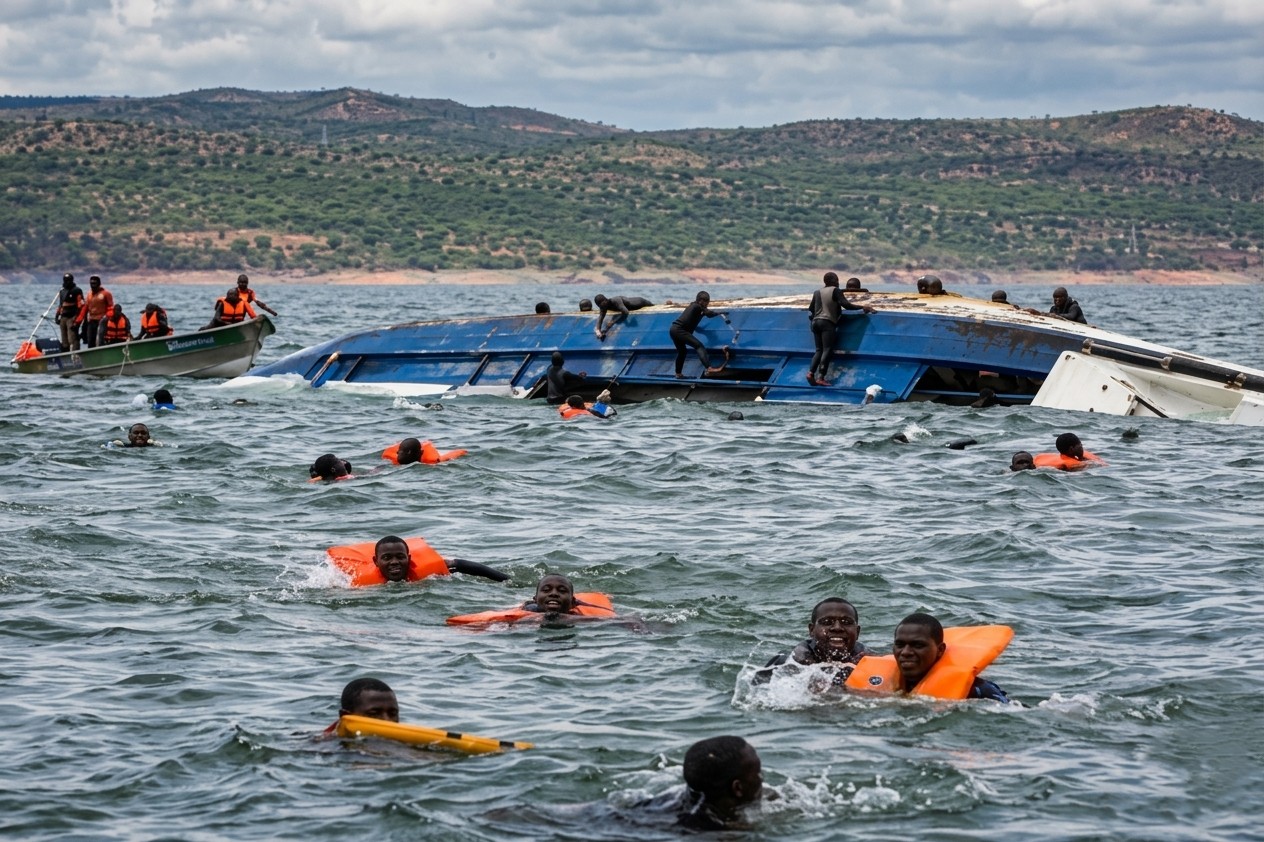
KARIBA — The human cost of Zimbabwe’s Lake Kariba ferry disaster has come into sharp focus as the confirmed death toll rose to 44, with families in remote communities still waiting for news of relatives who boarded the Mbuya Nehanda on Tuesday afternoon.
Among those mourning is Kariba opposition MP Shine Gwangwaba, who told Masvingo Mirror that his blood sister, several of her nephews and at least 15 close relatives were on the vessel. His account underlines the scale of a disaster that has affected entire families, rather than individual households.
“I have loss of words. We have lost relatives and funerals are all over. In my family, I lost a sister and at least 15 close relatives, neighbours lost relatives and the village lost several people. As I speak we are already gathered here in Kariba rural for the funeral of my sister and other relatives,” Gwangwaba said.
He said Mola Village, under Chief Mola, had lost several people, while other families had also lost multiple relatives. “Kariba is in state of mourning,” he said, describing funerals taking place across the area.
The ferry was travelling from Kariba towards Chalala Fishing Camp, near Long Island, when it capsized in strong winds and waves. The route is not simply a leisure crossing. Lake Kariba connects communities, fishing camps and islands with Kariba town, where people seek markets, schools, health care and other services. For many residents, travelling by water is part of daily life and may offer few realistic alternatives.
President Emmerson Mnangagwa has declared the incident a State of Disaster, allowing national resources to be mobilised for search, rescue and recovery. The response has included an army boat squadron, a police sub-aqua unit and a privately owned helicopter, according to government officials cited by the BBC.
Yet as the rescue operation has expanded, one of the most important facts about the disaster has remained unsettled: how many people were actually aboard the boat?
The numbers do not yet fit together
The Mbuya Nehanda was built to carry 90 passengers. Reuters reported that police believed more than 120 people may have been aboard when the ferry crossed the lake. A Civil Protection Unit account cited by The Guardian recorded ticket sales for 114 adults and five crew members, while also noting that an unknown number of children below the ticketing age may have been on board. A crew member told Zimbabwe Broadcasting Corporation that 153 people, including infants, were aboard, according to reports carried by local media.
Those figures are not minor discrepancies. They are central evidence in determining what happened, who was responsible for counting passengers and whether the boat left port already overloaded. The discrepancy also affects the calculation of survivors and missing people. If children were not included in ticket records, then adult tickets alone cannot provide a complete manifest.
The publicly reported figures changed repeatedly as the operation moved from rescue to recovery. Early reports said 15 people had died and 27 were missing, while 77 passengers were rescued. NewsDay later reported that 13 bodies had initially been recovered, a figure subsequently corrected by the Civil Protection Unit to 15. On Wednesday, 24 more bodies were found near Long Island, taking the reported total to 37 at that stage. Police later said 44 bodies had been retrieved.
The timeline is therefore still being assembled. The ticket count was made before departure. The vessel then left Kariba for Chalala. Accounts say that water began entering the boat after it encountered heavy waves, before the ferry overturned. Survivors were rescued by Matusadonha teams and other responders, with some taken to Long Island and later transported to shore. Divers and boats then continued searching the waters around Long Island and nearby channels.
The precise sequence — including when the crew recognised the danger, whether a distress call was made, how quickly rescue craft arrived and how many life jackets were available and used — must be established by investigators rather than inferred from the changing early reports.
A disaster beyond the water
The immediate response has also exposed a second crisis: whether Kariba’s health and mortuary services can cope with a mass-casualty incident of this size.
During the first major recovery operation, NewsDay reported that bodies were taken to the Kariba mortuary while relatives gathered to identify loved ones. At that point, 57 survivors were being housed at Mahombekombe Primary School Trauma Centre and seven had been admitted to Kariba District Hospital. Three of those hospitalised had been discharged by Wednesday morning, the newspaper reported.
This practical chain of care is often overlooked when attention is fixed on the search itself. Victims must be recovered, recorded, transported, identified and released to families. Post-mortems may be required. Death certificates must be issued. Relatives travelling from islands, fishing camps and rural villages need transport, information and somewhere to wait. Survivors, particularly children, may need medical treatment, food, blankets, counselling and protection from repeated questioning.
The State of Disaster declaration raises questions about what resources were available before the ferry overturned and what was moved afterwards. Kariba District Hospital and the Ministry of Health should be able to state how many mortuary spaces are normally available, whether additional cold storage or transport was brought in, and how many staff were assigned to identification and post-mortem work. The Civil Protection Unit should explain how funeral transport and other emergency costs are being handled.
These are not accusations. They are basic public-service questions raised by a disaster in which the number of victims has grown sharply within a day. A functioning emergency plan must account not only for boats and divers, but also for records, medical care, family notification and the preservation of dignity.
Overloading, weather and accountability
Authorities have indicated that the investigation points to overloading and heavy winds. Those are serious lines of inquiry, but they are not yet a final finding of negligence. Investigators will need to examine the ferry’s condition, its loading procedures, the weather information available before departure, the crew’s training, the availability of flotation equipment and the system used to record passengers.
The vessel was operated by the Rural Infrastructure Development Agency, commonly known as RIDA. A report carried by New Zimbabwe said the boat had a capacity of 90 passengers, while an official account recorded 114 adult passengers, five crew members and children below ticketing age. Local reports also described the vessel as old, but that description should be tested against inspection records rather than treated as proof that its condition caused the capsize.
The investigation should answer several straightforward questions. Was the final passenger list checked against the boat’s capacity before departure? Were infants and young children counted? Were life jackets available for every passenger, and were passengers shown how to use them? Did the crew receive a weather warning? Was the route considered safe in the conditions reported on Tuesday? Were there working communications and an emergency plan for a ferry operating far from the town?
The authorities have urged the public and media to rely on verified updates while the scene is managed. That caution is understandable. But the eventual official report must be detailed enough to explain not only the final death toll, but also the chain of decisions that preceded it. Families cannot be expected to accept a number without a clear account of how that number was reached.
The wider setting matters too. Lake Kariba is one of the world’s largest man-made reservoirs and straddles Zimbabwe and Zambia. It supports fishing, transport and tourism, while also providing hydroelectric power to both countries. That combination makes the lake an economic lifeline, not an isolated stretch of water. Safety rules for passenger boats must reflect the reality that people use these services because they need to travel, not because they are seeking adventure.
The tragedy has also renewed attention on regulation. Any review should involve RIDA, the Department of Civil Protection, the Ministry of Transport, the police, the Ministry of Health and the relevant maritime-safety authorities. Survivors and relatives should be given a meaningful opportunity to describe what happened, with children’s identities protected and interviews conducted only with consent.
For Kariba’s families, the disaster is no longer measured only in official updates. It is measured in funerals, unanswered telephone calls and the search for names. Gwangwaba’s loss of a sister and 15 relatives shows how quickly a transport accident can become a village-wide bereavement.
The final lesson is that disaster readiness cannot be judged only by the arrival of helicopters or divers after a boat has sunk. It must also be judged by the quiet systems that should exist before departure: accurate passenger records, enforceable capacity limits, weather warnings, life jackets, trained crews, functioning communications and a mortuary and trauma plan that can protect families when the worst happens.
Until investigators reconcile the passenger numbers and publish a full account of the ferry’s final journey, the most important questions on Lake Kariba will remain unanswered. The death toll is now 44. The number of people who boarded, and the decisions that placed them at risk, still need to be established.