


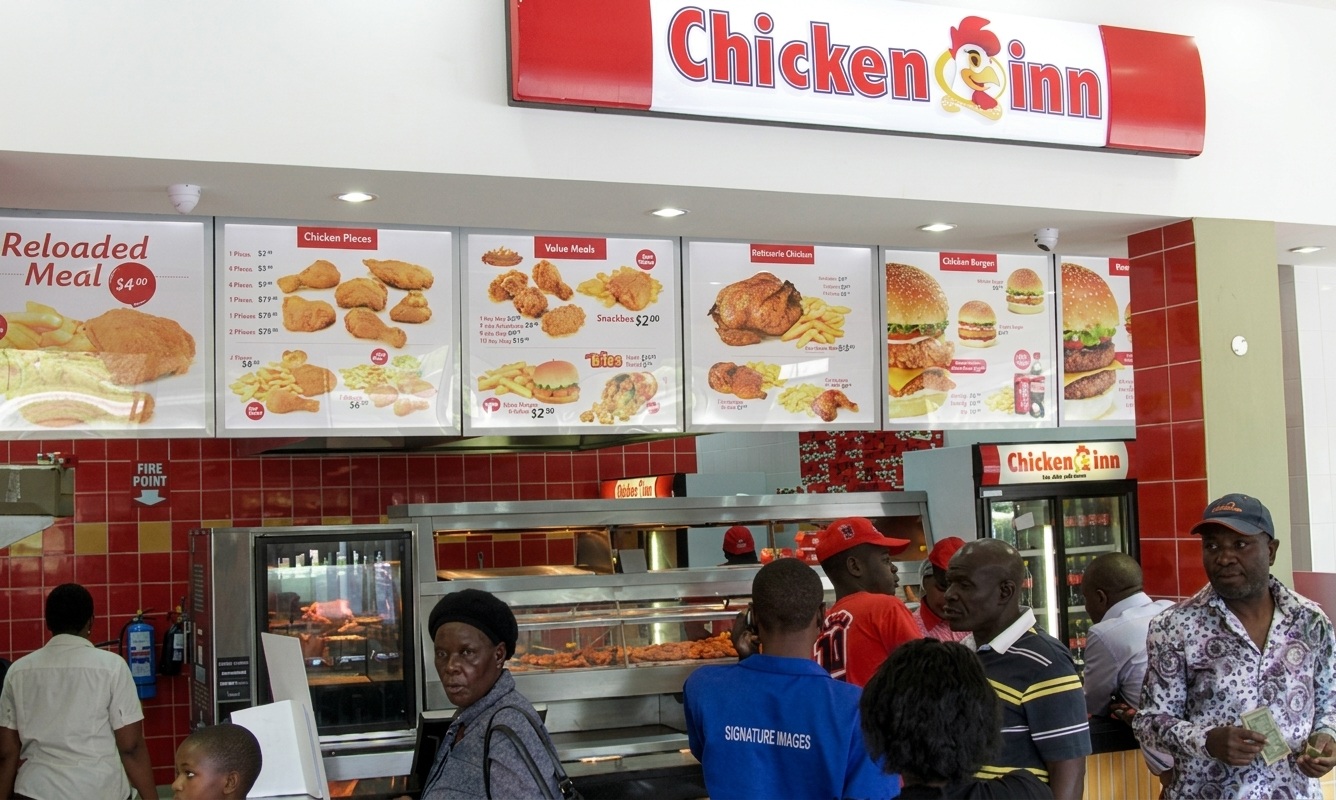
A Harare man who twice obtained meals from Chicken Inn after claiming that Zanu PF would settle the bill has been sentenced to 20 days in prison, although the sentence was wholly suspended on condition that he repays the fast-food outlet US$12.
Niven Nyarugwe, aged 52, pleaded guilty to two counts of making off without payment when he appeared before Harare magistrate Ayanda Dhlamini. The case has drawn attention not only because of the small amount involved, but also because of Nyarugwe’s earlier appearance in court over allegations that he printed fake Central Intelligence Organisation and Zanu PF identity cards.
The latest case began at a Chicken Inn outlet along Samora Machel Avenue in Harare. According to the court account, Nyarugwe arrived at about noon on 31 July and ordered food. He allegedly told the outlet’s representative, Rocky Sam, that he wanted to eat and that his political party would pay for the meal.
The outlet then gave him a three-piece chicken meal valued at US$9. Nyarugwe left without paying and did not return to settle the bill, despite allegedly knowing that payment was required immediately. Nothing was recovered from that first incident.
A week later, at about 12.30pm on 7 August, he allegedly returned to the same outlet. The court heard that he again said his political party would pay for his food. He was given a one-piece meal worth US$3 and once more left without making payment. The two incidents left Chicken Inn with a total loss of US$12.
Investigations followed, and the claim that the party would pay was found to be false. Prosecutor Takudzwa Mutyavaviri represented the State. In passing sentence, Magistrate Dhlamini imposed 20 days’ imprisonment, wholly suspended on the condition that Nyarugwe restitutes the full amount.
The suspended sentence means that the immediate punishment is tied to the restitution condition rather than an automatic spell behind bars. The case therefore ended with a criminal conviction and a clear order to repay the money, but not with Nyarugwe being taken directly to prison on this charge.
In 2020, when he was 46, Nyarugwe was reported as having been charged with subversion after allegedly printing fake Zanu PF and Central Intelligence Organisation (CIO) identification cards at his Kuwadzana residence. NewsDay reported that he was remanded in custody and advised to apply for bail at the High Court.
According to that report, police allegedly found four fake identity cards for State security agents, nine fake Zanu PF identity cards, a computer, a printer and three flash discs containing templates for the fake State security cards. The prosecution alleged that Nyarugwe and accomplices who were still at large had created a template and manufactured the cards for themselves.
The cards allegedly carried the bearers’ full names, national identity numbers and photographs, even though the people pictured were not members of, or employed by, the State security agency. Prosecutors said the fake CIO cards could have given the men the appearance and privileges of security agents, including access to classified information, government security institutions and State executives, as well as the possession and handling of weapons. The fake Zanu PF cards allegedly offered access to party institutions where senior government figures also held office.
The State alleged that the conduct compromised national security. NewsDay’s report described the charge as subversion, while the supplied brief refers to the earlier case as a treason arrest. My Zimbabwe News could not immediately ascertain how the case was finalised, if it has done so yet.
Nyarugwe’s professional identity has also added to the public interest around the new case. According to information available online, his LinkedIn profile says he is employed by Zanu PF as a driver. That claim has not been independently verified in the court report.
The alleged Chicken Inn explanation — that the party would settle a personal food bill — also sits within a broader political culture in which food and other benefits have sometimes accompanied attendance at ruling-party events. The point is not that every person attending a Zanu PF gathering does so for a meal, nor that the Chicken Inn outlet accepted the claim because such arrangements are formally authorised. Rather, the case has exposed how a familiar practice at large political or State-linked functions could be invoked as a private excuse for not paying.
In 2023, The Zimbabwe Independent reported that, according to Zanu PF’s own estimate, close to 127,000 people attended a rally in Muzarabani. The publication said attendees received a loaf of bread, a two-piece chicken box, a fizzy drink and party regalia, including a T-shirt, cap and scarf. The report presented the figures in an opinion article examining the cost and extravagance of the event, so its calculations and characterisation should be read in that context.
A separate 2023 NewsDay in-depth report described thousands of empty fast-food boxes scattered across the venue after President Emmerson Mnangagwa’s Harare rally. It said supporters who had travelled long distances on hired Zupco buses scrambled for chips, chicken and fizzy drinks provided at the event. The report contrasted the experience of ordinary supporters sitting in the dust with that of political leaders under specially made tents.
These accounts help explain why a boxed meal can become more than a side detail at a mass gathering. For people facing high food prices, unemployment and shortages, a two-piece portion, bread and a drink may be a practical reason to attend an event that also carries political messaging. Some attendees may go because they support the party, some because local leaders expect them to be present, some because transport is provided and others because the food and clothing are useful. In that setting, the meal becomes part of the event’s mobilisation system, whether or not every attendee sees it as political payment.
The 2022 United States Department of State human-rights report on Zimbabwe documented a wider concern about the politicisation of assistance. Citing local NGOs, it said traditional leaders and government officials often distributed food aid according to perceived political affiliation. It recorded a report that the Zanu PF Zaka district chair required attendance at Zanu PF meetings to receive assistance, while opposition supporters were removed from a beneficiary list at Manica Bridge Community Hall. The report presents these as allegations and observations in a human-rights assessment, not as a finding that every Zanu PF meeting operates in this way.
Against that background, Nyarugwe’s alleged promise to Chicken Inn was strikingly specific. He did not simply leave after eating. The court heard that he used the name of the ruling party as the supposed payer, returned to the same outlet and repeated the claim. The value of the food was modest, but the method depended on the credibility of a political connection that the investigation found did not exist for the purpose he described.
For Chicken Inn, the loss was US$12. For Nyarugwe, the consequences include a conviction, a restitution order and renewed scrutiny of his earlier alleged connection to counterfeit security and party documents.